Artifacts
1995
The Rise of Public Opinion Polling
Monitoring Obshchestvennogo Mneniia, the monthly publication of the All Russian Center for the Study of Public Opinion (VTsIOM).
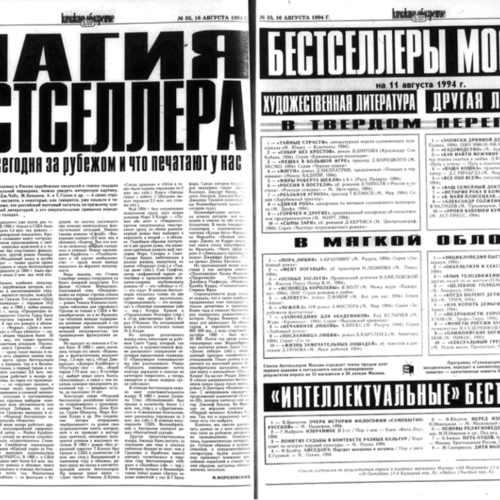
Bestsellers of Moscow
Post-Soviet Russia's first bestseller lists, compiled by the weekly industry newspaper Knizhnoe obozrenie and published from late 1993 through 1998.
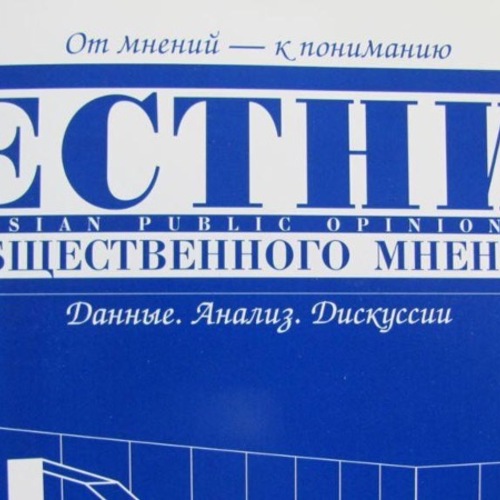
The Rise of Public Opinion Polling
Monitoring Obshchestvennogo Mneniia, the monthly publication of the All Russian Center for the Study of Public Opinion (VTsIOM).
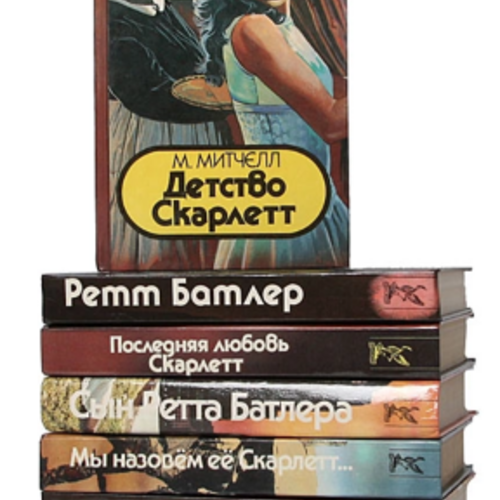
Gone with the Wind - The post-Soviet Sequels
Series of five collectively authored sequels to Margaret Mitchell's bestselling Gone with the Wind. Writing in Minsk, the anonymous authors published under the pseudonym Dzhuliia Khilpatrik and released titles like We'll Call Her Scarlett, Rhett Butler's Son, and Scarlett's Last Love.
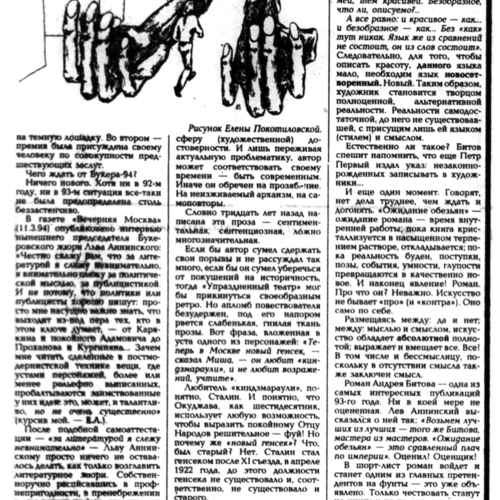
The Russian Booker - Scandals
A series of five articles scandalously decrying the new literary prize, imported from England, the Russian Booker.
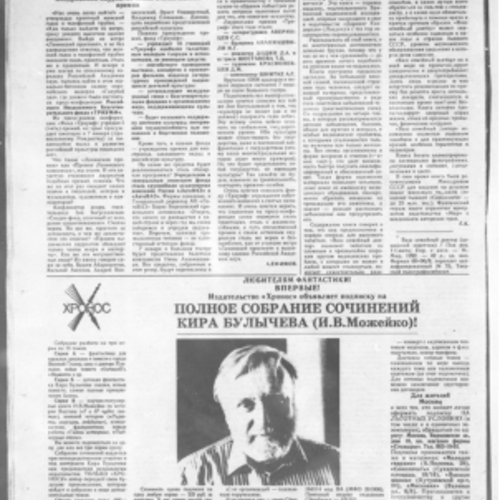
The Triumph Prize
Launched at the same time as the Russian Booker and funded by the newly minted oligarch Boris Berezovsky, the Triumph Prize promised an even broader program of cultural guardianship and philanthropy.
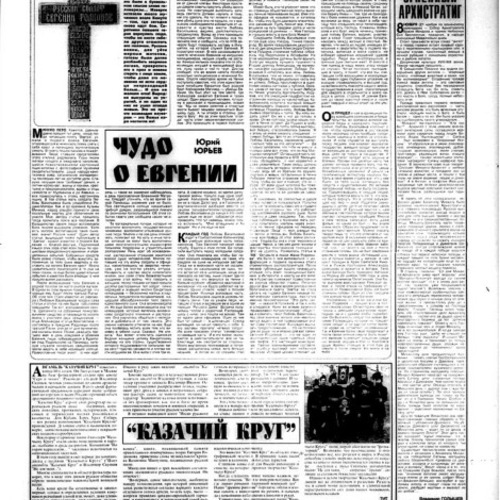
The Miracle of Evgenii
A Russian soldier during the first Chechen War, Rodionov was captured outside of Grozny and reputedly executed for refusing to renounce his Orthodox faith. His image has since served as the inspiration for several of post-Soviet Orthodoxy's most popular new icons.

OMON Uniform
Though the police special forces unit known as OMON was introduced before the fall of the Soviet Union, their now-ubiquitous light blue camouflage was only introduced in 1994, when OMON began to be deployed as part of the first Chechen War. OMON (and its light blue camouflage) has since been associated with street intimidation, market clearings, and protest quashing especially in the capitals.
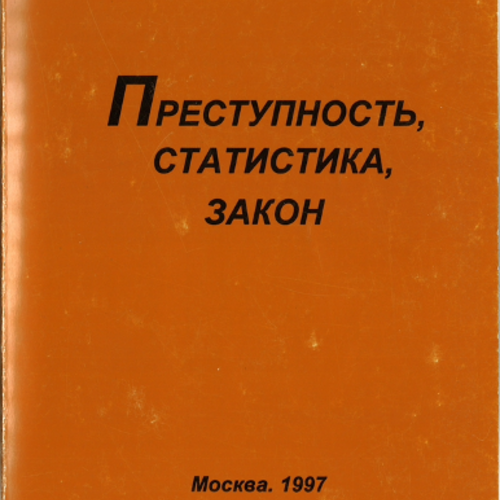
Russian Crime Statistics, 1980–1996
Nothing characterized the everyday experience of the urban Russian 1990s like crime; as shown in this first comprehensive statistical study of the 1990s, crime was just as bad as everyone had known. But the numbers also reveal some unexpected trends.
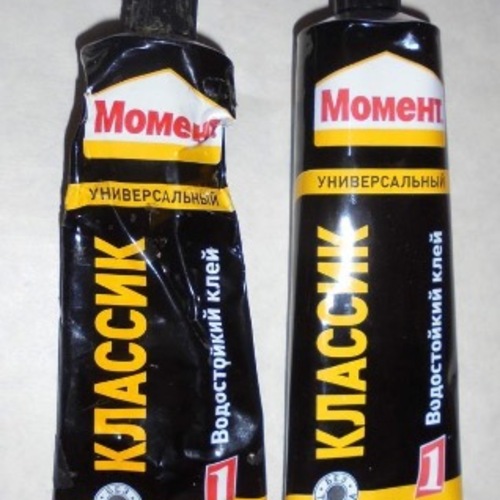
Klei-Moment
Made by the German Henkel company, Moment glue was a staple of post-Soviet hobbyists. It also became one of the prefered drugs among the post-Soviet youth. The brand name became synonymous with huffing itself.

Lada 110-series
The first post-Soviet Lada model, the VAZ-2110 appeared in 1995 and sold for between $5,000 and $8,000. Targeted at the emerging middle class, the car represented the hopes that Russian manufacturing and Russian consumer power could come together to build a domestic market that would move the economy beyond raw materials extraction and imported consumer goods.
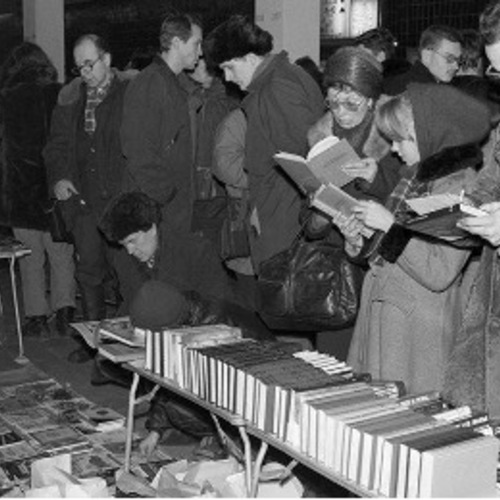
Olympic Stadium Book Market
The center of the post-Soviet book trade made its home in the corridors of the enormous stadium built for the 1980s summer games in Moscow. It was chaotic, even dangerous, and an embarrassment of riches.
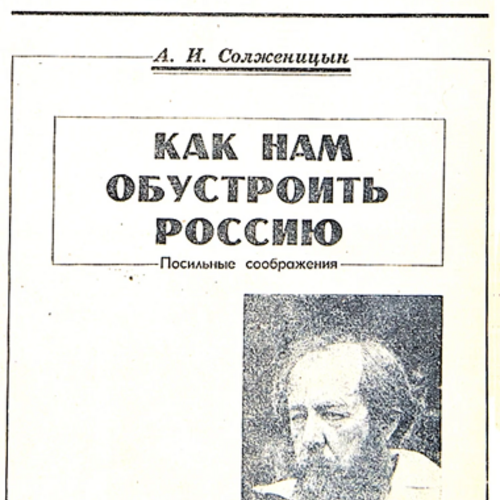
Rebuilding Russia
Alexander Solzhenitsyn's traditionalist prescription for pulling Russia out of its difficulties was seen by many as out of touch with the times, but many of the ideas he expounded in 1991 have become part of Russia's neo-revanchism in recent years.
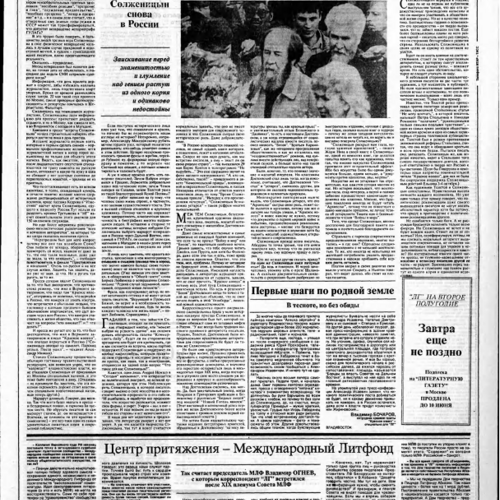
Solzhenitsyn's Return
In 1994, Alexander Solzhenitsyn staged a theatrical return to Russia, flying from America to Magadan, and then returning by train from Vladivostok to Moscow. The journey and the salvific importance Solzhenitsyn attached to it soon became the target of much derision, as well as some praise.
Early Vzgliad parodies itself
A 1988 celebration of a year of Vzgliad, where several sketch comedy artists parody and recapitulate Vzgliad's casual, sincere, freewheeling style of television programming
A coup d'etat holds a press conference
Press conference held by the State Committee for the Emergency Situation (GKChP), the group of hard line government officials who had attempted a coup d'etat overthrowing Mikhail Gorbachev. This press conference was held the next day and shows the coup coming apart at the seams.
TV Commercials for the MMM Pyramid Scheme
A series of 15-second TV spots advertising post-Soviet Russia's most successful pyramid scheme, MMM. The scheme's popularity had much to do with the simple action-reward structure of the TV spots which gave a simultaneously winking and sincere vision of a capitalist utopia.
Putting the "Spotlight" on an experimental three-hour line for Soviet luxury clothes
Prozhektor Perestroiki [Perestroika's Spotlight], a glasnost-era televised investigative journalism project, investigates a three-hour line for luxury clothes at the recently opened Luxe Fashion Center, where the reporters discover the problem of supply and demand in the USSR.
Soviet technical intelligentsia learns Reaganomics on the Chto? Gde? Kogda? gameshow
Chto? Gde? Kogda? [What? Where? When?], a long-running high-brow quiz show for the late Soviet technical intelligentsia, debates the economic principles of Soviet private enterprise in the heat of Perestroika’s economic reforms in 1988
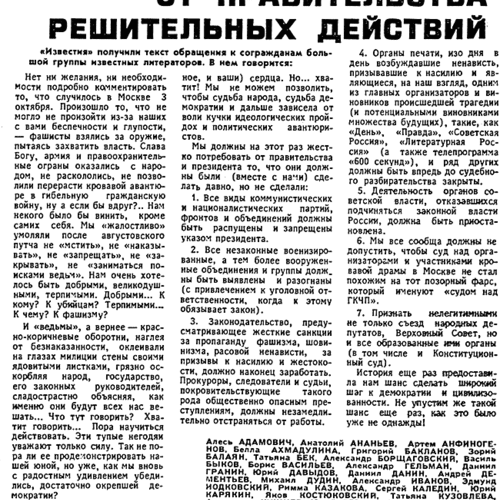
Writers demand a Yeltsin coup ("Letter of the 42")
"Pisateli trebuiut ot pravitel’stva reshitel’nykh deistvii [Writers demand decisive actions from the government].” A letter signed by prominent intelligentsia during the 1993 Parliamentary crisis, in which the liberals urge Yeltsin to use lethal force to destroy the Communist-led parliamentary opposition.
Shevchuk (DDT) in Chechnya
Excerpt from Vremia DDT, a 2002 documentary centered on DDT, one of Russia’s most famous rock bands throughout the 1990s and later. A montage of amateur film made by the group leader and frontman, Yuri Shevchuk during his visit to Russian frontlines during the First Chechen War in 1995-1996, overlaid by the song, “Patsany [The guys],” inspired by what Shevchuk saw there.
"Tema" Talk Show- Racism in Russia
A clip from the talk show "Tema [Theme]," List'ev's major post-Soviet project after the 1991 end of Vzgliad. This particular episode is dedicated to the theme of racism in Russia. Includes Dzheims Lloidovich Patterson, the grown up boy from the classic Stalin-era film, "Circus"
"Tema" Talk Show- Racism in Russia
A clip from the talk show "Tema [Theme]," List'ev's major post-Soviet project after the 1991 end of Vzgliad. This particular episode is dedicated to the theme of racism in Russia. Includes Dzheims Lloidovich Patterson, the grown up boy from the classic Stalin-era film, "Circus"
The Glasnost Booth on the last October Revolution anniversary in the USSR
“Glas naroda [The People’s Voice]”– a booth installed in the middle of town, into which random people can enter and speak their minds. Episode from the Kremlin, on USSR’s last anniversary of the October Revolution, in 1991.
The post-Soviet people’s show, Pole Chudes
A clip from the most-watched entertainment show of the 1990s, "Pole Chudes [Field of Miracles],” which renders the post-Soviet narod of regular folks, engaged in a free-flowing relationship with capitalism and Russia’s central television
"Politburo" versus the specter of communism, during the 1993 political crisis
A clip from "Politburo," a weekly commentary show from Aleksandr Politkovsky (a Vzgliad alum). This show takes place just prior to May 1, and just after the 1993 Referendum, as well as Rutskoi's first salvo in the "Kompromat Wars," regarding 11 suitcases of materials documenting Yeltsin's corruption. Here, Politkovsky is happy to return the favor to Rutskoy. The show ends with anti-communist chiastushki for Mayday.
The View from the Other Side
LGBTQ activist Yaroslav “Slava” Mogutin’s response to another article on gay men in post-Soviet Russia (by Aelita Efimova) in the magazine Совершенно секретно.
Primetime hypnotic tele-healing seances with Kashpirovskii
Anatolii Kashpirovskii, the psychic and guru of Perestroika era's "new thinking" uses the power of suggestion to heal the Soviet people from all ailments physical and spiritual
The Chechen Knot: 13 theses.
Infamous article on the Chechen war by controversial gay journalist Slava Mogutin

The logo for the "Dendy" Entertainment Console by Ivan Maximov.
The logo of an young, anthropomorphic elephant giving the victory sign with his left hand announced Russia''s first game console, which became enormously popular between 1992 and 1996.
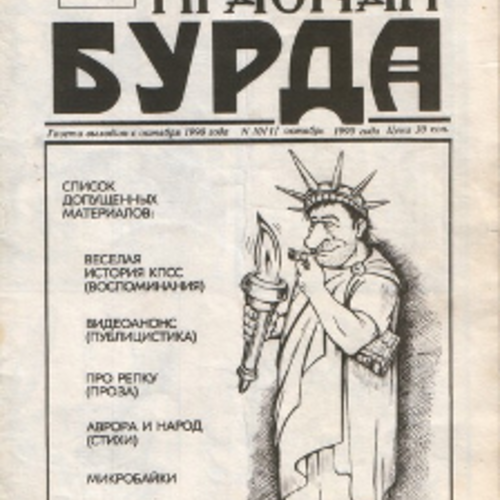
Cover for “Red Hogwash” [“Krasnaia Burda”], issue 1, October 1990 by G. Malyshev.
The first issue of Red Hogwash's cover depicts a man in the costume of the Statue of Liberty lighting a cigarette with the torch.
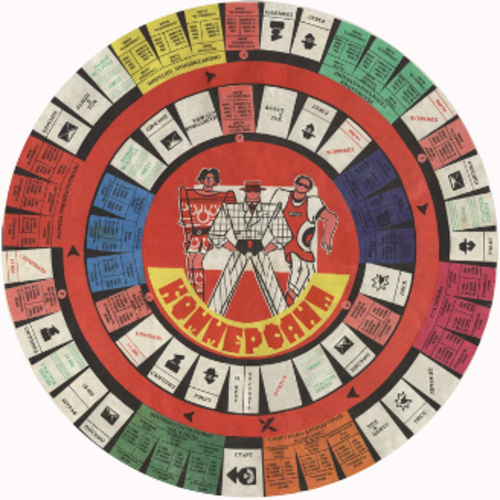
Kommersant Board Game
Kommersant attempted to represent the 90s market economy via a Monopoly-like of two economies, an inner and an outer, with racketeering as a recurring threat.
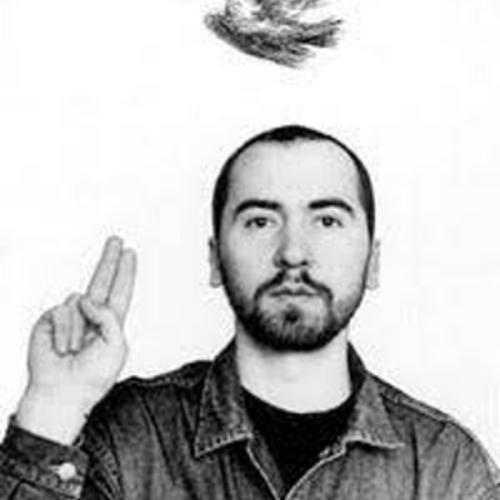
Shaburov Sasha Christ
Alexander Shaburov developed a series of performances about artistic identity, which included both mocking and pastiching the cult leader Marina Tsvigun (AKA "Maria Devi Christ" ) whose group attempted to seize the Saint Sophia Cathedral in Kyiv in 1993.
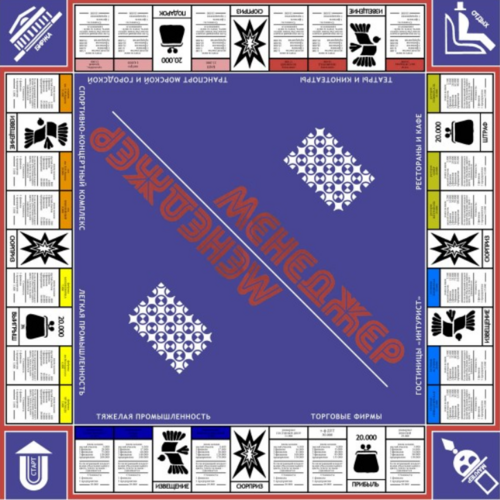
Manager Board Game 1st edition
A square, indigo board game similar to Monopoly, but reading "Manager". Manager, which became the most successful Monopoly-like made in the former Soviet Union, initially presented itself as scientific and rational in its promise of capitalist success.
A Man Who Keeps Up with the Times
A piece on David Bowie, focusing on the star’s bisexuality, in the glossy color gay magazine Мальчишник
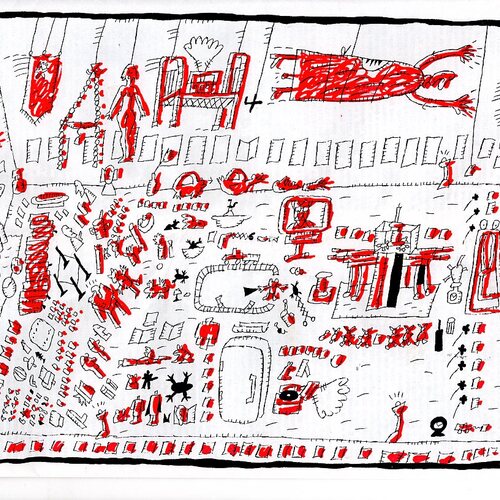
Ivan Zhaba: Russian Superman
A major installation artwork by Alexander Shaburov engaged with the Western Superhero genre through a multimedia hagiography of a Russian superman.
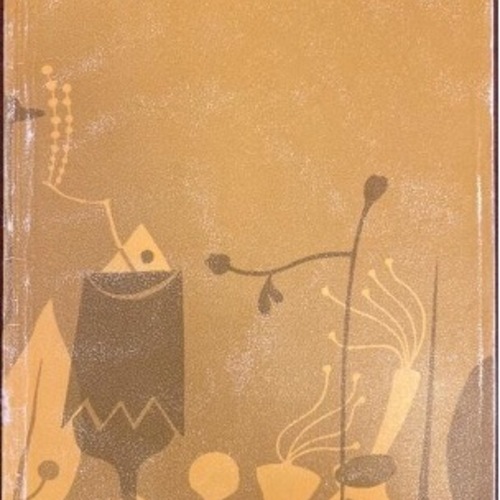
Philosophy on the Margins
Series of philosophical and theoretical texts from Russian and international authors published by Ad Marginem and meant to bring the latest in global thought into newly opened post-Soviet minds.
One on One with Vladimir Zhirinovskii and Boris Nemtsov
Aleksandr Liubimov’s talk show One on One staged debates between public figures who disagreed strongly with each other. When nationalist provocateur Vladimir Zhirinovskii and liberal reformer Boris Nemtsov met on air in as the First Chechen War was just beginning, sparks—and piece of the set—flew.
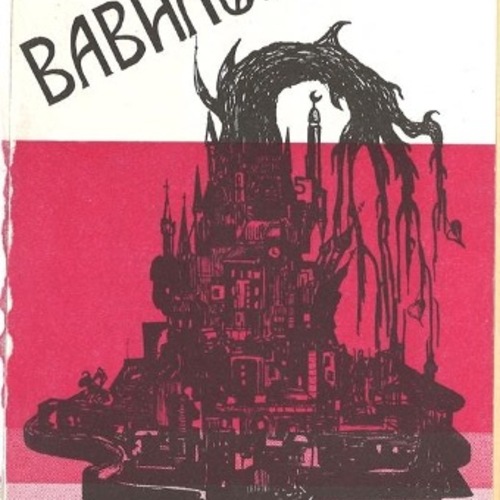
Babylon (online) Vavilon (.ru)
Vavilon, or Babylon, began as a loose group of young poets brought together by Dmitry Kuz'min in 1988. In the post-Soviet years, the group's almanac and then webside became a driving forces behind some of the most innovative poetry of the 1990s.
Chumak sends morning healing vibes to Perestroika audiences
A healing seance with TV-psychic Allan Chumak in 1989, during the morning newscast, “120 Minutes.” Works on people, their drinking water and their creams.
Kino’s last concert (Luzhniki Stadium, Moscow)
Footage of a live Kino concert at Moscow's Luzhniki Stadium on June 24, 1990, roughly a month and half prior to frontman Viktor Tsoi's death in a car accident in rural Latvia. The footage shows the band at the very height of its popularity, as well as offering an unencumbered look at a country in transition: a heavy and conspicuous Soviet police detail is assigned to the event, while audience members wave both the Soviet flag and the Russian tricolor banner.
List'ev's Russian Liberals on "Chas Pik"
An excerpt from a compilation of most memorable moments with Vladislav LIst'ev and his Russian liberal guests on "Chas Pik," aired in the week after his murder
Loss of the Soviet Nation at KVN
The Winter 1992 opening broadcast of the amateur variety and improv contest show KVN, filmed just a few months after the dissolution of the USSR, with former Soviet university teams lamenting the rise of national borders around them
Perestroika Women Speak to US Women
A clip from one of many Perestroika-era televised conversations between American and Soviet "regular people," in which they find common ground with the help of long-time Soviet propagandist and future star of liberal post-Soviet TV, Vladimir Pozner
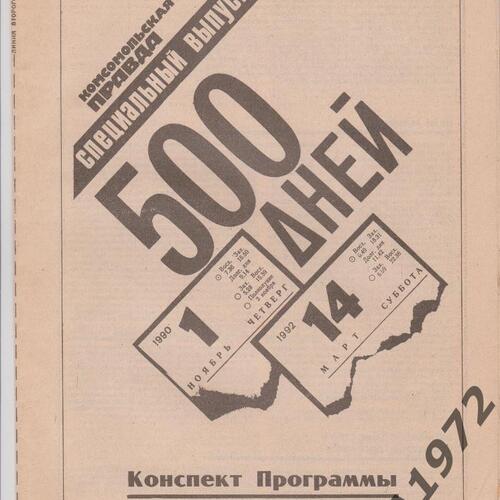
“500 Days: Program Summary,” a special issue of Komsomol’skaya Pravda, 29 September 1990
Komsomol'skaya pravda "500 days" special issue
Yeltsin 'sleeps through' Ireland
Footage of the Shannon diplomatic incident and/or Yeltsin’s justification of same, September 1994. More specifically: 25 seconds of TV footage of Yeltsin confronting reporters in Vnukovo-2 in which he says, “Я скажу честно: я просто проспал, восемнадцать часов в полете, до этого, понимаешь, значит, столько не спал, а служба безопасности не пустила тех людей которые, так сказать, э-э-э, должны меня были разбудить. Я, конечно, разберусь. Им врежу, как следует.”
Evgeny Kiselev discusses the 21 September – 4 October 1993 Russian Constitutional Crisis on Itogi, 10 October 1993
Excepts from first episode of Itogi with Ev. Kiselev on NTV
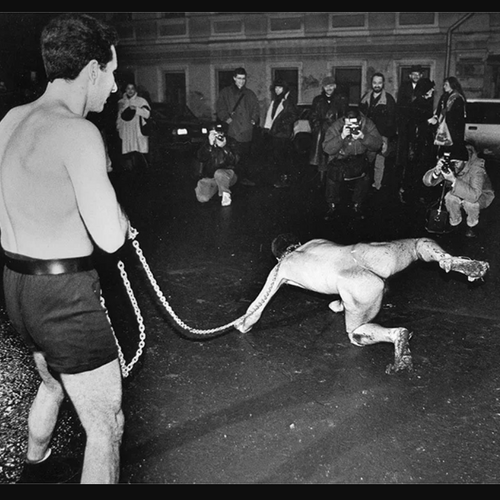
Oleg Kulik and Alexander Brener, Rabid Dog or the last taboo guarded by a lone Cerberus, Nov. 23rd, 1994. The street outside Marat Guelman’s gallery, Moscow.
A snarling, nude and chained Kulik attacks cars and strangers, while Brener pulls on the chain, both are in a public street.
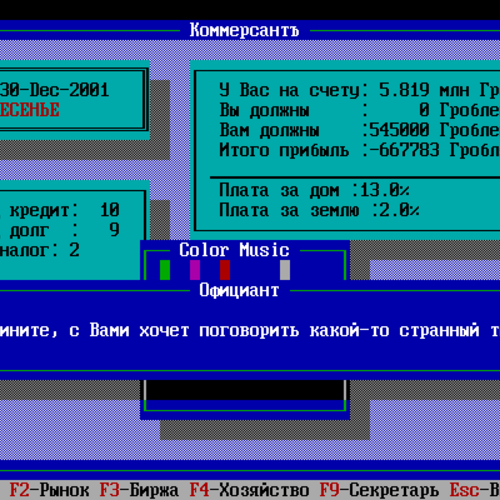
Kommersant’ by Vladimir Kharchenko and Rada Ltd, 1991.
The Ukranian video game attempted to represent the rough transition to capitalism via a detailed, simulationist interface.
Vyacheslav Marychev, "Actor" of the Russian Duma
During a Duma session, Marychev cocks a gun while wearing sunglasses and a Megadeth t-shirt tucked into high-waisted slacks
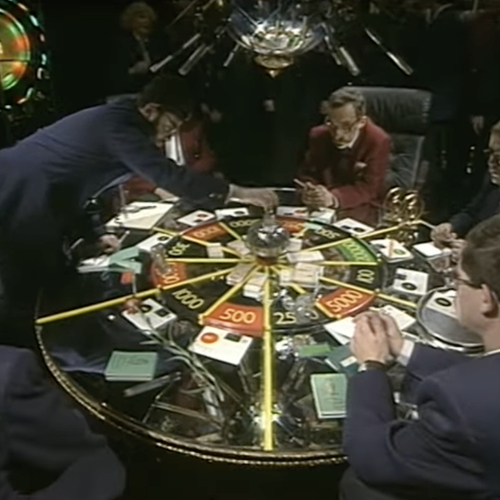
The Raspberry blazer as the uniform of the New Russian
The origins and the meaning of the raspberry blazer as the iconic dresscode of New Russians in the early 1990s
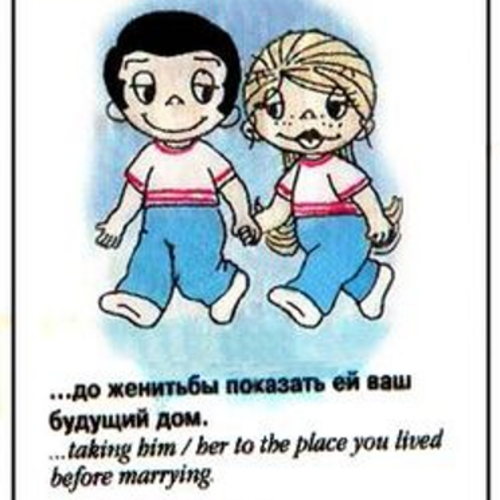
"LoveIs" gum insert
"LoveIs" gum insert. Image shows a man and woman walking somewhere. The English text reads: "taking him/her to the place you lived before marrying". The Russian text reads: "Showing her your future marriage house". LoveIs featured Kim Casali's syndicated cartoon "Love Is", however the explosion in similarly adorned gum included everything from film stills from the Godfather and Jurassic Park to pornography.
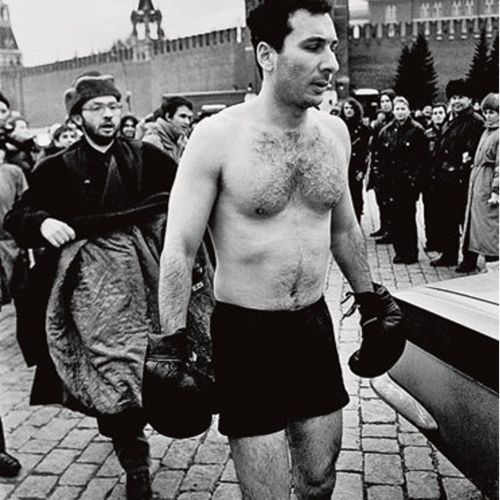
"First Glove" by Alexander Brener
Alexander Brener, "First Glove" 1995: a performance where Brener challenged Yeltsin to a fist-fight on the Red Square.
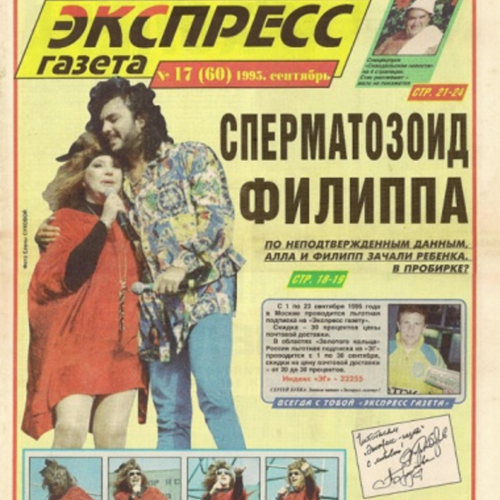
Express-Gazette Cover, Headlines: “Pugacheva is being tricky”, “Fillip’s Spermatozoid” 1998
Busy tabloid cover depicting pop stars Alla Pugacheva and Fillip Kirkorov embracing next to a headline speculating about the viability of Kirkorov's sperm.
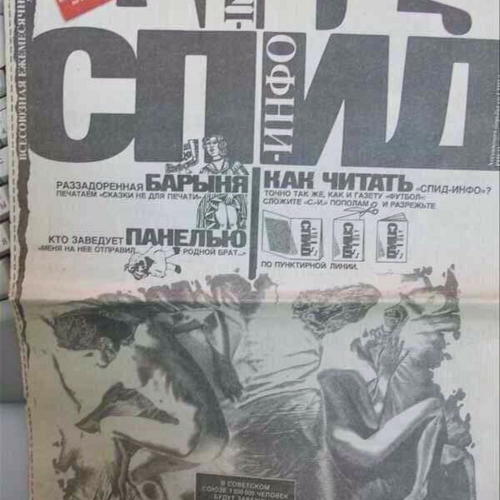
SpidInfo #1, January 1991
Cover of the first issue of SpidInfo depicting an anxious nude couple turned away from each other in bed.
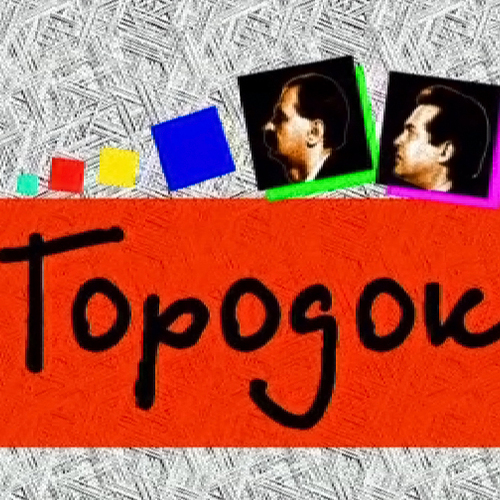
Gorodok [Little Town]: 1993-2012
title screen, "Little Town"/"Gorodok" by Iurii Stoyanov and Ilya Oleinikov, 1996
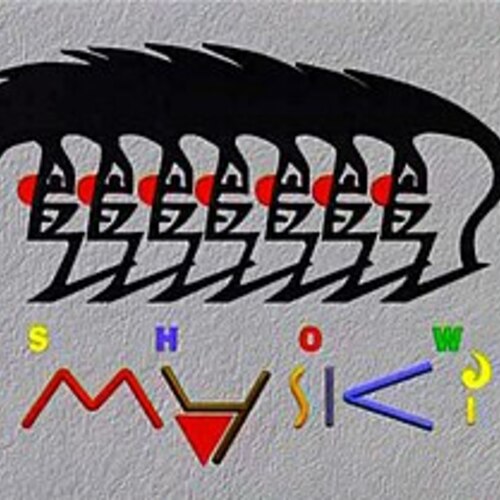
Georgii Deliev, Mask Show (Маски Шоу), 1991-2006.
title screen, "Maski-Show"/"Maski-Show", 1991 by Georgi Deliev, showing a stylized image of multiple people in clown make-up.
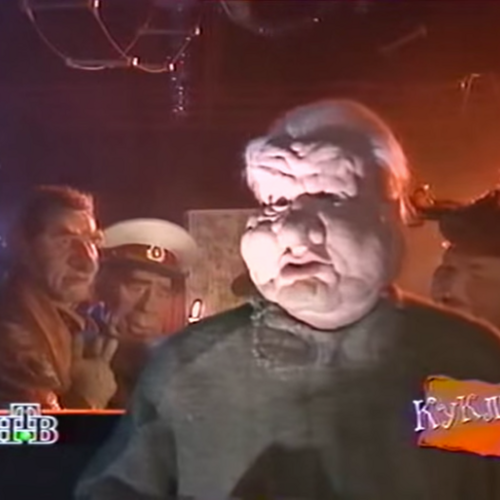
Kukly ["Dolls'], still from episode 2 “The Old New Year” (01/07/1995) featuring the first appearance of Boris Yelstin’s puppet on the show.
Still from Dolls"/"Kukly", 1994-2002, an influential political satire showing several politicians as puppets.
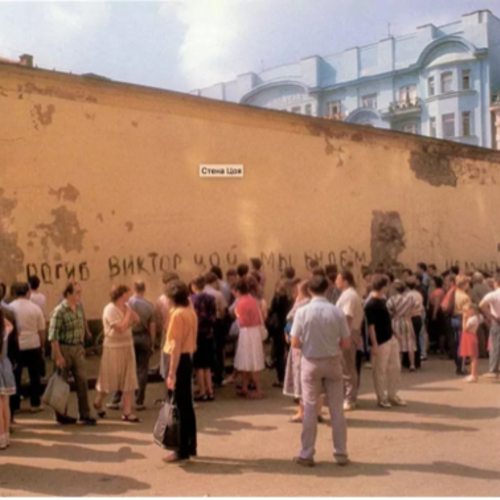
"Tsoi's Wall" on Arbat
A wall of fan graffiti dedocated to the late Soviet rock star Viktor Tsoi on Moscow's famous Arbat Street.
Meaning of pluralism on Vzgliad
A conversation about pluralism between Evgeny Dodolev and Alexander Liubimov, after an expose on Nina Andreeva
Love is Nasty, It Can Make you Fall in Love with An Asshole
Item in Правда about Slava Mogutin’s attempt to register marriage to partner Robert Filipini
Ernst’s “Russian Project” as cultural therapy for the post-Soviet Russian masses
Konstantin Ernst’s series of social advertisements extolling Russia’s shared values and national identity at a time of seeming social crisis in the mid-1990s
Yeltsin's Orderly (Sanitar Yeltsina)
Delo Muryleva. Smert' za kvartiry (The Murylev case. Death for Apartments). First episode of the crime show Kriminal'naia Rossiia (NTV, 1995-2002, with various later versions on TVS, Pervyi kanal, and others)
A Conservative Revolutionary Avant-Garde
“The New against the Old,” a programmatic article by Aleksandr Dugin from the first issue of Limonka, the official newspaper of Eduard Limonov’s National Bolshevik Party (NBP), radical political organization/countercultural movement.
Top Secret: Investigative Journalism and True Crime During Perestroika
Sovershenno sekretno, the first privately owned periodical in Soviet Russia since 1917, showcased a combination of transparency and sensationalism that became a distinguishing feature of journalistic writing in the post-Soviet period.
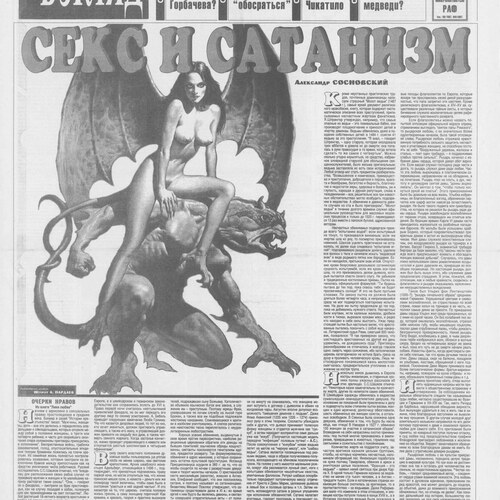
Novyi Vzgliad: Violence, Political Irony, and National Pride
Novyi Vzgliad authors write some of the most scandalous and incendiary political commentaries of the 1990s, producing new forms of political irony. Iaroslav Mogutin and Eduard Limonov turn violence into a paradoxical source of identity. The main artifact here–an article by Mogutin–exemplifies this process.
"What is Concealed Will Be Revealed." Kuryokhin's and Dugin's Post-Ironic Political Campaign in Saint Petersburg
An episode from Dugin's political campaign in Saint Petersburg, in which Sergey Kuryokhin and Aleksandr Dugin make fun of liberal democracy (and Yeltsin’s referendum) on Russian TV.
"Only the Wildest and Craziest": Kurekhin's Neo-Avant-Garde on Radio-1, Petrograd
An episode of Kuryokhin’s radio program “Vasha liubimaia sobaka” (aka “Nasha malenkaia rybka,” aka “Russkii liudoed”).
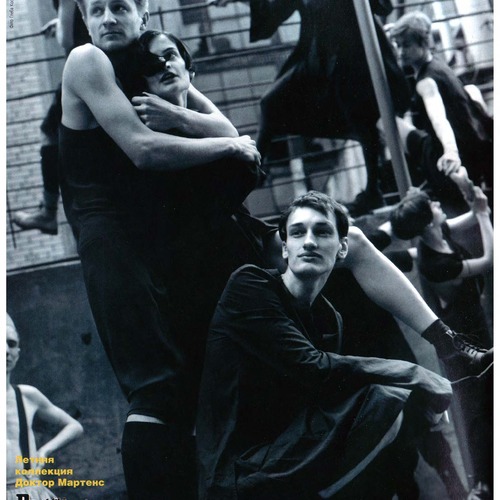
Fascist Fashion Between Counterculture and Mainstream
Images from a photo shoot from the Polushkin Brothers’ collection Fash-Fashion–alluding to both queer and fascist aesthetics–is used as an ad for the popular brand Dr. Martens in the lifestyle magazine Ptiuch and as a model for a nascent National Bolshevik countercultural aesthetics in the pages of the newly founded political newspaper Limonka.
The World Made of Plastic Has Won
Egor Letov performs his song “Moia oborona” (My defense), during his “concert in the hero city Leningrad,” part of Grazhdanskaia oborona’s 1994 tour Russkii proryv (Russian breakthrough).
Let's Go To War!
The model, writer, singer, and TV personality Natalia Medvedeva (Limonov’s third wife) performs her song “Poedem na voinu!” (Let’s go to war!), a countercultural hymn romanticizing war, violence, and rebellion.
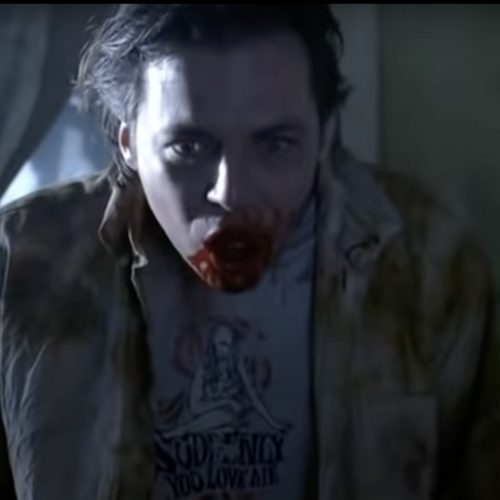
Mumiy Troll's Breakthrough “Utekai” (Take Off) Becomes the Song of the Year 1997
Video and lyrics of Mumiy Troll’s 1997 breakthrough song “Utekai” (Beat it) displaying the combination of surrealism, dark humor, and provincial romanticism that comes to shape the band’s trademark style.
Stalin, Beria, Gulag: Natsboly against Gaidar and Mikhalkov
Two of the early direct actions organized by the young members of the NBP that combined self-martyrdom and totalitarian styob.
Soviet identity and Jewish Emigration on KVN
An excerpt from the 1992 season of the amateur variety improv competition show, KVN, in which an Israeli team of recent Russian émigrés competes against former compatriots in Moscow
Soviet Engineers become Post-Soviet Aristocrats on TV
Chto? Gde? Kogda? (What? Where? When?) goes through an aristocratic overhaul and becomes an "intellectual casino'
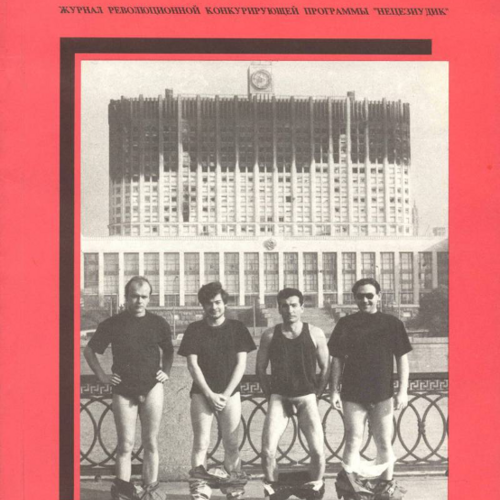
Issue #1 of “Radek”, 1994
Cover of "Radek" featuring four denuded men in front of the burned White house.
The Future of Crimea
Campaign documents surrounding the 1991–92 referenda on the independence of Crimea.
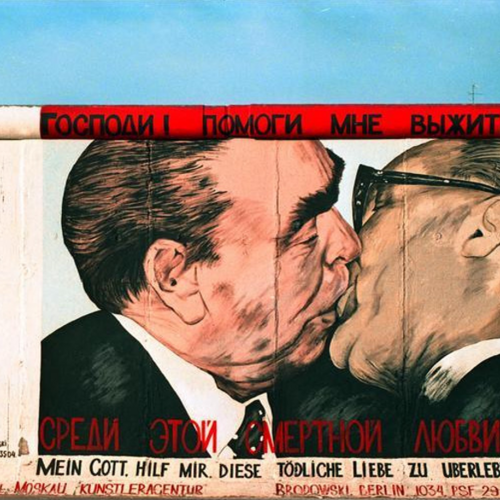
Dmitri Vrubel, "My God, Help Me To Survive This Deadly Love", 1990, graffiti, Berlin Wall, East Berlin.
Graffiti of Leonid Brezhnev and Erich Honecker kissing on the East Berlin wall.
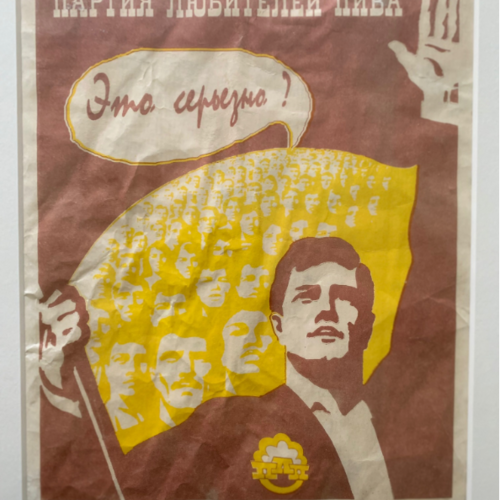
Poster of the The Beer Lovers' Party, Text: “Beer Lovers’ Party: Is this serious? This is serious!” 1995.
Poster in the style of Soviet agit-prop promoting the Beer Lovers' Party
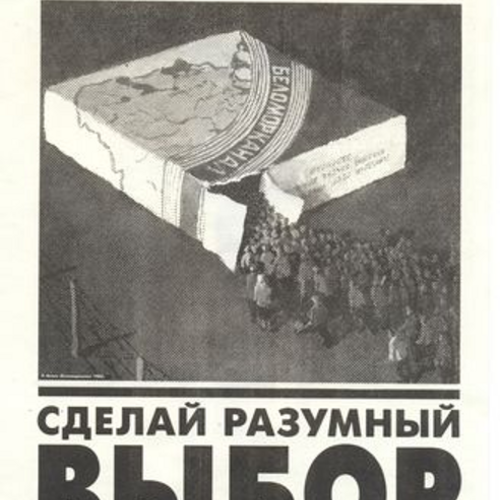
Election poster for the Democratic Choice of Russia--United Democrats 1995 campaign for the Duma.
Poster depicting a stream of people entering a giant pack of Belomor Canal cigarettes to promote the Democratic Choice of Russia--United Democrats Party.
"Stalin, Beria, Gulag!": the Natsboly Go Against Gaidar and Mikhalkov
Two of the early direct actions organized by the young members of the NBP that combined self-martyrdom and totalitarian styob.
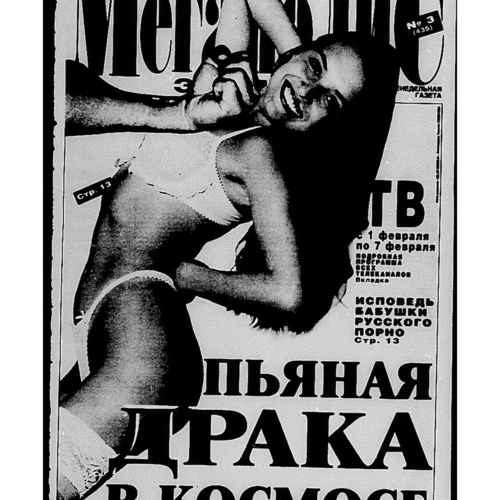
Megapolis-Ekspress: Urban Exoticism and National Pride
Igor Dudinsky takes over the magazine Megapolis-ekspress and turns it into an extreme and surreal parody of the lowest and most excessively sensationalist forms of Western tabloids.
Transilvania is Bothering You (On Radio 101 FM)
The cult radio program Transilvania bespokoit (Transilvania is bothering you) creates an alternative musical canon and produces a new nationalist counterpublic.