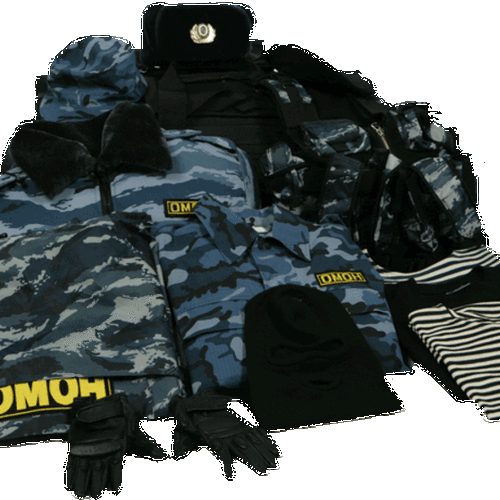
OMON Uniform

Source
https://forma-odezhda.ru/encyclopedia/forma-omon/
Description
Though the police special forces unit known as OMON was introduced before the fall of the Soviet Union, their now-ubiquitous light blue camouflage was only introduced in 1994, when OMON began to be deployed as part of the first Chechen War. OMON (and its light blue camouflage) has since been associated with street intimidation, market clearings, and protest quashing especially in the capitals.
Era
Post-Soviet
Date
1994
Annotation
Anyone who has been at a street protest in post-Soviet Russia has seen first-hand the light blue uniforms of the OMON, the special forces of the Russian police (or, in the original, Otriad militsii osobogo naznacheniia). The name was first used by the White Army under Admiral Aleksandr Kolchak, but the term was resurrected in 1988, when mass unrest spread from the Eastern Bloc to the peripheries of the Soviet Union itself. The first OMON squads were set up in Moscow, Leningrad, Minsk, Riga, Vilnius, and Kyiv. After the fall of the Soviet Union OMON squads appeared in major cities throughout Russia as an elite division of law enforcement, specially trained to respond to mass civil unrest. The now-iconic light blue uniforms were introduced in 1994 as OMON’s urban camouflage (a more traditional green camouflage is used for field operations). Soon thereafter, OMON became a regular feature of national and international news as squads from around the country were deployed to the First and then the Second Chechen War, where they were accused of many human rights abuses and civilian atrocities. Anna Politkovskaia, for instance, reported on OMON Ltn. Sergei Lapin’s torture and disappearance of a Chechen student and in 2006 the European Court of Human Rights found OMON guilty of the massacre of a Chechen family—including a pregnant woman, a one-year-old child, and an elderly man.
Even as the accusations mounted, OMON’s presence in the rest of Russia only grew. In Yekaterinburg in 1998, for instance, a peaceful protest of students demanding that higher education remain free of cost turned into a bruising battle between unarmed students and special forces in light blue camouflage and riot gear. Throughout the post-Soviet era, OMON and its light blue uniforms, have acted as the literal cordon that marks the edges of the public sphere. As political violence has become more acceptable, OMON’s mandate has grown. It counted 7,000 members in 1988, 12,000 in 2003, and 25,000 in 2014. As OMON grew over those years, the limits of the public sphere shrunk in direct proportion.
Bibliographic Reference
https://forma-odezhda.ru/encyclopedia/forma-omon/
Explore Related Artifacts