Video
Test 1989
An item from 1989 to test date searching.
Chikatilo Trial
snippet of BBC footage of trial; photograph of Chikatilo at the trial
Piskunov's Kitchen Diary
Excerpt of Kitchen Diary written by Piskunov and sent to KP
Sakharov Returns from Gorky
Photograph of reports swamping Sakharov as he steps out of a car in Moscow after his releast from Gorky on 23 December 1986
Pro Eto - The Sexual Lives of the Disabled
Clip from Pro Eto hosted by Elena Khanga that brings together 1990s interest in sex with the increasing visibility of disabilities and the disintegration of state institutions previously entrusted with their care.
Early Vzgliad parodies itself
A 1988 celebration of a year of Vzgliad, where several sketch comedy artists parody and recapitulate Vzgliad's casual, sincere, freewheeling style of television programming
A coup d'etat holds a press conference
Press conference held by the State Committee for the Emergency Situation (GKChP), the group of hard line government officials who had attempted a coup d'etat overthrowing Mikhail Gorbachev. This press conference was held the next day and shows the coup coming apart at the seams.
“Go buy some food… for the last time!” Yeltsin takes on Zyuganov in the 1996 presidential election
An anti-Zyuganov campaign poster from 1996
Vzgliad at GKChP
Clips of Vzgliad's reports during GKChP in 1991. These include being holed up in the White House (the RSFSR parliament) alongside its defenders and celebrities, such as Mstislav Rostropovich.
Putting the "Spotlight" on an experimental three-hour line for Soviet luxury clothes
Prozhektor Perestroiki [Perestroika's Spotlight], a glasnost-era televised investigative journalism project, investigates a three-hour line for luxury clothes at the recently opened Luxe Fashion Center, where the reporters discover the problem of supply and demand in the USSR.
"Can't Live Like This": Imperial nostalgia as a post-Soviet Russian project
Tak zhit' nel'zia [Can't Live Like This], excerpt from Stanislav Govorukhin's influential documentary on the late Perestroika malaise and the way out of it
"Our boys" fight against "fascist" Baltic independence
"Nashi [Our Boys]"- Alexander Nevzorov's propagandistic documentary of the Latvian and Lithuanian Soviet OMON, fighting off the local independence movement in early 1991
Shevchuk (DDT) in Chechnya
Excerpt from Vremia DDT, a 2002 documentary centered on DDT, one of Russia’s most famous rock bands throughout the 1990s and later. A montage of amateur film made by the group leader and frontman, Yuri Shevchuk during his visit to Russian frontlines during the First Chechen War in 1995-1996, overlaid by the song, “Patsany [The guys],” inspired by what Shevchuk saw there.
"A Man Resembling the Chief Prosecutor"
An example of the "Kompromat War": a sex video of the Chief Prosecutor Iurii Skuratov, aired on the nightly news show "Vesti." Skuratov was recorded with two sex workers in a KGB/FSB apartment, with the material sent directly to RTR news. It is widely assumed that Yeltsin's operatives were behind this video leak.
The Glasnost Booth on the last October Revolution anniversary in the USSR
“Glas naroda [The People’s Voice]”– a booth installed in the middle of town, into which random people can enter and speak their minds. Episode from the Kremlin, on USSR’s last anniversary of the October Revolution, in 1991.
Artifact 00001
Vremia reports on Chernobyl, excerpt TBD
Artifact 00010
Vesti (first episode, excerpt TBD)
Artifact 00011
600 sekund (first episode, excerpt TBD)
Yeltsin 'sleeps through' Ireland
Footage of the Shannon diplomatic incident and/or Yeltsin’s justification of same, September 1994. More specifically: 25 seconds of TV footage of Yeltsin confronting reporters in Vnukovo-2 in which he says, “Я скажу честно: я просто проспал, восемнадцать часов в полете, до этого, понимаешь, значит, столько не спал, а служба безопасности не пустила тех людей которые, так сказать, э-э-э, должны меня были разбудить. Я, конечно, разберусь. Им врежу, как следует.”
Evgeny Kiselev discusses the 21 September – 4 October 1993 Russian Constitutional Crisis on Itogi, 10 October 1993
Excepts from first episode of Itogi with Ev. Kiselev on NTV
Evgeny Kiselev intervenes in the “Xerox affair,” 20 June 1996
Kiselev special broadcast on "Xerox affair"
Tusovka Music Journal (Samizdat)
A central zine of the Siberian underground music community. One of Tusovka's central feats was duping the KGB into allowing the continuation of its publication and dissemination. Before the first issue went to print, the journal's founder Valerii Murzin took the bold step of delivering the pre-print manuscript of the journal to his local KGB office, in this way guaranteeing the publication's survival.
Interview with Sergei Bodrov Jr. (1997) (selections)
Interview with actor Sergei Bodrov Jr., who famously played the loveable gangster Danila Bagrov in Aleksei Balabanov’s films Brother and Brother 2, becoming a post-Soviet cultural icon.
Meaning of pluralism on Vzgliad
A conversation about pluralism between Evgeny Dodolev and Alexander Liubimov, after an expose on Nina Andreeva
"What is Concealed Will Be Revealed." Kuryokhin's and Dugin's Post-Ironic Political Campaign in Saint Petersburg
An episode from Dugin's political campaign in Saint Petersburg, in which Sergey Kuryokhin and Aleksandr Dugin make fun of liberal democracy (and Yeltsin’s referendum) on Russian TV.
Limonov Becomes a Post-Soviet Nationalist Rock Star
During an “encounter” with the émigré writer Eduard Limonov broadcasted from the concert hall in the Ostankino TV studios in Moscow (a common genre during perestroika), a young neformal in the audience suggests to create a subculture made up of young “limonovians.”
"The Mysteries of the Century": Post-Truth and Mystical Nazism on Russian TV
An episode from the TV program “Tainy veka” (The mysteries of the century), hosted by Iurii Vorobevskii and Aleksandr Dugin. One of the first examples of post-truth on Russian television.
"Tema" Talk Show- Racism in Russia
A clip from the talk show "Tema [Theme]," List'ev's major post-Soviet project after the 1991 end of Vzgliad. This particular episode is dedicated to the theme of racism in Russia. Includes Dzheims Lloidovich Patterson, the grown up boy from the classic Stalin-era film, "Circus"
"Tema" Talk Show- Racism in Russia
A clip from the talk show "Tema [Theme]," List'ev's major post-Soviet project after the 1991 end of Vzgliad. This particular episode is dedicated to the theme of racism in Russia. Includes Dzheims Lloidovich Patterson, the grown up boy from the classic Stalin-era film, "Circus"
"Pro Eto." Male Prostitution
A clip from the talk show "Pro Eto" with Elena Khanga, episode on male prostitution.
"Politburo" versus the specter of communism, during the 1993 political crisis
A clip from "Politburo," a weekly commentary show from Aleksandr Politkovsky (a Vzgliad alum). This show takes place just prior to May 1, and just after the 1993 Referendum, as well as Rutskoi's first salvo in the "Kompromat Wars," regarding 11 suitcases of materials documenting Yeltsin's corruption. Here, Politkovsky is happy to return the favor to Rutskoy. The show ends with anti-communist chiastushki for Mayday.
Tsoi on "Before 16 and After"
A Zastoi-origin youth show trying to make sense of Viktor Tsoi in 1988, while still operating within the symbolic universe of relatively orthodox Soviet programming.
Test Only
testing, testing.
One on One with Vladimir Zhirinovskii and Boris Nemtsov
Aleksandr Liubimov’s talk show One on One staged debates between public figures who disagreed strongly with each other. When nationalist provocateur Vladimir Zhirinovskii and liberal reformer Boris Nemtsov met on air in as the First Chechen War was just beginning, sparks—and piece of the set—flew.
Perestroika Women Speak to US Women
A clip from one of many Perestroika-era televised conversations between American and Soviet "regular people," in which they find common ground with the help of long-time Soviet propagandist and future star of liberal post-Soviet TV, Vladimir Pozner
Test Artifact
test, test.

Test Object
Test Description.
Lenin Was a Mushroom
An excerpt from the famous episode of the TV show Piatoe koleso in which the experimental musician and performer Sergey Kuryokhin argued and almost convinced Soviet audiences that "Lenin was a mushroom."
TV Commercials for the MMM Pyramid Scheme
A series of 15-second TV spots advertising post-Soviet Russia's most successful pyramid scheme, MMM. The scheme's popularity had much to do with the simple action-reward structure of the TV spots which gave a simultaneously winking and sincere vision of a capitalist utopia.
Artifact 00021
World History: Bank Imperial
Soviet technical intelligentsia learns Reaganomics on the Chto? Gde? Kogda? gameshow
Chto? Gde? Kogda? [What? Where? When?], a long-running high-brow quiz show for the late Soviet technical intelligentsia, debates the economic principles of Soviet private enterprise in the heat of Perestroika’s economic reforms in 1988
The Creation of Adam (1993, dir. Iu. Pavlov)
Scene from 1993 Russian feature film with gay themes
Soviet Nostalgia– Old Songs About the Most important
The most popular Soviet nostalgia project of the 1990s- "Starye pesni o glavnom [Old Songs About the Most Important"
Parfenov’s Namedni as memory-work in the 1990s
Namedni [Recently], Parfenov's project about recent history, was one of the most successful shows of the 1990s. Eschewing big narrative arcs, the show highlighted the past as a collection of memory sites– in this case, the origin of the New Russian in 1991.
The post-Soviet people’s show, Pole Chudes
A clip from the most-watched entertainment show of the 1990s, "Pole Chudes [Field of Miracles],” which renders the post-Soviet narod of regular folks, engaged in a free-flowing relationship with capitalism and Russia’s central television
Konstantin Ernst's "Matador"
A clip from the art show "Matador," created by VID's junior partner, Konstantin Ernst, in 1990, and then remained his project as Ernst rose up and took VID's helm. This particular clip is from the show on Contemporary Art. It has a remarkably joyously elitist feel that is consistent with the "new Russian" ethos of ViD.
Primetime hypnotic tele-healing seances with Kashpirovskii
Anatolii Kashpirovskii, the psychic and guru of Perestroika era's "new thinking" uses the power of suggestion to heal the Soviet people from all ailments physical and spiritual
Egoist
Music video for Boris Moiseev's song "Egoist"
Chumak sends morning healing vibes to Perestroika audiences
A healing seance with TV-psychic Allan Chumak in 1989, during the morning newscast, “120 Minutes.” Works on people, their drinking water and their creams.
Kino’s last concert (Luzhniki Stadium, Moscow)
Footage of a live Kino concert at Moscow's Luzhniki Stadium on June 24, 1990, roughly a month and half prior to frontman Viktor Tsoi's death in a car accident in rural Latvia. The footage shows the band at the very height of its popularity, as well as offering an unencumbered look at a country in transition: a heavy and conspicuous Soviet police detail is assigned to the event, while audience members wave both the Soviet flag and the Russian tricolor banner.
Auktsyon’s performance at the 8th Leningrad Rock Club Festival
Live performance of the rock band Auktsyon at the Leningrad Rock Club. As an art-jazz-rock collective, Auktsyon was a genre-blending musical and performance phenomenon within the Leningrad underground, which distinguished itself from other bands with both its longevity and stylistic variation, gradually increasing antiestablishment content in its music throughout the post-Soviet period, while maintaining a layer of ideological ambiguity.
Yahha, documentary film
Rashid Nugmanov's course project for Sergei Solov'ev's workshop at VGIK, which included some of the first film footage of the everyday life of the Leningrad rock music scene.
List'ev's Russian Liberals on "Chas Pik"
An excerpt from a compilation of most memorable moments with Vladislav LIst'ev and his Russian liberal guests on "Chas Pik," aired in the week after his murder
Loss of the Soviet Nation at KVN
The Winter 1992 opening broadcast of the amateur variety and improv contest show KVN, filmed just a few months after the dissolution of the USSR, with former Soviet university teams lamenting the rise of national borders around them
Interview with Viktor Tsoi and Natalia Razlogova. Conducted by Sergei Sholokhov at the Golden Duke Film Festival in Odessa, 1988
This eight-minute interview, which took place on a cruise ship chartered for Odessa’s Golden Duke Film Festival in September 1988, depicts rock musician Viktor Tsoi and film critic Natalia Razlogova speaking to a journalist about the insurmountable generational tensions that inhabit the Soviet film industry. Tsoi was attending the festival to promote the film The Needle, where he played the lead role. The interview is significant highlighting the aesthetic and ideological crisis of the Soviet film industry in the last Soviet decade.
Nautilus Pompilius performing "Last Letter" (Poslednee Pis'mo: Gudbai Amerika)
A televised performance of Nautilus Pomplius's cult song lamenting the frustrated hopes of Perestroika-era Westernization, which was further popularized by its prominent position in Aleksei Balabanov's popular gangster drama Brother 2 (2000), inscribing it into the post-Soviet cultural and cinematic discourse as a sort of antidote to Viktor Tsoi's "Changes!" at the end of S. Solov'ev's ASSA.
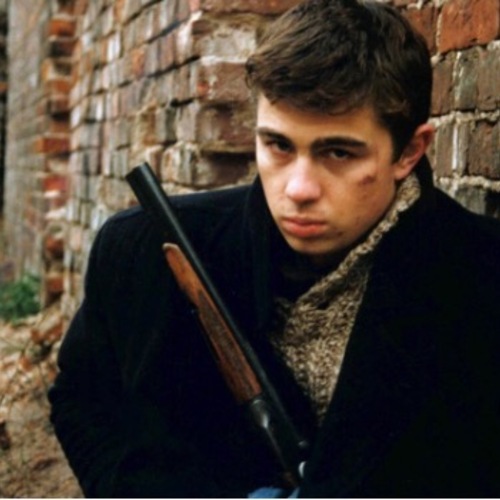
Brother. Motion Picture. Dir. Aleksei Balabanov (Excerpts)
Aleksei Balabanov's cult crime drama, which made its title character, the loveable killer Danila Bagrov into a youth idol and a national emblem of post-Soviet masculinity
Brother 2. Motion Picture. Dir. Aleksei Balabanov (Excerpts)
A sequel of the original Brother, which is partially set in the United States, where national hero Danila Bagrov avenges his friend's death, while reflecting Russo-American cultural differences
Gagarin (1994), directed by Alexei Kharitidi and the Moscow Animation studio “Pilot”
"Gagarin", the Oscar-nominated cartoon, directed by Alexei Kharitidi and the Moscow Animation studio “Pilot”

TaMtAm Rock Club documentary by German television (1993)
The first and until 1994 the only Western-style rock club in Russia, which was founded in 1991 by cellist Vsevolod (Seva) Gakkel (Akvarium) after he visited the famous music club CBGB in New York. The club specialized in punk rock specifically, providing the budding underground punk scene in Russia a much-needed performance venue and cultural legitimacy. Some have accused Gakkel's establishment for breeding far-right nationalist sentiments among Russia's youth subcultures (or at least providing them with a physical organizational platform) in the early 1990s. The fact that a German television production company took interest in TaMtAm is also a testament to punk as a truly transnational movement after fall of the Berlin Wall.
Yeltsin's Orderly (Sanitar Yeltsina)
Delo Muryleva. Smert' za kvartiry (The Murylev case. Death for Apartments). First episode of the crime show Kriminal'naia Rossiia (NTV, 1995-2002, with various later versions on TVS, Pervyi kanal, and others)
The Russian (Extreme Version of) MTV
Selection from the music TV show Drëma, which aired on TV-6 in 1997-98 before being shut down because of its provocative content. Hosted by Vladimir Epifantsev and Anfisa Chekhova. An early (quite experimental) example of pop culture in post-Soviet Russia.
The Making of an Anti-Bourgeois Hero
Excerpt from an early episode (the second) of a new version of the popular talk show Vzgliad, co-hosted by Aleksandr Liubimov and Sergey Bodrov Jr., which aired weekly on the TV channel ORT in 1996-1999.
Soviet identity and Jewish Emigration on KVN
An excerpt from the 1992 season of the amateur variety improv competition show, KVN, in which an Israeli team of recent Russian émigrés competes against former compatriots in Moscow
Soviet Engineers become Post-Soviet Aristocrats on TV
Chto? Gde? Kogda? (What? Where? When?) goes through an aristocratic overhaul and becomes an "intellectual casino'
Boris Moiseev: Egoist
Music video for song by pop-music artist Boris Moiseev
Gorodok [Little Town]: 1993-2012
title screen, "Little Town"/"Gorodok" by Iurii Stoyanov and Ilya Oleinikov, 1996
Georgii Deliev, Mask Show (Маски Шоу), 1991-2006.
title screen, "Maski-Show"/"Maski-Show", 1991 by Georgi Deliev, showing a stylized image of multiple people in clown make-up.
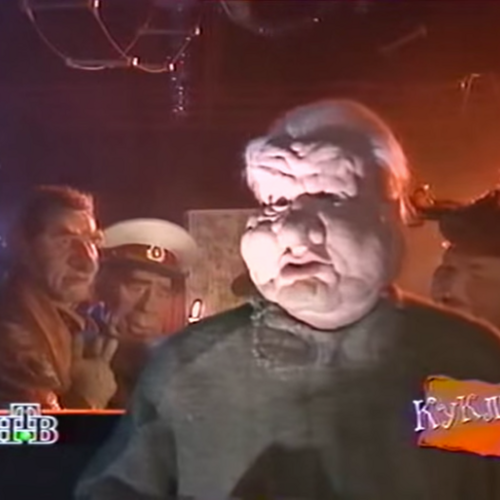
Kukly ["Dolls'], still from episode 2 “The Old New Year” (01/07/1995) featuring the first appearance of Boris Yelstin’s puppet on the show.
Still from Dolls"/"Kukly", 1994-2002, an influential political satire showing several politicians as puppets.
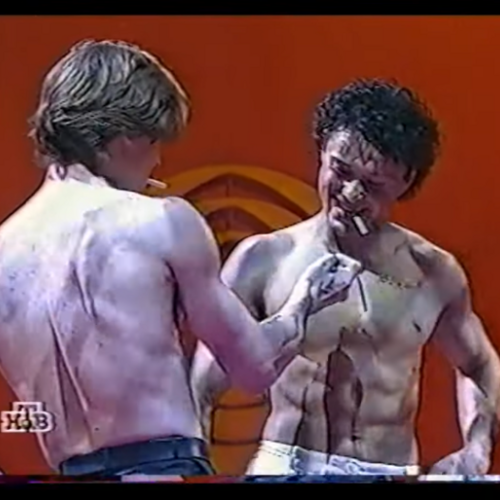
Still from the television show “About It” with host Elena Khanga, Episode “Homosexuality”, 1998
Image of two shirtless men lighting cigarettes in the course of a dance performance illustrating homosexuality
Svetlana Baskova captures the surreal, deeply violent, and grotesque essence of the 1990s and the Chechen wars in her cult trash movie, Zelenyi slonik (The little green elephant, 1999).
An excerpt from Svetlana Baskova’s film Zelenyi slonik (The little green elephant, 1999).
Referendum 1993: the "Yes Yes No Yes" campaign
Da, Da, Net, Da- Agitational propaganda for the 1993 referndum, "Yes, yes, no, yes"- note the slogan at the end, "we are building a new Russia!"
"Eleven Suitcases of Kompromat"
Rutskoi's speech, regarding "11 suitcases of kompromat," proving the corruption of Yeltsin's team– the first salvo in the 'Kompromat wars,' as a counterattack to Yeltsin's "Yes Yes No Yes" referendum.
Grigory Yavlinsky of the Yabloko Party runs for president, 1996
Grigory Yavlinsky’s absurd 11-minute 1996 presidential campaign ad
Ernst’s “Russian Project” as cultural therapy for the post-Soviet Russian masses
Konstantin Ernst’s series of social advertisements extolling Russia’s shared values and national identity at a time of seeming social crisis in the mid-1990s
The First (Home-Made) Post-Soviet Independent TV
The Saint Petersburg “New Artists” stage a meeting of the committee “anti-state of emergency” on their “Pirate Television,” declaring their support of Yeltsin against the group of communist hardliners who led the coup d’etat against Gorbachev on August 19, 1991.
Stalin, Beria, Gulag: Natsboly against Gaidar and Mikhalkov
Two of the early direct actions organized by the young members of the NBP that combined self-martyrdom and totalitarian styob.
ASSA, motion picture
Scene of Viktor Tsoi performing his rock-anthem "Changes!" (“Peremen!”) during the last seven minutes of Sergei Solov’ev’s 1987 film Assa. Kino's cinematic performance became a defining mass-cultural event that legitimized Soviet rock music as a product of the official mainstream collaborating with the Soviet underground rock movement, crowning Tsoi as USSR's ultimate rock star, and promoting rock music as a legitimate artform for the late-Soviet audience.
Alexei Uchitel's 1992 documentary film Posldenii Geroi.
Made with the collaboration of Tsoi's widow Marianna Tsoi, the film includes scenes from Viktor Tsoi's funeral and chronicles the mass mourning of the late musician, and the perestroika era by proxy.
Lyube "Stop Fooling Around, America!" (Ne Valiai Duraka, Amerika!) music video
Music video for the fourth track on Lyube’s second studio album Who Said We Lived Poorly? (Kto skazal, chto my plokho zhili?), which was released in 1992. Written from the perspective of the Russo-Soviet “common man,” while using folk vernacular, the song explores questions of Alaska’s historical and territorial integrity – lamenting its sale to the United States and demanding its return while celebrating Russia’s national character.
Lyube "Stop Fooling Around, America!" (Ne Valiai Duraka, Amerika!) music video
Music video for the fourth track on Lyube’s second studio album Who Said We Lived Poorly? (Kto skazal, chto my plokho zhili?), which was released in 1992. Written from the perspective of the Russo-Soviet “common man,” while using folk vernacular, the song explores questions of Alaska’s historical and territorial integrity – lamenting its sale to the United States and demanding its return while celebrating Russia’s national character.