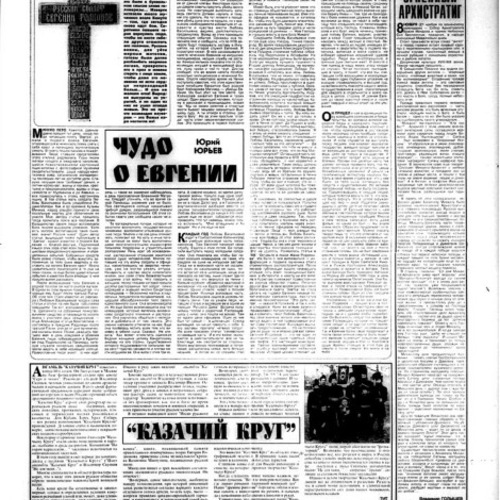
The Miracle of Evgenii
Iurii Iur'ev, “Chudo o Evgenii,” Zavtra, No. 46 (311), November 1999: 5.

“The Miracle of Evgenii,” by Iurii Iur’ev, retells the story of Evgenii Rodionov’s capture and death. Zavtra, No. 46 (311), November 1999: 5.
Icon of the “Martyr Warrior Evgenii” Rodionov from Petergof.

Source
Iurii Iur'ev, “Chudo o Evgenii,” Zavtra, No. 46 (311), November 1999: 5.
Description
A Russian soldier during the first Chechen War, Rodionov was captured outside of Grozny and reputedly executed for refusing to renounce his Orthodox faith. His image has since served as the inspiration for several of post-Soviet Orthodoxy's most popular new icons.
Era
Post-Soviet
Date
1999
Annotation
“The Miracle of Evgenii,” by Iurii Iur’ev, retells the story of Evgenii Rodionov’s capture and death. Zavtra, No. 46 (311), November 1999: 5.
Serving as a border guard during the First Chechen War, the eighteen-year-old Evgenii Rodionov and three colleagues stopped an ambulance at their post on February 14, 1996. When they found the ambulance to be carrying weapons, all four were taken prisoner. After subjecting them to three months of torture, their Chechen captors—according to accounts published later—gave them the choice of their life or their faith. “He had the choice to stay alive,” his killer said later, according to an account published in Pravda, “He could have changed his faith, but he didn’t want to take off his cross. He tried to escape…” He was beheaded and when his mother was allowed to see his body, she identified it only by the cross still hanging on a chain around his neck.
Though the story was known at the time, it wasn’t widely reported until 1999, when the early rumblings of the Second Chechen War made the topic relevant once again. In a series of articles in the far-right newspaper Zavtra (Tomorrow) Iurii Iur’ev recounted the Rodionov’s death in sensationalist, and often racist tones, calculated to stoke vengeful support for the coming war. In this follow-up, Iur’ev recounts the “mountains of mail” in response to the first story, but quickly moves on to something more mystical. After Rodionov’s mother gave her son a proper burial, he started appearing to hear in dreams, saying that he would find rest only after the “third Easter from his death.” Sure enough, Iur’ev writes, the next time people gathered to commemorate his death, they saw the sun playing in the sky. “Orthodox people know what that means. Just such a portent was seen on the day of the glorification of the Blessed Matrona Nikonova.”
Iur’ev was not the only one to report miracles. The next year, Father Vadim Shkliarenko from Dnepropetrovsk reported reading a brochure about Rodionov’s story and then seeing him in a vision that night “in camouflage, just like on the brochure, but with a red cape cast over his shoulder as martyrs are rendered on icons.” The next day, Father Shkliarenko saw that “the front of the brochure with the portrait of the neomartyr for Christ, the warrior Evgenii was sprinkled with drops of myrrh that sparkled in the morning sun.” The brochure miracle helped feed an intensive campaign to canonize Rodionov in the coming years and Father Shkliarenko’s vision served as the basis for many icons painted of the “Martyr Warrior Evgenii” throughout the Orthodox world.
Associated People
Rodionov, Evgeny
Geography: Place Of Focus
Chechnya
Bibliographic Reference
Iurii Iur'ev, "Chudo o Evgenii," Zavtra, No. 46 (311), November 1999: 5.
Explore Related Artifacts