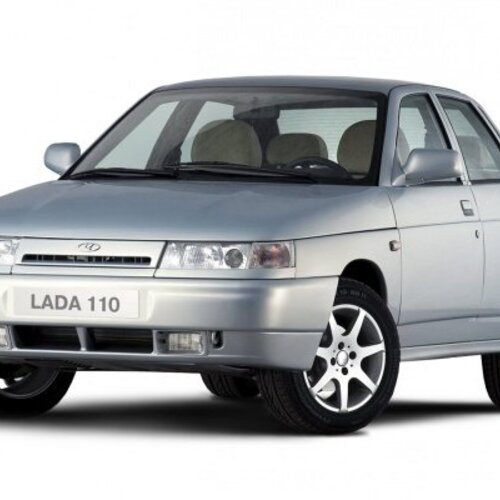
Lada 110-series
Lada-110 manufacturer’s images. 1995.


Description
The first post-Soviet Lada model, the VAZ-2110 appeared in 1995 and sold for between $5,000 and $8,000. Targeted at the emerging middle class, the car represented the hopes that Russian manufacturing and Russian consumer power could come together to build a domestic market that would move the economy beyond raw materials extraction and imported consumer goods.
Era
Post-Soviet
Date
1995
Annotation
The Lada 110, also known as the VAZ-2110, was the first post-Soviet design from the venerable Soviet car manufacturer, AvtoVAZ. Automobiles had become an unlikely site of early privatization and its criminal underbelly. Even before the fall of the Soviet Union, eager (and unscrupulous) entrepreneurs like Boris Berezovsky were able to open private dealerships for AvtoVAZ vehicles; but the dealerships soon became criminal enterprises engaged in stealing cars directly from the increasingly decrepit factory and selling them for 100% profit. As Berezovsky’s LogoVAZ dealerships became rich, the factory lost money. When it was privatized as a joint stock company and listed on the Moscow Stock Exchange in 1993, it was deeply in debt and hadn’t paid workers for months.
Nevertheless, demand for cars remained strong in the post-Soviet years. According to Lewis Sieglebaum, car ownership doubled in the first post-Soviet decade, from 75 to 150 per thousand inhabitants. “The total number of cars [in Russia] was approximately 11 million in 1992, surpassed 20 million by 2000, and reached 25 million in 2003.” Some of the increase was driven by foreign imports, but the most popular models remained domestic automobiles, led by the Lada 110-series. Introduced in 1995, the Lada 110 was the first update on the basic AvtoVAZ sedan in decades. Its more streamlined design was meant to modernize its Soviet predecessor’s iconic boxy shape, but its selling point was always its reliability—or at least its repairability. Domestic cars were easier to fix, easier to find parts to fit, and more familiar than foreign imports.
But the post-Soviet explosion in car ownership could not save the financial situation of AvtoVAZ and foreign investors and competitors slowly took over. A GM-AvtoVAZ joint venture in 2001 gave the company a boost. In 2008, AvtoVAZ attracted a $1 billion investment from Renault only to narrowly avoid bankruptcy the following year. It continued faltering, and by 2014 Renault-Nissan had purchased a majority stake. Failed privatization had led to the foreign ownership of Russia’s flagship auto manufacturer.
Geography: Place Of Origin
Togliatti
Geography: Place Of Focus
Russia and FSU
Bibliographic Reference
Image: https://s.auto.drom.ru/img1/catalog/photos/fullsize/lada/2110/lada_2110_31448.jpg; Prices: https://www.abw.by/novosti/rb/153934
Explore Related Artifacts