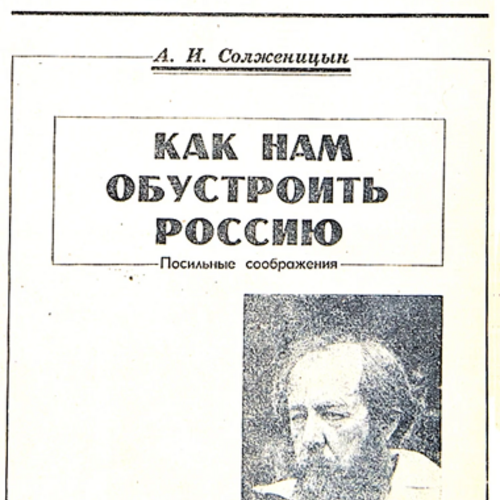
Rebuilding Russia

Aleksandr Solzhenitsyn, “Kak nam obustroit’ Rossiiu,” Komsomol’skaia pravda, September 1990.
Source
Aleksandr Solzhenitsyn, “Kak nam obustroit’ Rossiiu,” Komsomol’skaia pravda, September 1990.
Description
Alexander Solzhenitsyn's traditionalist prescription for pulling Russia out of its difficulties was seen by many as out of touch with the times, but many of the ideas he expounded in 1991 have become part of Russia's neo-revanchism in recent years.
Era
Perestroika
Date
1991
Annotation
As the Soviet Union’s internal weakness became clear in mid-1990, Alexander Solzhenitsyn wrote down his vision for Russia’s path forward. His brochure published later that year and translated as Rebuilding Russia (the original Kak nam obustroit’ Rossiiu is closer to “How we are to set up Russia”), begins by proclaiming that “Time has run out for communism. But its concrete edifice has not yet crumbled. And we must take care not to be crushed beneath its rubble instead of gaining liberty.” For Solzhenitsyn, the first condition for his new vision for Russia is ethnic homogeneity. “It must be declared loudly, clearly, and without delay” that all the non-Russian republics of the Soviet Union “will be separated off unequivocally and irreversibly,” he wrote. The remainder would be a Russian Union (Rossiiskii soiuz) comprising Russia, Ukraine, and Belarus.
By the time the pamphlet appeared, history had outpaced the publication process, and the dream of an ethnically Slavic super state seemed increasingly far-fetched. Some of Solzhenitsyn’s other insights, however, bear up better under the scrutiny of hindsight. Though he advocated for individual ownership, for instance, he saw the dangers of too-rapid privatization. Agricultural land, he suggested, should be handed over from collective farms to decentralized local councils (zemstvos) that would parcel out territory to individual farmers. Natural resources, especially would invite an “inequitable sell-off” to “foreign capitalists.” “Western capital must not be lured in on terms that are advantageous to it but humiliating to us, in come-and-rule-over-us style.” “Any thoughtless wholesale adoption of a foreign type of economy,” he warned, “would also have ruinous consequences.”
Solzhenitsyn’s pamphlet was widely read and discussed, but he was seen as largely out of touch. As his economic warnings went unheeded, post-Soviet Russia found itself under the thrall of western capital and the very “wholesale adoption of a foreign type of economy” he warned against indeed proved disastrous. Ironically, the very disaster he foresaw laid the groundwork for Putin’s neo-imperialism, a vision that shares much with Solzhenitsyn’s aspirations for the ethnically Slavic Russian Union.
Geography: Place Of Origin
Vermont
Associated People
Solzhenitsyn, Alexander
Geography: Place Of Focus
Russia
Bibliographic Reference
Aleksandr Solzhenitsyn, “Kak nam obustroit’ Rossiiu,” Komsomol’skaia pravda, September 1990.
Explore Related Artifacts