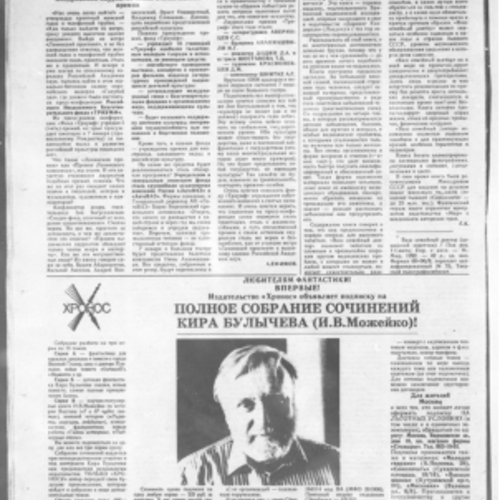
The Triumph Prize

A. Efimov, "Triumf. Pozdravliaem laureatov novoi otechestvennoi premii," Knizhnoe obozrenie, 18 Dec 1992: 10.
Source
Description
Launched at the same time as the Russian Booker and funded by the newly minted oligarch Boris Berezovsky, the Triumph Prize promised an even broader program of cultural guardianship and philanthropy.
Era
Post-Soviet
Date
1992
Annotation
Launched in 1992 and trumpeted as the first independent cultural prize in post-Soviet Russia, the Triumph seemed to have all it needed to succeed. But it failed. The Triumph foundation was set up and funded by Boris Berezovskii, the wealthy businessman and soon to be oligarch, who always seemed one step ahead of the rest. He had gotten rich early and now, before any of his peers, decided to convert some of his wealth into cultural power. Berezovsky appointed Zoya Boguslavskaia head of the Triumph prize and she quickly set about bringing together Soviet and imperial symbols to inform its vision for Russian culture. The prize was announced at the Soviet (and now Russian) Academy of Sciences; the award ceremony would be held at the Bolshoi Theatre, and the prize medallions were emblazoned with an image of the triumphal arch in St. Petersburg, erected in 1814 to celebrate the victory over Napoleon. The appeal to the imperial greatness of Russian culture was not subtle, but it wasn’t meant to be. And it fit with a widely held post-Soviet feeling that hoped for something of a return to (largely imagined) pre-Revolutionary status.
The prize was also richer than its competitors, giving out more prizes with richer purses than, for instance, the recently imported Booker. At the same time, however, the Triumph projected a relationship to the arts that was somewhere between aristocratic patronage and the socialist welfare state. It promised not only prizes, but grants for “talented young creators and performers without means,” support for exhibits and shows, and even “support to cultural figures who have lost the ability to work or who have falling into difficult situations.” In other words, though it was funded by post-Soviet capitalism’s most favored son (for the moment), it was not a capitalist prize, but a prize that believed (in Boguslovskaia’s words) that “culture cannot (and should not) support [soderzhat’] itself.”
Unfortunately, that belief proved to be out of step with the times, as did much of the prize’s organization. Instead of generating suspense and creating media scandals, as the Booker did, the Triumph deflated any speculation by announcing laureates ahead of time. The laureates, too, were not meant to be exciting young creators—or even masters at the height of their powers—but lifetime contributors. It celebrated, in other words, culture gone by. And with the growth of markets for culture, its economic models—both patronage and the social welfare state—seen as obsolete. A culture that could support itself in the new conditions of the market was the one that would survive and take over the mainstream.
Associated People
Boris Berezovskii and Boguslavskaia, Zola
Geography: Place Of Focus
Russia
Bibliographic Reference
A. Efimov, "Triumf. Pozdravliaem laureatov novoi otechestvennoi premii," Knizhnoe obozrenie, 18 Dec 1992: 10.
Explore Related Artifacts