Gone with the Wind - The post-Soviet Sequels

Source
Description
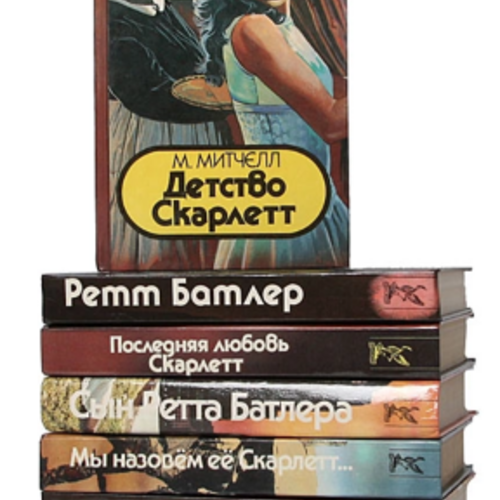
Series of five collectively authored sequels to Margaret Mitchell's bestselling Gone with the Wind. Writing in Minsk, the anonymous authors published under the pseudonym Dzhuliia Khilpatrik and released titles like We'll Call Her Scarlett, Rhett Butler's Son, and Scarlett's Last Love.
Era
Post-Soviet
Date
1994
Annotation
Inspired by the late-Soviet success of Margaret Mitchell’s Gone with the Wind, and the more recent success of Alexandra Ripley’s Scarlett (1991; Russian translation 1992), the Minsk publisher Liesma sistems launched a series of unauthorized continuations of the Scarlett O’Hara story, written by anonymous author collectives and all published under the apparently American pseudonym Julia Hillpatrick (“Dzhuliia Khilpatrik”). The seven novels, several of which became Russian bestsellers, represent an attempt to create a homegrown equivalent to the massively popular genre bestsellers that were flooding the Russian book market.
The earliest bestseller lists published in Russia made it clear that readers’ preferences had shifted away from the previously banned literature that had dominated perestroika-era publishing towards mostly imported genre fiction. Translations of Stephen King, Danielle Steele, and James Hadley Chase dominated the market in the early 1990s. Soon, however, writers and publishers from the former Soviet Union began to deconstruct the bestseller in order to adapt it to local purposes. Several of the most successful Russian authors of the 1990s successfully blended the genre conventions of the bestseller with local realia, creating new hybrid genres like the zhenskii detektiv of Aleksandra Marinina and Daria Dontsova, a mystery novel whose author, protagonist, and intended reader were all women, and the post-Soviet boevik, or action thriller, by the likes of Viktor Dotsenko, that grafted the conventions of bestsellers like Rambo onto the crime-ridden chaos of post-Soviet Russia.
But another kind of imitative bestseller blossomed at the same time. Collectively authored and pseudonymously published, this type of manufactured bestseller presented itself to the Russian reader as an authentic import. In an article entitled “How We Wrote a Bestseller,” the author Lev Lobarev describes being invited to such a collective. The popular telenovela Simplemente Maria (Prosto Maria) had just finished its run on Russian television, and Lobarev’s collective was tasked with writing a continuation called Forgive Me, Maria! (Prosti, Maria!), published as a “translation” from the Spanish by an author called Amanta Santos. The Julia Hillpatrick books operate by a similar logic—they appropriate the success of an already-popular cultural project by imitation and putative continuation. Throughout the 1990s, these collectively authored bestsellers developed many of the marketing strategies and literary aesthetics that would go on to influence the Russian literary mainstream by the late 1990s and early 2000s through such influential projects as the Erast Fandorin novels of the pseudonymous Boris Akunin.
Associated People
Mitchell, Margaret and Khilpatrik, Dzhuliia (Julia)
Geography: Place Of Focus
American South
Bibliographic Reference
Dzhuliia Khilpatrik, My nazovem ee Skarlett (Minsk: BDPPR, 1994)
Explore Related Artifacts