Russian Crime Statistics, 1980–1996
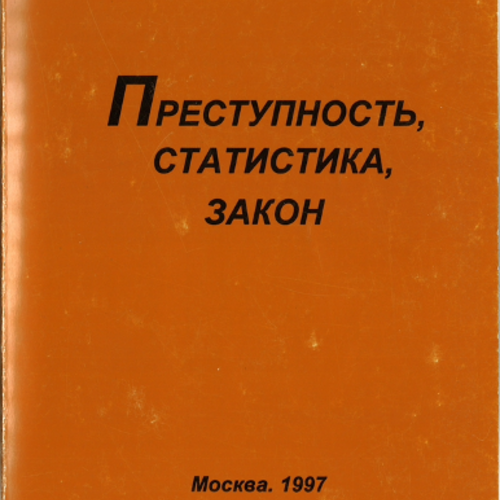
Cover of Dolgova, 1997

Title page of Dolgova, 1997

Source
Azalia Dolgova, ed. Crime, Statistics, Law (Moscow: Kriminologicheskaia assotsiatsiia, 1997)
Description
Nothing characterized the everyday experience of the urban Russian 1990s like crime; as shown in this first comprehensive statistical study of the 1990s, crime was just as bad as everyone had known. But the numbers also reveal some unexpected trends.
Era
Post-Soviet
Date
1997
Annotation
In the last years of the 1980s and early 1990s, crime in the Soviet Union and Russia skyrocketed. Between 1989 and 1992, most registered offenses grew by 20–25% each year. But something surprising happened beginning in 1994: crime went down. By most measures, society had not stabilized. Pyramid schemes, for instance, peaked that year with the meteoric rise and fall of MMM. The shelling of the White House was less than a year in the past and the first Chechen war was underway. But the trend continued with lower numbers of crimes reported, fewer criminals convicted, and fewer victims found.
Meanwhile, Russia finally adopted its first post-Soviet criminal code. For the first five years of the Russian Federation, law enforcement had worked under the Criminal Code of the Russian Soviet Federated Socialist Republic, though it had undergone some changes. “Crimes against socialist property,” for instance, had been on the books until January 1994, and accounted for 642,595 crimes in 1993, or 23% of the total registered crimes that year. Though such changes might account for some of the statistical drop, law enforcement saw lower numbers not just in total crime, but also in each individual category.
In order to better understand this issue and to track crime rates throughout the lifetime of the Soviet-era criminal code, a group of sociologists and criminologists under the leadership of Azalia Dolgova combed through the available data and published Crime, Statistics, Law (1997) in the months directly after the new criminal code was passed. The results are striking, not only for the steep increase in crime in the years of transition, but also for its leveling off in the mid-1990s. Perhaps even more impressive is the granularity of data, which allows researchers to understand precisely which kinds of crimes were reported at higher rates in which years.
Associated People
Dolgova, Azalia
Geography: Place Of Focus
Russia
Bibliographic Reference
Azalia Dolgova, ed. Crime, Statistics, Law (Moscow: Kriminologicheskaia assotsiatsiia, 1997)
Explore Related Artifacts