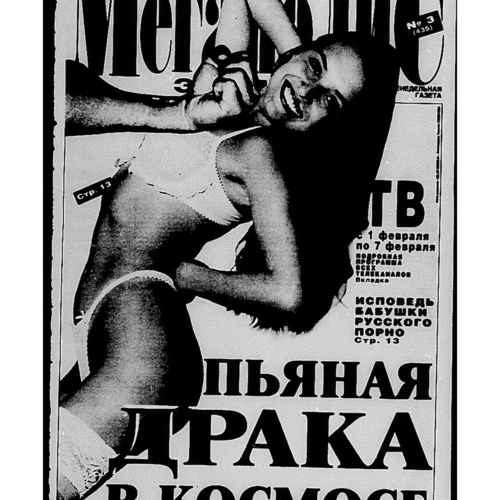
Megapolis-Ekspress: Urban Exoticism and National Pride

 (Download File)
(Download File)
(Download File)
Description
Igor Dudinsky takes over the magazine Megapolis-ekspress and turns it into an extreme and surreal parody of the lowest and most excessively sensationalist forms of Western tabloids.
Era
Post-Soviet
Date
1995
Annotation
Megapolis-ekspress—one of the most popular tabloids of the 1990s—started as a classical “perestroika magazine” on politics and society (often described as occupying the same niche as Ogonek and Moskovskie novosti), but changed drastically in 1994, when Igor Dudinsky took over the magazine as-editor in-chief. With Dudinsky—like Dugin a former member of postmodern writer Yuri Mamleev’s “metaphysical” underground circle—Megapolis-ekspress turned into a sort of extreme parody of the lowest and most excessively sensationalist forms of Western tabloids. Its slogan and subheading became “The Exotics of Urban Life” and the stories featured in it included cases of (self-)cannibalism, sexual encounters with werewolves, interviews to retired “babushki of Russian porn,” travels to the afterlife, brawls in space, and Santa’s drinking benders and sexual escapades. Like other former members of Mamleev’s circle, Dudinsky had a particular taste for black magic, shamanism, witchcraft, satanism, and “mystical Nazism”—and for the absurd sadism and the gratuitous violence of Lautréamont’s Songs of Maldoror, which had served as a source of inspiration for the Surrealist Movement. The artifact presented here—an article by Dudinsky from a 1995 issue of the magazine, entitled “Nine days in the arms of a witch”—reflects this fascination with occultism, the afterlife, and the secret codes and surreal irony of underground culture.
Although Megapolis-ekspress was clearly a commercial and highly lucrative enterprise (at its peak, its print runs got close to 1 million copies per issue), Dudinsky himself used a populist-patriotic argument of sorts to justify his decision to experiment with the genre of tabloids. The fact that his publication was so commercially successful, he explained, allowed it to be free from financial and political pressure, in contrast with more “elitist” and arguably more serious Russian periodicals on politics and society, which did not earn any profit and owed their existence to various oligarchs, whose interests they were supposed to represent. Megapolis-ekspress—he argued—provided a popular, highly accessible form of entertainment; at the same time, he continued, the objects of the magazine’s grotesque irony were capitalism, consumerism, and the decadence of “the Western way of life”—with its promises of eternal youth and instant sexual gratification—to which Russians had turned after the fall of the Soviet Union. In this sense, according to Dudinsky his tabloid was supposed to be seen, paradoxically, as a highly “popular,” anti-Western, and patriotic project.
Associated People
Dudinsky, Igor
Geography: Place Of Focus
Moscow
Bibliographic Reference
Igor Dudinskii, . “Desiat’ dnei v ob”iat’iakh ved’mi: Ira Trubina iz bezimiannoi mogily prishla v odnu iz moskovskikh kvartiry.” Megapolis-ekspress, no. 17 (244): April 26, 1995; Selection of covers of Megapolis-ekspress, 1996-1999.
Explore Related Artifacts