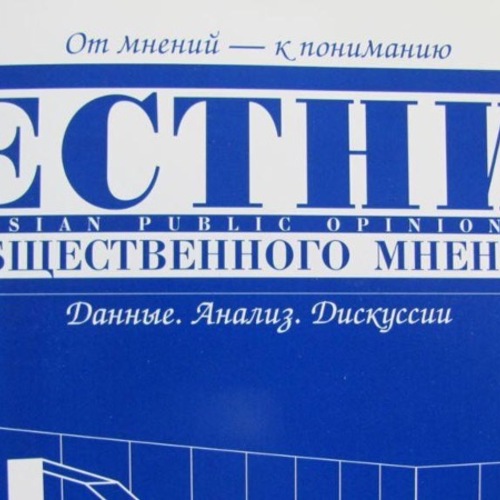
The Rise of Public Opinion Polling

Monitoring obshchestvennogo mneniia. Ekonimicheskie i sotsial’nye peremeny. Published by the All-Russian Center for the Study of Public Opinion (VTsIOM), 1993–2003; thereafter by the Levada Center under the title Vestnik obshchestvennogo mneniia. Dannye. Analiz. Diskussii
Description
Monitoring Obshchestvennogo Mneniia, the monthly publication of the All Russian Center for the Study of Public Opinion (VTsIOM).
Era
Post-Soviet
Date
1992
Annotation
The All-Union (after 1992, All-Russian) Center for the Study of Public Opinion (or Vsesoiuznyi / Vserossiiskii tsentr izucheniia obshchestvennogo mneniia, VTsIOM) was founded in 1987 as a part of glasnost’s efforts to encourage openness and understand the populace. After the fall of the Soviet Union it became the essential polling organization in the Russian Federation, providing the most reliable statistics on everything from presidential approval ratings to consumption habits and reading preferences. VTsIOM worked with regional and international organizations to develop a broad data-gathering network across the post-Soviet space in an ambitious attempt to understand the economic and social changes the country was undergoing. The founders of VTsIOM, Tatiana Zaslavskaia, Yuri Levada, Lev Gudkov, Boris Dubin and others saw their work as an attempt to approach objective truth through broad based statistical analysis. For them, raw data was the distilled essence of the glasnost’s promise. More than half of each issue of Monitoring obshchestvennogo mneniia is devoted to publishing reams of raw statistical data, in a gesture of perhaps futile, but radical openness.
At the same time, the sociologists involved in the project were educated in the Soviet Union, suspicious of uncomplicated positivism, and committed to many of the principles of Marxian analysis, even as they read and favored several western sociologists and cultural theorists. These theoretical commitments come through in the first half of each issue of Monitoring, which was filled with analytical essays and interpretations, alongside exhaustive and careful methodological notes. In this way, each issue of the periodical—along with publishing statistics with the power to sway presidential campaigns and price regulations—staged an essential conflict at the heart of postsocialist culture. On one side was an almost boundless faith in statistics as an objective window into social truth; on the other was a suspicion of the positivism represented by those statistics, a suspicion fed by years of Soviet education, and by the jarring nature of post-Soviet experience. More than anyone else, VTsIOM’s sociologists occupied both sides of this conflict, advocating for and internalizing both the promise and the skepticism of statistical research. In the pages of their periodical, they worked through the conflict and produced the sociology that would be most characteristic of postsocialist culture.
Associated People
Zaslavskaya, Tatyana, Levada, Yuri, and Gudkov, Lev
Geography: Place Of Focus
All-Union, then All-Russia
Bibliographic Reference
Vserossiĭskiĭ t︠s︡entr izuchenii︠a︡ obshchestvennogo mnenii︠a︡. 1992–2009. Monitoring obshchestvennogo mneni i︠a︡: ėkonomicheskie i sot︠s︡ialʹnye peremeny : alʹmanakh
Explore Related Artifacts