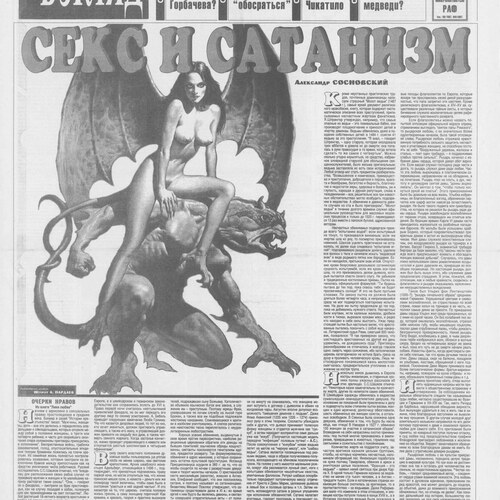
Novyi Vzgliad: Violence, Political Irony, and National Pride
 (Download File)


Description
Novyi Vzgliad authors write some of the most scandalous and incendiary political commentaries of the 1990s, producing new forms of political irony. Iaroslav Mogutin and Eduard Limonov turn violence into a paradoxical source of identity. The main artifact here–an article by Mogutin–exemplifies this process.
Era
Post-Soviet
Date
1993
Annotation
Initially conceived as an extension of the popular TV show Vzgliad, Novyi vzgliad was founded by a former correspondent of Sovershenno sekretno, Evgeny Dodolev, and followed in Sovershenno sekretno’s footsteps in combining transparency, sensationalism, and political irony. As far as sensationalism goes—in the form of sex, violence, and true crime—Novyi vzgliad pushed things even a little further, as exemplified by the general tone of some of its headlines: “Boobs in Flour”; “The Cannibal-Lover”; “Serial Murders”; and “Uxoricides.” Most notably, the biweekly magazine became closely associated with new forms of political irony and was widely known for the fierce debates that took place on its pages and the few public legal trials that some of these debates caused. In accordance with its slogan—“Total Pluralism”—the magazine took pride in the fact that it regularly published, side-by-side, completely opposite (political views: the Stalinist, ultranationalist essentialism of Aleksandr Prokhanov, “the army headquarters’ nightingale” was supposed to be counterbalanced by the hyper-liberal, anti-Russian essentialism of the self-defined magazine’s “main politextremist,” the former dissident Valeriya Novodvorskaya. Two of Novyi vzgliad’s contributors in particular—the provocative émigré writer Eduard Limonov and the poet, journalist, and queer multimedia artist Yaroslav (Slava) Mogutin—combined discourses on violence, sexuality, and transgression as part of a new paradoxical conception of politics and national identity. Mogutin, in particular, had an essential role in defining Novyi vzgliad’s style as a combination of tabloid-like sensationalism and “total pluralism.” Mogutin was one of the first openly gay authors in Russia—and one of the first authors who made writing about his sexuality, and about homosexuality in general, central to his work. His public persona was based on a mix of irony and defiance, a specific form of anti-intellectualism, Russian nationalism, and a fascination with youth and (aggressive) masculinity—and with young soldiers and lumpen proletarians and the raw beauty of their muscular bodies. As part of an art performance of sorts, he publicly celebrated and tried to register his wedding with his male partner, the American artist Robert Filippini. He ended up being prosecuted because of a fervently pro-Russian and vehemently anti-Chechen article he wrote as a commentary to the war in Chechnya and was ultimately forced to emigrate to the United States. In the article selected here, “Boobs Coated in Flour,” Mogutin claimed that violence and sadism—in the form of rape, cannibalism, and serial killing—were an essential component of Russia’s everyday life, its literature, and its identity—and of his own generation’s relationship with sex. In both texts, a kind of classically (self-)critical attitude toward this pervasive horror and “lack of boundaries” was mixed with a somewhat ironic pride for the country’s seeming descent into barbarianism. Mogutin’s piece and the style of Novyi vzgliad more generally offer a good example of the way in which in the early post-Soviet period styob, or “parody based on overidentification,” becomes increasingly associated with politics and dark irony, with the result of producing somewhat “shifty” political statements and positions, a tendency that has become pervasive during the Putin era. At the same time, the kind of moral unmasking or revealing (razoblachenie) that characterized chernukha during perestroika turns into and overlaps with a somewhat twisted and paradoxical form of national pride, and with a sense of belonging and identity connected with the experience of violence itself.
Geography: Place Of Origin
Moscow and Russia
Associated People
Evgenii Dodolev
Geography: Place Of Focus
Russia and former Soviet Union
Bibliographic Reference
Mogutin, Iaroslav. “Sis’ki v teste.” Novyi Vzgliad, no. 117, 1993. [ +Selection of 3 additional covers and titles from Novyi vzgliad.]
Explore Related Artifacts