Artifacts
1992
The Rise of Public Opinion Polling
Monitoring Obshchestvennogo Mneniia, the monthly publication of the All Russian Center for the Study of Public Opinion (VTsIOM).
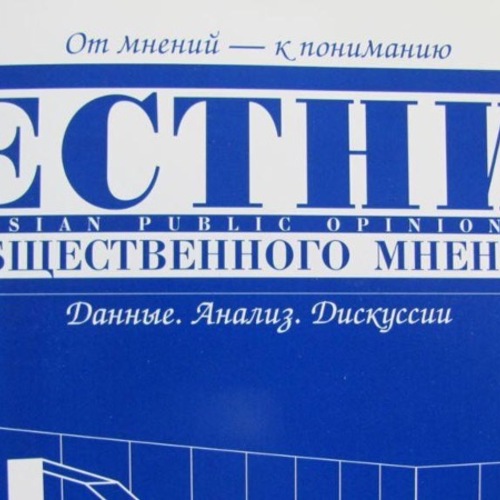
The Rise of Public Opinion Polling
Monitoring Obshchestvennogo Mneniia, the monthly publication of the All Russian Center for the Study of Public Opinion (VTsIOM).
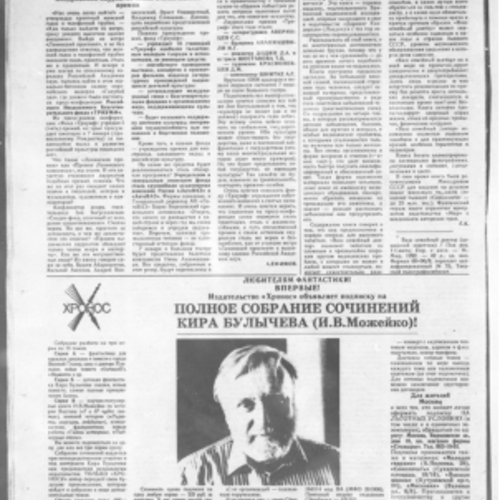
The Triumph Prize
Launched at the same time as the Russian Booker and funded by the newly minted oligarch Boris Berezovsky, the Triumph Prize promised an even broader program of cultural guardianship and philanthropy.
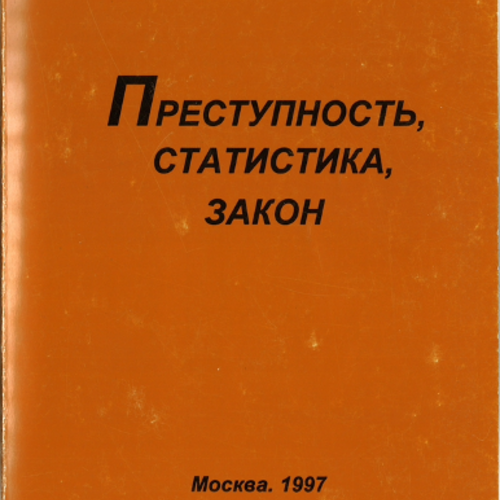
Russian Crime Statistics, 1980–1996
Nothing characterized the everyday experience of the urban Russian 1990s like crime; as shown in this first comprehensive statistical study of the 1990s, crime was just as bad as everyone had known. But the numbers also reveal some unexpected trends.
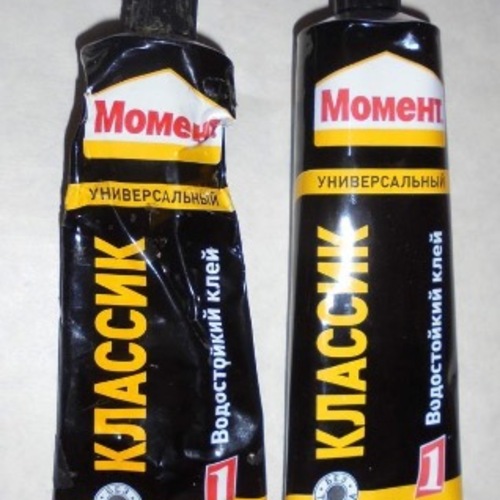
Klei-Moment
Made by the German Henkel company, Moment glue was a staple of post-Soviet hobbyists. It also became one of the prefered drugs among the post-Soviet youth. The brand name became synonymous with huffing itself.
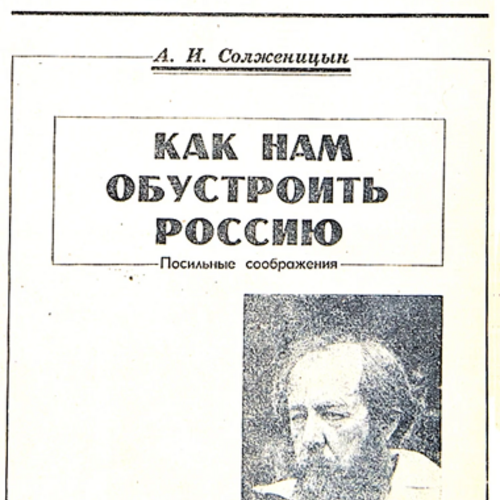
Rebuilding Russia
Alexander Solzhenitsyn's traditionalist prescription for pulling Russia out of its difficulties was seen by many as out of touch with the times, but many of the ideas he expounded in 1991 have become part of Russia's neo-revanchism in recent years.
Early Vzgliad parodies itself
A 1988 celebration of a year of Vzgliad, where several sketch comedy artists parody and recapitulate Vzgliad's casual, sincere, freewheeling style of television programming
A coup d'etat holds a press conference
Press conference held by the State Committee for the Emergency Situation (GKChP), the group of hard line government officials who had attempted a coup d'etat overthrowing Mikhail Gorbachev. This press conference was held the next day and shows the coup coming apart at the seams.
The Unknown Diaghilev
Russian translation of an article by American scholar Simon Karlinsky on Sergei Diaghilev, published in the LGBTQ magazine Тема
Elena Bonner: Nothing Interests Me Less than This Problem
Masha Gessen interview with Elena Bonner, published in the LGBTQ magazine Тема
Putting the "Spotlight" on an experimental three-hour line for Soviet luxury clothes
Prozhektor Perestroiki [Perestroika's Spotlight], a glasnost-era televised investigative journalism project, investigates a three-hour line for luxury clothes at the recently opened Luxe Fashion Center, where the reporters discover the problem of supply and demand in the USSR.
Soviet technical intelligentsia learns Reaganomics on the Chto? Gde? Kogda? gameshow
Chto? Gde? Kogda? [What? Where? When?], a long-running high-brow quiz show for the late Soviet technical intelligentsia, debates the economic principles of Soviet private enterprise in the heat of Perestroika’s economic reforms in 1988
Petrovich the Soviet everyman survives post-Soviet Russia at Kommersant
A collection of "Petrovich" cartoons at Russia’s ‘first business newspaper,’ Kommersant, drawn by Andrei Bil’zho. They depict a hapless and repulsive comic personage, born and raised in the Soviet era and now trying to get used to the realia of post-Soviet capitalism.
"Tema" Talk Show- Racism in Russia
A clip from the talk show "Tema [Theme]," List'ev's major post-Soviet project after the 1991 end of Vzgliad. This particular episode is dedicated to the theme of racism in Russia. Includes Dzheims Lloidovich Patterson, the grown up boy from the classic Stalin-era film, "Circus"
"Tema" Talk Show- Racism in Russia
A clip from the talk show "Tema [Theme]," List'ev's major post-Soviet project after the 1991 end of Vzgliad. This particular episode is dedicated to the theme of racism in Russia. Includes Dzheims Lloidovich Patterson, the grown up boy from the classic Stalin-era film, "Circus"
The Glasnost Booth on the last October Revolution anniversary in the USSR
“Glas naroda [The People’s Voice]”– a booth installed in the middle of town, into which random people can enter and speak their minds. Episode from the Kremlin, on USSR’s last anniversary of the October Revolution, in 1991.
"New Russians" at Kommersant
Series of articles from the nascent Kommersant Daily in late 1992-early 1993, assessing and explaining the nature of its target audience, the “New Russians”
Primetime hypnotic tele-healing seances with Kashpirovskii
Anatolii Kashpirovskii, the psychic and guru of Perestroika era's "new thinking" uses the power of suggestion to heal the Soviet people from all ailments physical and spiritual
Two Lives, Two Destinies. Sketch of S.E. Esenin and N. Kliuev
Article about the love affair between and the literary destinies of the poets Sergei Esenin and Nikolai Kliuev in the literary supplement to the gay newspaper 1/10
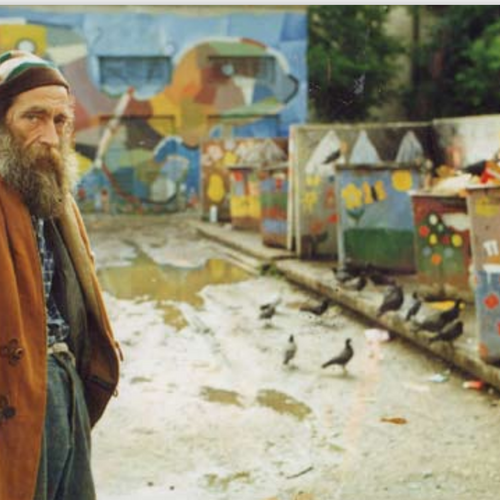
The Collective Society “Kartinnik”[”Picture-man”] with B.U.Kashkin in front of painted Ural Electro-Technical Institute rubbish pins. 1993.
The bearded B.U.Kashkin stands in front of a set of trashbins which have been painted with bright, colorful scenes of trees, butterflies and flowers. Pigeons are digging through the garbage and mud apparent throughout the site.

The logo for the "Dendy" Entertainment Console by Ivan Maximov.
The logo of an young, anthropomorphic elephant giving the victory sign with his left hand announced Russia''s first game console, which became enormously popular between 1992 and 1996.
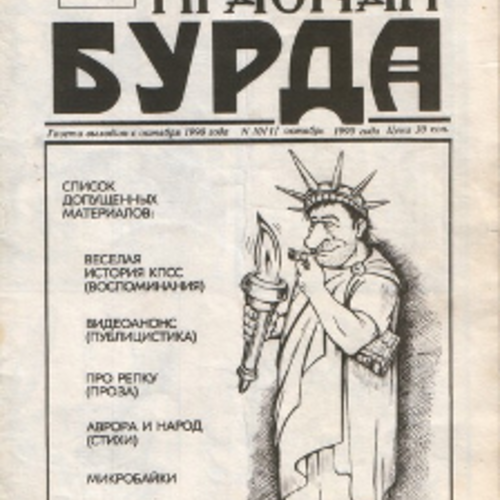
Cover for “Red Hogwash” [“Krasnaia Burda”], issue 1, October 1990 by G. Malyshev.
The first issue of Red Hogwash's cover depicts a man in the costume of the Statue of Liberty lighting a cigarette with the torch.
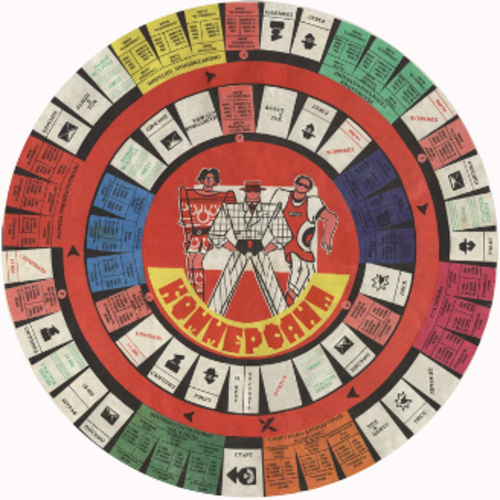
Kommersant Board Game
Kommersant attempted to represent the 90s market economy via a Monopoly-like of two economies, an inner and an outer, with racketeering as a recurring threat.
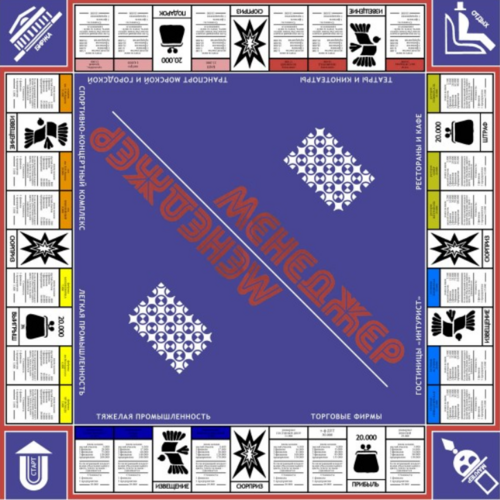
Manager Board Game 1st edition
A square, indigo board game similar to Monopoly, but reading "Manager". Manager, which became the most successful Monopoly-like made in the former Soviet Union, initially presented itself as scientific and rational in its promise of capitalist success.
A Man Who Keeps Up with the Times
A piece on David Bowie, focusing on the star’s bisexuality, in the glossy color gay magazine Мальчишник
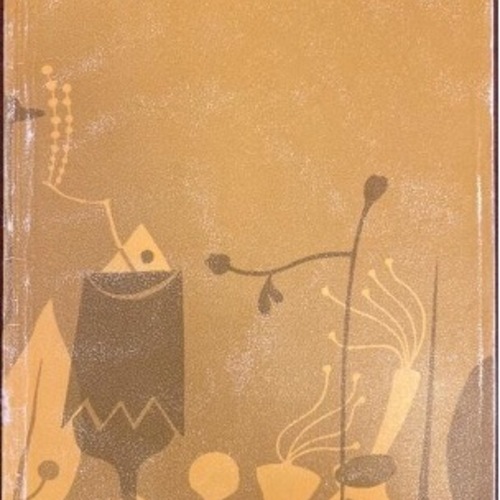
Philosophy on the Margins
Series of philosophical and theoretical texts from Russian and international authors published by Ad Marginem and meant to bring the latest in global thought into newly opened post-Soviet minds.
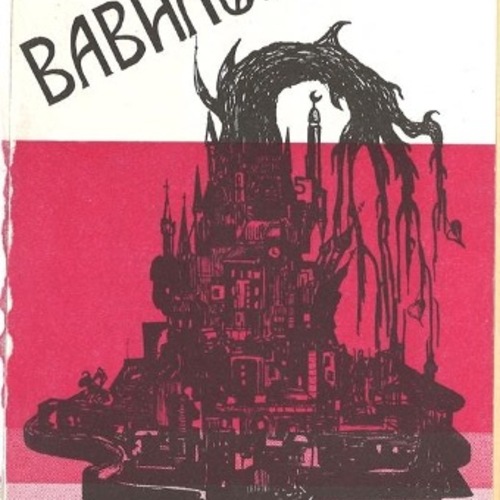
Babylon (online) Vavilon (.ru)
Vavilon, or Babylon, began as a loose group of young poets brought together by Dmitry Kuz'min in 1988. In the post-Soviet years, the group's almanac and then webside became a driving forces behind some of the most innovative poetry of the 1990s.
Chumak sends morning healing vibes to Perestroika audiences
A healing seance with TV-psychic Allan Chumak in 1989, during the morning newscast, “120 Minutes.” Works on people, their drinking water and their creams.
Kino’s last concert (Luzhniki Stadium, Moscow)
Footage of a live Kino concert at Moscow's Luzhniki Stadium on June 24, 1990, roughly a month and half prior to frontman Viktor Tsoi's death in a car accident in rural Latvia. The footage shows the band at the very height of its popularity, as well as offering an unencumbered look at a country in transition: a heavy and conspicuous Soviet police detail is assigned to the event, while audience members wave both the Soviet flag and the Russian tricolor banner.
Loss of the Soviet Nation at KVN
The Winter 1992 opening broadcast of the amateur variety and improv contest show KVN, filmed just a few months after the dissolution of the USSR, with former Soviet university teams lamenting the rise of national borders around them
Perestroika Women Speak to US Women
A clip from one of many Perestroika-era televised conversations between American and Soviet "regular people," in which they find common ground with the help of long-time Soviet propagandist and future star of liberal post-Soviet TV, Vladimir Pozner
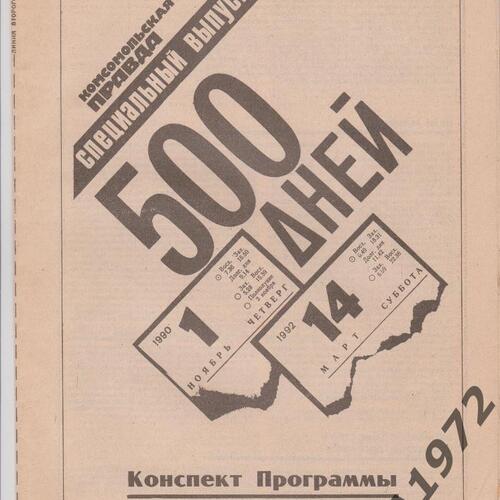
“500 Days: Program Summary,” a special issue of Komsomol’skaya Pravda, 29 September 1990
Komsomol'skaya pravda "500 days" special issue
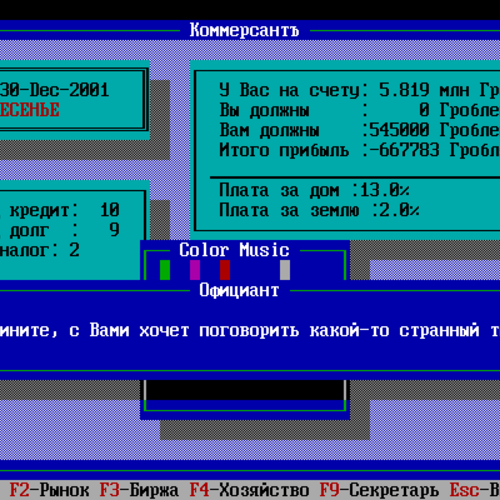
Kommersant’ by Vladimir Kharchenko and Rada Ltd, 1991.
The Ukranian video game attempted to represent the rough transition to capitalism via a detailed, simulationist interface.
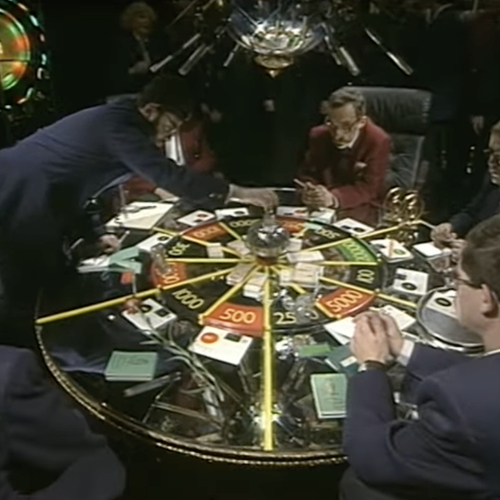
The Raspberry blazer as the uniform of the New Russian
The origins and the meaning of the raspberry blazer as the iconic dresscode of New Russians in the early 1990s
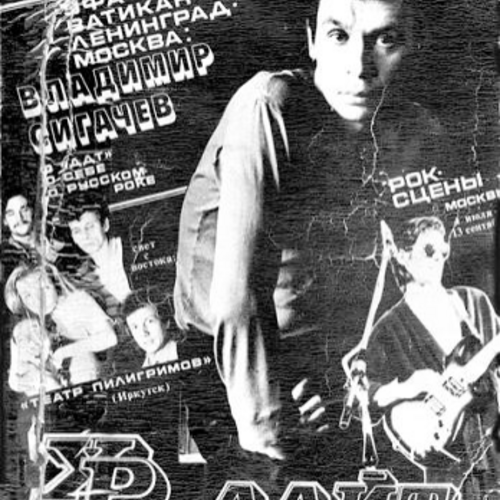
Urlait Music Journal (Samizdat) 1985-1992
Moscow's samizdat music journal, which followed in the footsteps of Lenigrad's Roksi while forging a new journalistic style. The journal positioned itself to in many ways reject the Leningrad scene. Despite Moscow-based bands generally leaning towards a more avant-garde, art-rock aesthetic, Urlait made a point to promote so-called "national rock." According to Urlait's founder I. Smirnov, bands like DDT, DK, and Oblachnyi Krai (Yuri Loza) were said to be "oriented towards national problems, in opposition to estrada and the confluence of Western and domestic cultural traditions."
Lyube "Stop Fooling Around, America!" (Ne Valiai Duraka, Amerika!) music video
Music video for the fourth track on Lyube’s second studio album Who Said We Lived Poorly? (Kto skazal, chto my plokho zhili?), which was released in 1992. Written from the perspective of the Russo-Soviet “common man,” while using folk vernacular, the song explores questions of Alaska’s historical and territorial integrity – lamenting its sale to the United States and demanding its return while celebrating Russia’s national character.
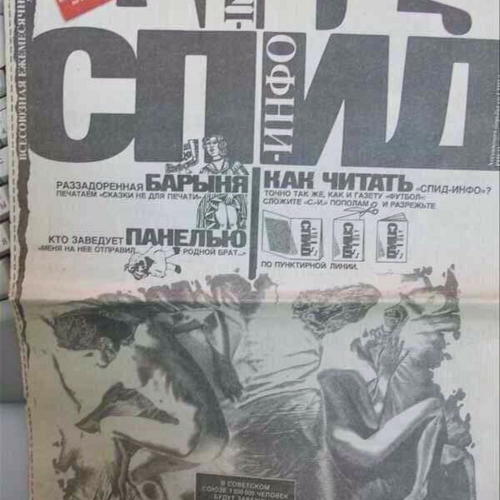
SpidInfo #1, January 1991
Cover of the first issue of SpidInfo depicting an anxious nude couple turned away from each other in bed.
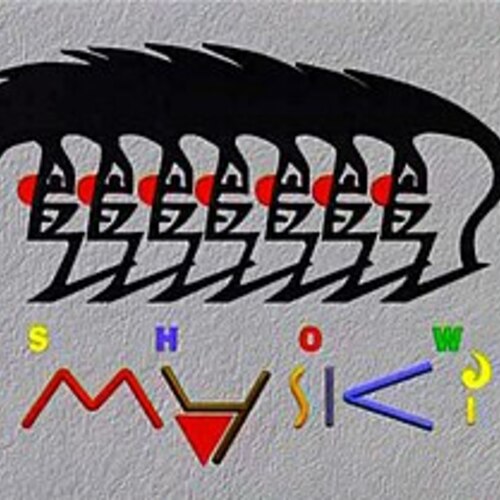
Georgii Deliev, Mask Show (Маски Шоу), 1991-2006.
title screen, "Maski-Show"/"Maski-Show", 1991 by Georgi Deliev, showing a stylized image of multiple people in clown make-up.
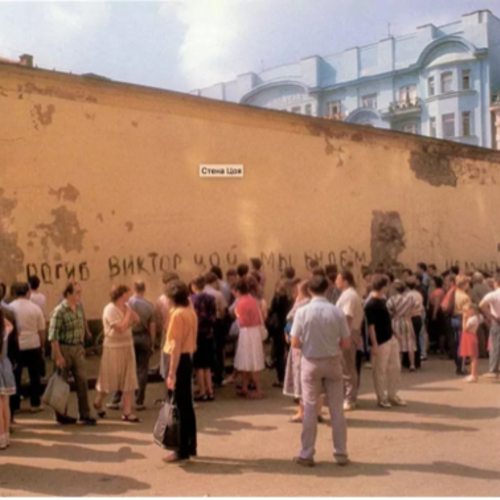
"Tsoi's Wall" on Arbat
A wall of fan graffiti dedocated to the late Soviet rock star Viktor Tsoi on Moscow's famous Arbat Street.
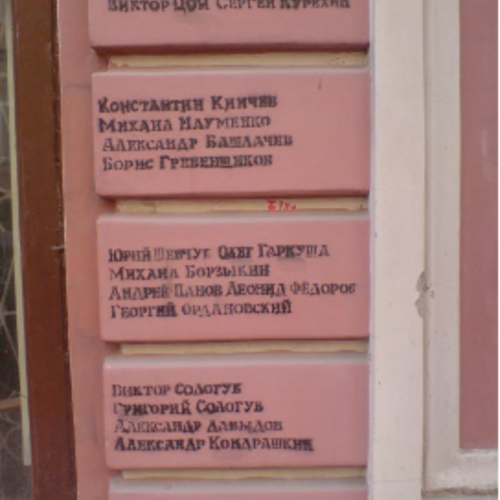
Leningrad Rock Club
A wall of graffiti in the courtyard of the Leningrad Rock Club (1981-1991) on 13 Rubinshteyna Street in Leningrad (St. Petersburg), which featured fan street art dedicated to USSR's most revered rock-music collectives. When the wall was painted over in 2010 by the bulding's new proprietor, this caused a public outcry from both rock fans and the many surviving musicians from that era, who sought to preserve the LRC's legacy and designmate the wall and the building a historical landmark.

TaMtAm Rock Club documentary by German television (1993)
The first and until 1994 the only Western-style rock club in Russia, which was founded in 1991 by cellist Vsevolod (Seva) Gakkel (Akvarium) after he visited the famous music club CBGB in New York. The club specialized in punk rock specifically, providing the budding underground punk scene in Russia a much-needed performance venue and cultural legitimacy. Some have accused Gakkel's establishment for breeding far-right nationalist sentiments among Russia's youth subcultures (or at least providing them with a physical organizational platform) in the early 1990s. The fact that a German television production company took interest in TaMtAm is also a testament to punk as a truly transnational movement after fall of the Berlin Wall.
Meaning of pluralism on Vzgliad
A conversation about pluralism between Evgeny Dodolev and Alexander Liubimov, after an expose on Nina Andreeva
Valerii Pereleshin
Piece on the gay Russian émigré poet Valerii Pereleshin with excerpts from his verse cycle “Ariel” in gay newspaper Shans
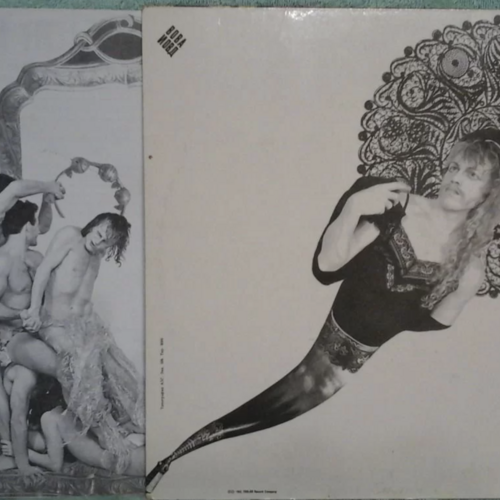
Impossible Love
LP (represented here by album cover and artwork) Impossible Love (Невозможная любовь) By Vova and the Organ of Internal Affairs (Вова и орган вунтренных дел)
Top Secret: Investigative Journalism and True Crime During Perestroika
Sovershenno sekretno, the first privately owned periodical in Soviet Russia since 1917, showcased a combination of transparency and sensationalism that became a distinguishing feature of journalistic writing in the post-Soviet period.
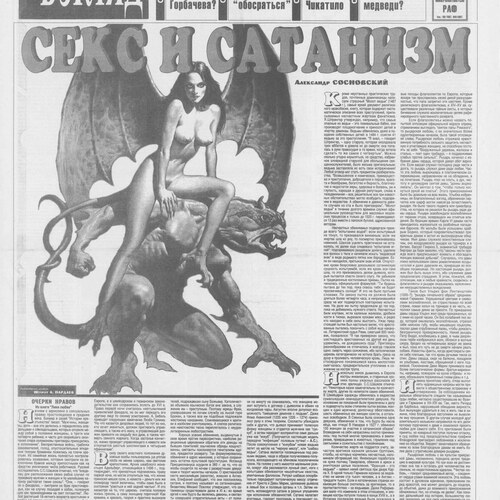
Novyi Vzgliad: Violence, Political Irony, and National Pride
Novyi Vzgliad authors write some of the most scandalous and incendiary political commentaries of the 1990s, producing new forms of political irony. Iaroslav Mogutin and Eduard Limonov turn violence into a paradoxical source of identity. The main artifact here–an article by Mogutin–exemplifies this process.
"The Mysteries of the Century": Post-Truth and Mystical Nazism on Russian TV
An episode from the TV program “Tainy veka” (The mysteries of the century), hosted by Iurii Vorobevskii and Aleksandr Dugin. One of the first examples of post-truth on Russian television.
Limonov Becomes a Post-Soviet Nationalist Rock Star
During an “encounter” with the émigré writer Eduard Limonov broadcasted from the concert hall in the Ostankino TV studios in Moscow (a common genre during perestroika), a young neformal in the audience suggests to create a subculture made up of young “limonovians.”
The World Made of Plastic Has Won
Egor Letov performs his song “Moia oborona” (My defense), during his “concert in the hero city Leningrad,” part of Grazhdanskaia oborona’s 1994 tour Russkii proryv (Russian breakthrough).
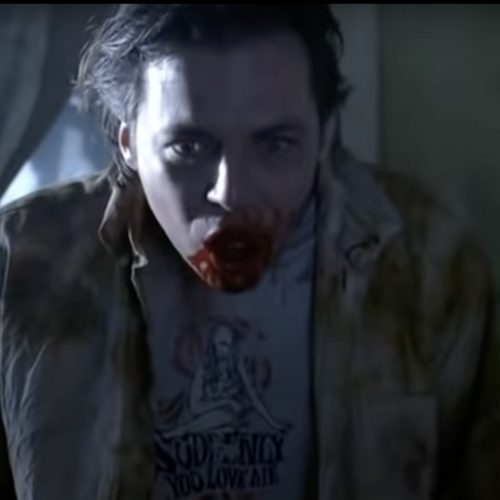
Mumiy Troll's Breakthrough “Utekai” (Take Off) Becomes the Song of the Year 1997
Video and lyrics of Mumiy Troll’s 1997 breakthrough song “Utekai” (Beat it) displaying the combination of surrealism, dark humor, and provincial romanticism that comes to shape the band’s trademark style.
Soviet identity and Jewish Emigration on KVN
An excerpt from the 1992 season of the amateur variety improv competition show, KVN, in which an Israeli team of recent Russian émigrés competes against former compatriots in Moscow
Chikatilo Trial
snippet of BBC footage of trial; photograph of Chikatilo at the trial
The Future of Crimea
Campaign documents surrounding the 1991–92 referenda on the independence of Crimea.
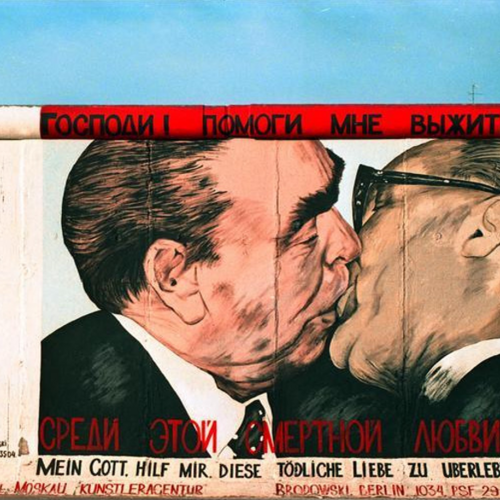
Dmitri Vrubel, "My God, Help Me To Survive This Deadly Love", 1990, graffiti, Berlin Wall, East Berlin.
Graffiti of Leonid Brezhnev and Erich Honecker kissing on the East Berlin wall.
The First (Home-Made) Post-Soviet Independent TV
The Saint Petersburg “New Artists” stage a meeting of the committee “anti-state of emergency” on their “Pirate Television,” declaring their support of Yeltsin against the group of communist hardliners who led the coup d’etat against Gorbachev on August 19, 1991.
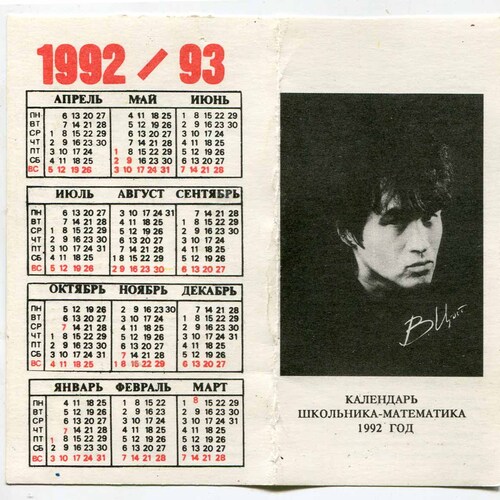
1992-1993 School math calendar
1992-1993 Math calendar intended for a secondary school student with a photograph of Viktor Tsoi, leader of the rock band Kino on its front cover.