Impossible Love

Description
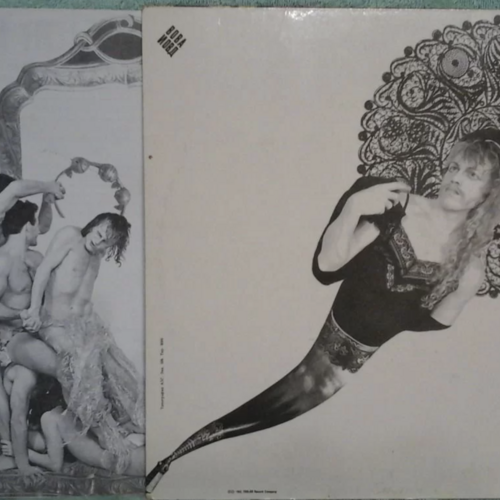
LP (represented here by album cover and artwork) Impossible Love (Невозможная любовь) By Vova and the Organ of Internal Affairs (Вова и орган вунтренных дел)
Era
Post-Soviet
Date
1992
Annotation
Most of the narratives about the flamboyant dancer Vladimir Veselkin (sometimes referred to as “the faun”) begin with his visit to Paris in 1989 as part of a sort of delegation of “underground” Soviet rock groups. At this stage of his career Veselkin was a classically-trained dancer and choreographer who had become attached to a famous rock-music act, and in this is strikingly similar to Boris Moiseev (see “Egoist”). Also a balletically-trained dancer and choreographer, Moiseev first achieved wide recognition touring with the pop-music star Alla Pugacheva. In Paris Veselkin is said to have been nicknamed “the faun,” least partially in reference to Vaclav Nizhinsky, the famous ballet dancer and choreographer whose “Afternoon of a Faun” premiered in Paris in 1912 under the auspices of Sergei Diaghiev’s Ballets Russes. It was well known that Nizhinsky in his early years had romantic entanglements with men, Diaghilev among them. On this same 1989 Paris sojourn Rudolph Nureyev is said to have invited Veselkin to stay on in Paris and dance with the Paris Opera Ballet (of which Nureyev was director). Nureyev, an enormously impactful gay ballet dancer from Russia, had defected from the Soviet Union in Paris in 1961. Veselkin is said to have declined Nureyev’s invitation. Back in Russia, he drifted away from Auktsyon and in 1992 released an album called “Impossible Love” as part of a “project” by the collective “Vova and the Organ of Internal Affairs” (“Vova i Organ Vnutrennykh Del”). The title song “Impossible Love,” sung by Veselkin, seems to be addressed to a man (the line “How could you have deceived me like this?” uses the masculine fore of the verb: “obmanul”) and alludes repeatedly to some “impossible” love that promises the singer no good and from whose clutches he is trying to escape. If the homoerotism of the song lyrics is latent or allusive, the homoeroticism of the album’s visual presentation and that presentation’s subversion of established gender norms, are unmistakable. The front cover features one of Tom of Finland’s intensely homoerotic paintings, and the back cover — a photograph of Veselkin in a long-haired wig and lingerie. The inside sleeve shows a photograph of three nearly naked men sitting on top of one another, with what appears to be an almost naked woman lying on the floor below them. The album addresses other formerly tabu gender and sexuality issues as well. It’s first side includes a song featuring singer and founding member of the group Colibri Natalia Pivovarova called “abortion.” In a development somewhat typical of the transition from the early post-Soviet era into the 2000s, Veselkin will eventually attempt to distance himself from the LGBTQ (to use the current terminology) aspects of the album’s presentation and the presentation of his own persona as associated with the album, and will specifically dismiss these expressions of gay desire and identity as elements of purely aesthetic constructs not directly representative of Veselkin as a person. In an interview from 2015 Veselkin, whose fortunes had long since taken a sharp turn for the worse (in 2006 the dancer lost one of his legs in a streetcar accident and had no fixed address since the mid 1990s), denies ever having had sexual or romantic entanglements with men, without even registering an in-principle tolerance of gay relationships. The homoerotic and gender-subversive aspects of “Impossible Love” and Veselkin’s self-presentation at that time are cast as mere aesthetic devices for defending, in the most general terms, the right of the individual to a “private life.” This defensive dissociative maneuver vis-à-vis LGBTQ elements of a constructed persona is also observed in the case of Eduard Limonov vis-à-vis the actively bisexual eponymous protagonist of the novel “It’s Me, Eddy,” and in the case of pop-music star Boris Moiseev vis-à-vis the homoerotic and gender-subversive aspects of his own recorded output and performances.
Homosexuality (https://lccn.loc.gov/sh85061780)--Russia (Federation) (https://lccn.loc.gov/n92056007)
Homosexuality and popular music (https://lccn.loc.gov/sh2005006972)--Russia (Federation) (https://lccn.loc.gov/n92056007)
Gay culture (https://lccn.loc.gov/sh2004003369)--Russia (Federation) (https://lccn.loc.gov/n92056007)
Associated People
Veselkin, Vladimir
Geography: Place Of Focus
Russia
Explore Related Artifacts