Search
Thematic Tags: Moscow
45 Results
Front page of Komsomol'skaia pravda in new format
Front page of KP when the format of the printed version changed to adjust to 1990s print media reading habits and financial constraints
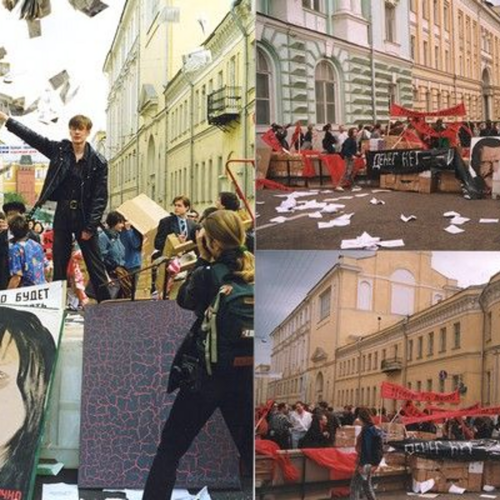
The Non-governmental Control Committee, Barricade, Bolshaia Nikitinskaia street, 1998
Photograph of artists barricading Bolshaia Nikitinskaia street
Kino’s last concert (Luzhniki Stadium, Moscow)
Footage of a live Kino concert at Moscow's Luzhniki Stadium on June 24, 1990, roughly a month and half prior to frontman Viktor Tsoi's death in a car accident in rural Latvia. The footage shows the band at the very height of its popularity, as well as offering an unencumbered look at a country in transition: a heavy and conspicuous Soviet police detail is assigned to the event, while audience members wave both the Soviet flag and the Russian tricolor banner.
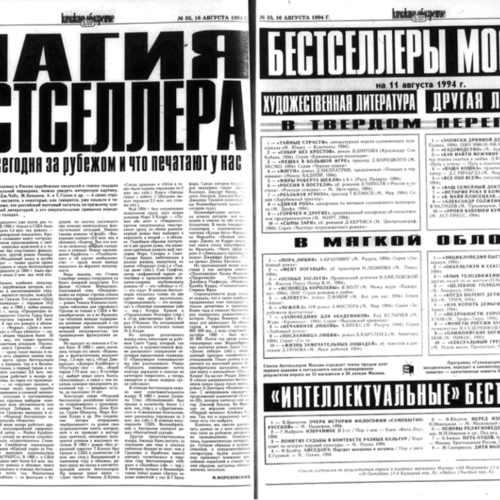
Bestsellers of Moscow
Post-Soviet Russia's first bestseller lists, compiled by the weekly industry newspaper Knizhnoe obozrenie and published from late 1993 through 1998.

Pro Eto - The Sexual Lives of the Disabled
Clip from Pro Eto hosted by Elena Khanga that brings together 1990s interest in sex with the increasing visibility of disabilities and the disintegration of state institutions previously entrusted with their care.
Ekho Moskvy - 20 August 1991
Live coverage of the GKChP putsch in August 1991 from the Echo of Moscow radio station. Demonstrates the chaos of the moment, the putschists' failure to control their message, and the power of the newly independent media.
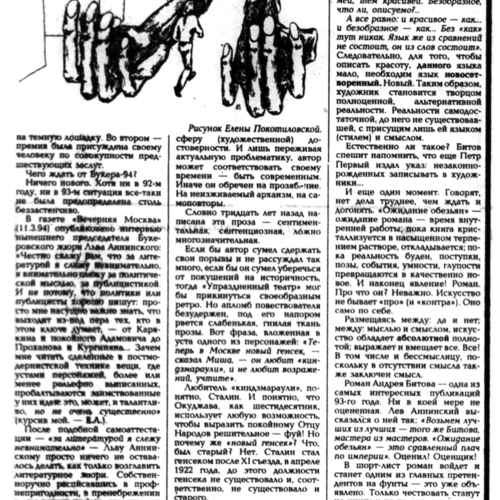
The Russian Booker - Scandals
A series of five articles scandalously decrying the new literary prize, imported from England, the Russian Booker.
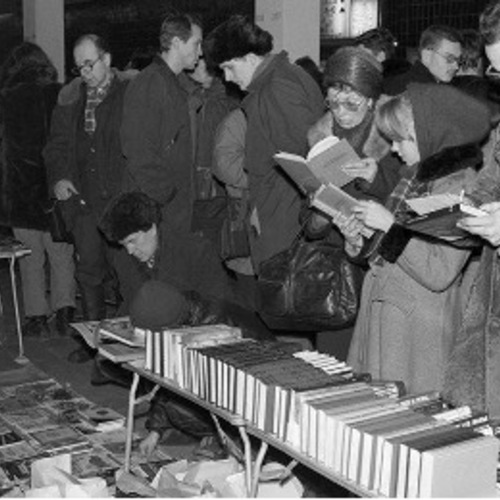
Olympic Stadium Book Market
The center of the post-Soviet book trade made its home in the corridors of the enormous stadium built for the 1980s summer games in Moscow. It was chaotic, even dangerous, and an embarrassment of riches.
Proekt OGI
A literary club opened by the United Humanitarian Publishers (OGI) in 1998 in the apartment of Dmitrii Ol'shanskii, Proekt OGI represented one of the more successful attempts to reclaim the late-Soviet underground in the new post-Soviet, capitalist world.
Interview with Victor Pelevin
After the launch of Victor Pelevin’s hit novel Generation ‘P’, the author set out on a publicity tour in which he behaved poorly, much like his protagonist. And much like his protagonist, he proved that in post-Soviet Russia, bad behavior sells.
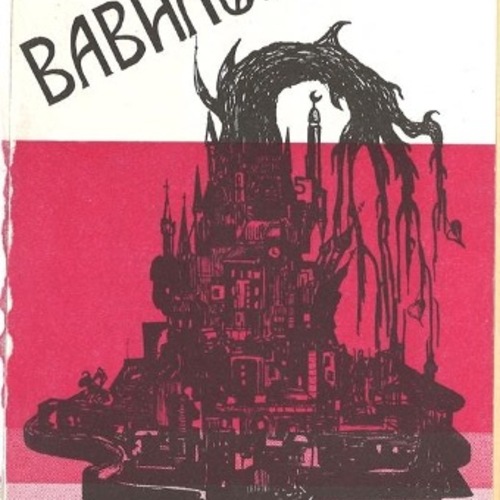
Babylon (online) Vavilon (.ru)
Vavilon, or Babylon, began as a loose group of young poets brought together by Dmitry Kuz'min in 1988. In the post-Soviet years, the group's almanac and then webside became a driving forces behind some of the most innovative poetry of the 1990s.
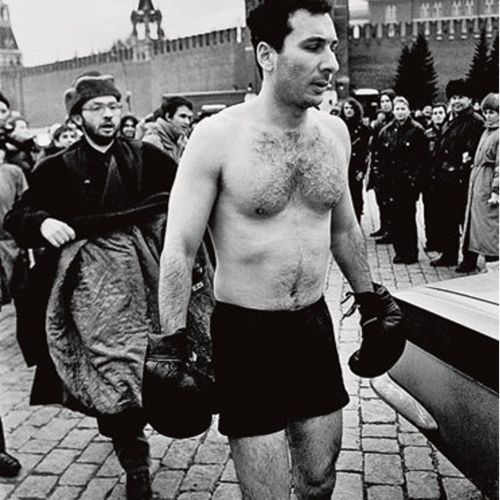
"First Glove" by Alexander Brener
Alexander Brener, "First Glove" 1995: a performance where Brener challenged Yeltsin to a fist-fight on the Red Square.
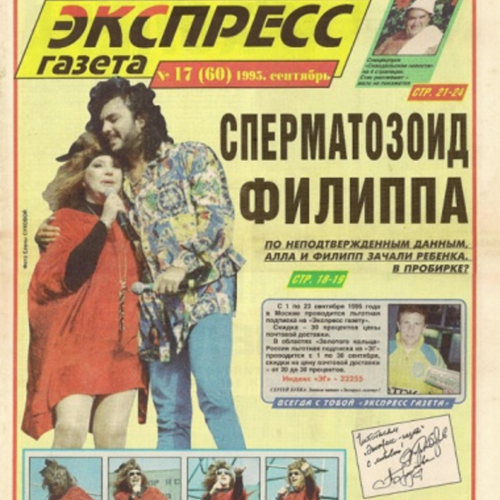
Express-Gazette Cover, Headlines: “Pugacheva is being tricky”, “Fillip’s Spermatozoid” 1998
Busy tabloid cover depicting pop stars Alla Pugacheva and Fillip Kirkorov embracing next to a headline speculating about the viability of Kirkorov's sperm.
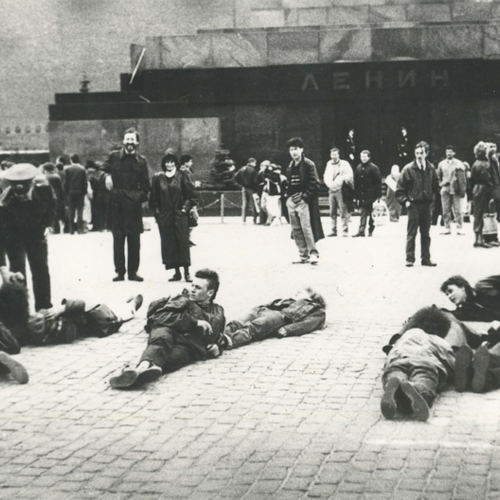
Expropriation of the Territory of Art, E.T.A--text, 1991
Image of the actionist group E.T.A. forming an obscene word out of their bodies in front of the Kremlin

The logo for the "Dendy" Entertainment Console by Ivan Maximov.
The logo of an young, anthropomorphic elephant giving the victory sign with his left hand announced Russia''s first game console, which became enormously popular between 1992 and 1996.
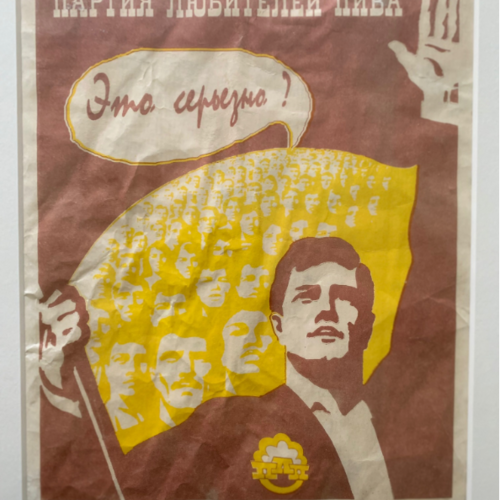
Poster of the The Beer Lovers' Party, Text: “Beer Lovers’ Party: Is this serious? This is serious!” 1995.
Poster in the style of Soviet agit-prop promoting the Beer Lovers' Party
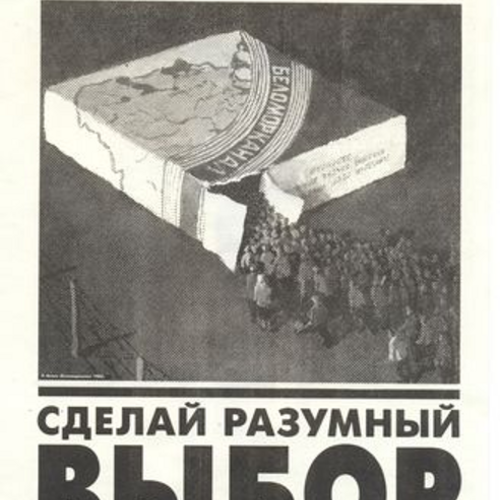
Election poster for the Democratic Choice of Russia--United Democrats 1995 campaign for the Duma.
Poster depicting a stream of people entering a giant pack of Belomor Canal cigarettes to promote the Democratic Choice of Russia--United Democrats Party.
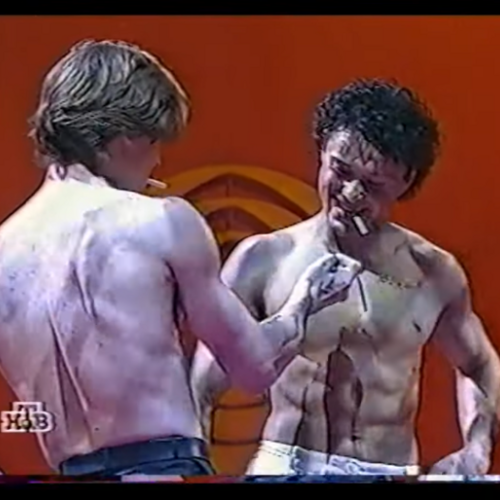
Still from the television show “About It” with host Elena Khanga, Episode “Homosexuality”, 1998
Image of two shirtless men lighting cigarettes in the course of a dance performance illustrating homosexuality
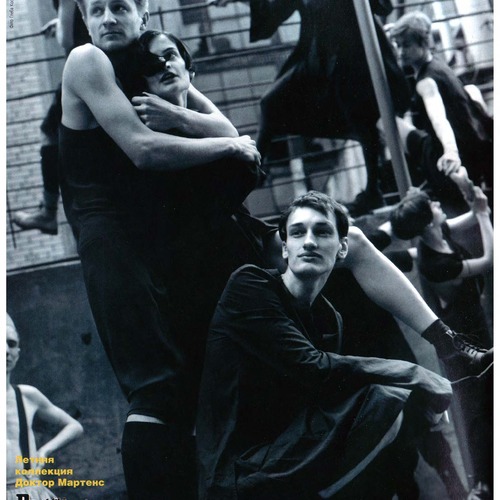
Fascist Fashion Between Counterculture and Mainstream
Images from a photo shoot from the Polushkin Brothers’ collection Fash-Fashion–alluding to both queer and fascist aesthetics–is used as an ad for the popular brand Dr. Martens in the lifestyle magazine Ptiuch and as a model for a nascent National Bolshevik countercultural aesthetics in the pages of the newly founded political newspaper Limonka.
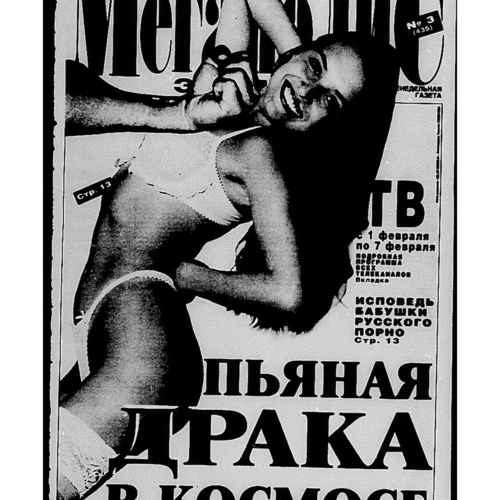
Megapolis-Ekspress: Urban Exoticism and National Pride
Igor Dudinsky takes over the magazine Megapolis-ekspress and turns it into an extreme and surreal parody of the lowest and most excessively sensationalist forms of Western tabloids.
Svetlana Baskova captures the surreal, deeply violent, and grotesque essence of the 1990s and the Chechen wars in her cult trash movie, Zelenyi slonik (The little green elephant, 1999).
An excerpt from Svetlana Baskova’s film Zelenyi slonik (The little green elephant, 1999).
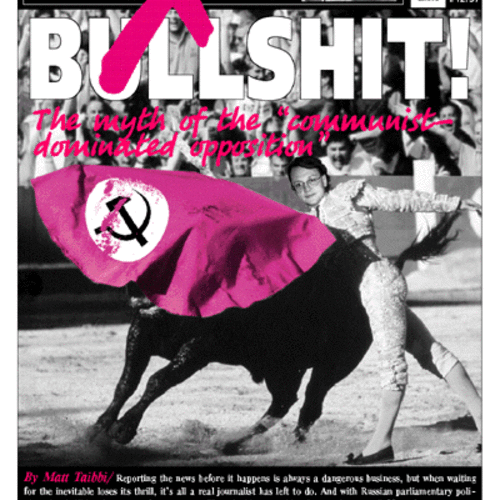
the eXile: Bespredel for Expats
A selection of articles from the English-language magazine the eXile, which combined gonzo journalism and styob and provided unique reporting on post-Soviet Russia, while at the same time fetishizing the 1990s lawlessness or bespredel and the Westerners’ exploitation of Russia (sexual and otherwise) that it itself denounced and condemned.
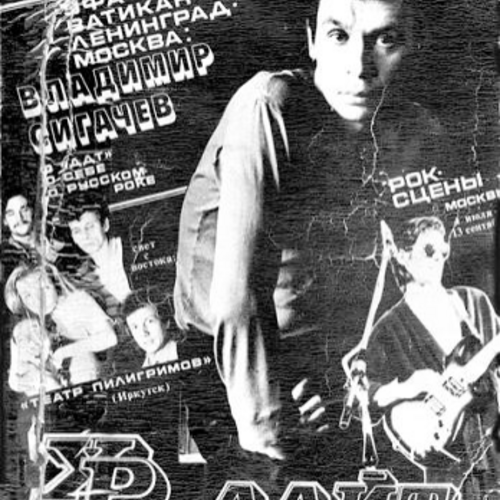
Urlait Music Journal (Samizdat) 1985-1992
Moscow's samizdat music journal, which followed in the footsteps of Lenigrad's Roksi while forging a new journalistic style. The journal positioned itself to in many ways reject the Leningrad scene. Despite Moscow-based bands generally leaning towards a more avant-garde, art-rock aesthetic, Urlait made a point to promote so-called "national rock." According to Urlait's founder I. Smirnov, bands like DDT, DK, and Oblachnyi Krai (Yuri Loza) were said to be "oriented towards national problems, in opposition to estrada and the confluence of Western and domestic cultural traditions."
Places of Interest for Gays in Moscow
An annotated map of gay locales (cafes, bars, nightclubs, saunas, and cruising areas or "pleshki" in a 1997 issue of the gay magazine Арго
Early Vzgliad parodies itself
A 1988 celebration of a year of Vzgliad, where several sketch comedy artists parody and recapitulate Vzgliad's casual, sincere, freewheeling style of television programming
Vzgliad at GKChP
Clips of Vzgliad's reports during GKChP in 1991. These include being holed up in the White House (the RSFSR parliament) alongside its defenders and celebrities, such as Mstislav Rostropovich.
Putting the "Spotlight" on an experimental three-hour line for Soviet luxury clothes
Prozhektor Perestroiki [Perestroika's Spotlight], a glasnost-era televised investigative journalism project, investigates a three-hour line for luxury clothes at the recently opened Luxe Fashion Center, where the reporters discover the problem of supply and demand in the USSR.
"Can't Live Like This": Imperial nostalgia as a post-Soviet Russian project
Tak zhit' nel'zia [Can't Live Like This], excerpt from Stanislav Govorukhin's influential documentary on the late Perestroika malaise and the way out of it
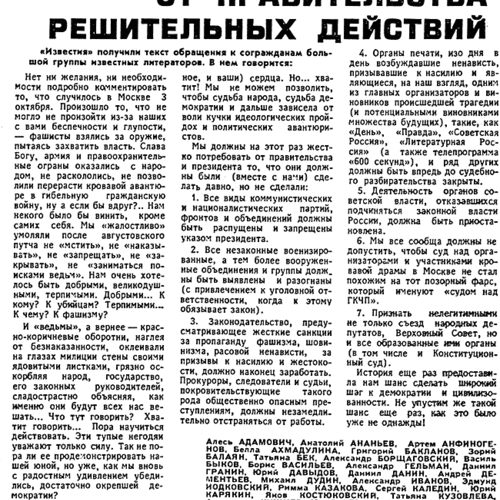
Writers demand a Yeltsin coup ("Letter of the 42")
"Pisateli trebuiut ot pravitel’stva reshitel’nykh deistvii [Writers demand decisive actions from the government].” A letter signed by prominent intelligentsia during the 1993 Parliamentary crisis, in which the liberals urge Yeltsin to use lethal force to destroy the Communist-led parliamentary opposition.
"We Are Building Communism! / We Are Building a New Russia!"
Billboard for Peresvet Trading Firm in Moscow, playing off of an existing Soviet billboard just above it
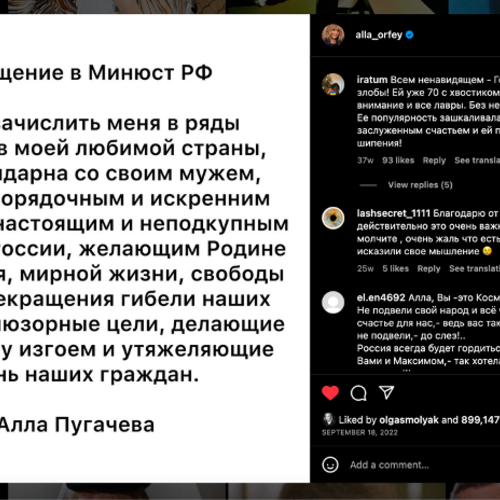
Alla Pugacheva — Post-Soviet Diva
The most famous woman in the Soviet Union transformed into a successful post-Soviet star.
Tsvetaeva and Parnok
Article on the affair between poets Marina Tsvetaeva and Sophia Parnok in LGBTQ magazine Риск
Soviet Nostalgia– Old Songs About the Most important
The most popular Soviet nostalgia project of the 1990s- "Starye pesni o glavnom [Old Songs About the Most Important"
"New Russians" at Kommersant
Series of articles from the nascent Kommersant Daily in late 1992-early 1993, assessing and explaining the nature of its target audience, the “New Russians”
Parfenov’s Namedni as memory-work in the 1990s
Namedni [Recently], Parfenov's project about recent history, was one of the most successful shows of the 1990s. Eschewing big narrative arcs, the show highlighted the past as a collection of memory sites– in this case, the origin of the New Russian in 1991.
Konstantin Ernst's "Matador"
A clip from the art show "Matador," created by VID's junior partner, Konstantin Ernst, in 1990, and then remained his project as Ernst rose up and took VID's helm. This particular clip is from the show on Contemporary Art. It has a remarkably joyously elitist feel that is consistent with the "new Russian" ethos of ViD.
A Man Who Keeps Up with the Times
A piece on David Bowie, focusing on the star’s bisexuality, in the glossy color gay magazine Мальчишник
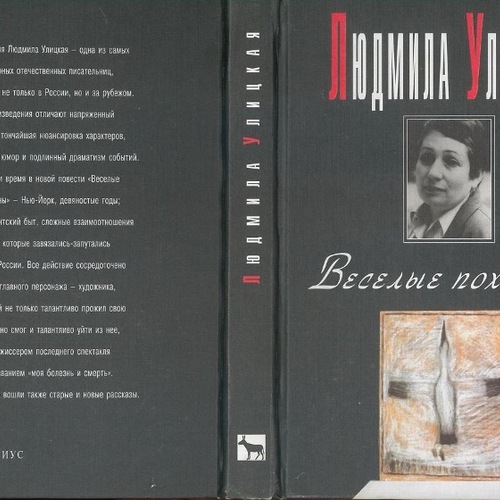
The Black Series from Vagrius
The book series “Contemporary Russian Prose” or the “Black Series,” published by Vagrius, one of post-Soviet Russia’s most successful commercial publishers, made bestsellers out of literary prose.
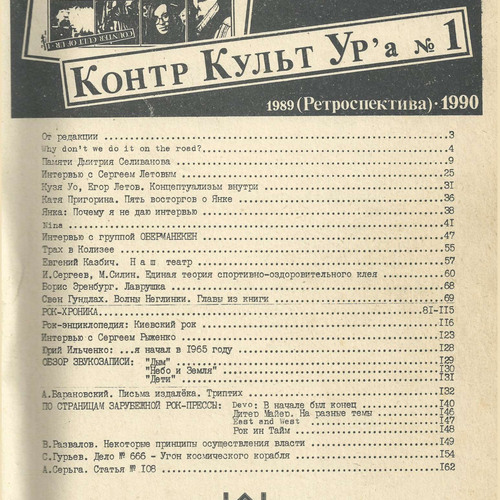
Kontr Kult Ur'a Music Journal (Samizdat) 1989-1991
Kontr Kult Ur'a was envisioned as an ideological reincarnation of Urlait, which was deemed by the new editorial board as "cult-like" and "radically positioned." The journal also was one of the first samizdat rock zines in Moscow and Leningrad to prominently feature and promote Siberian punk rock, including Egor Letov, Civil Defence, and Yanka.
Lyube "Stop Fooling Around, America!" (Ne Valiai Duraka, Amerika!) music video
Music video for the fourth track on Lyube’s second studio album Who Said We Lived Poorly? (Kto skazal, chto my plokho zhili?), which was released in 1992. Written from the perspective of the Russo-Soviet “common man,” while using folk vernacular, the song explores questions of Alaska’s historical and territorial integrity – lamenting its sale to the United States and demanding its return while celebrating Russia’s national character.
Lyube "Stop Fooling Around, America!" (Ne Valiai Duraka, Amerika!) music video
Music video for the fourth track on Lyube’s second studio album Who Said We Lived Poorly? (Kto skazal, chto my plokho zhili?), which was released in 1992. Written from the perspective of the Russo-Soviet “common man,” while using folk vernacular, the song explores questions of Alaska’s historical and territorial integrity – lamenting its sale to the United States and demanding its return while celebrating Russia’s national character.
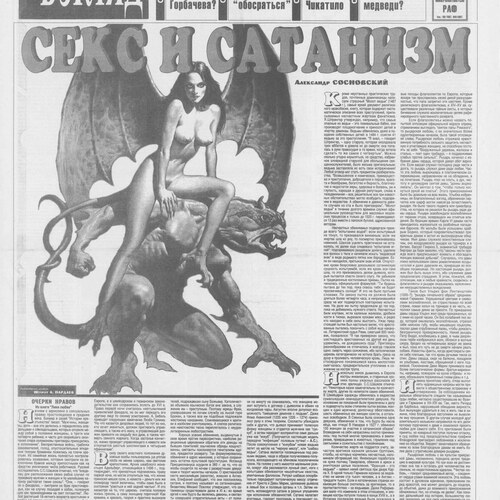
Novyi Vzgliad: Violence, Political Irony, and National Pride
Novyi Vzgliad authors write some of the most scandalous and incendiary political commentaries of the 1990s, producing new forms of political irony. Iaroslav Mogutin and Eduard Limonov turn violence into a paradoxical source of identity. The main artifact here–an article by Mogutin–exemplifies this process.
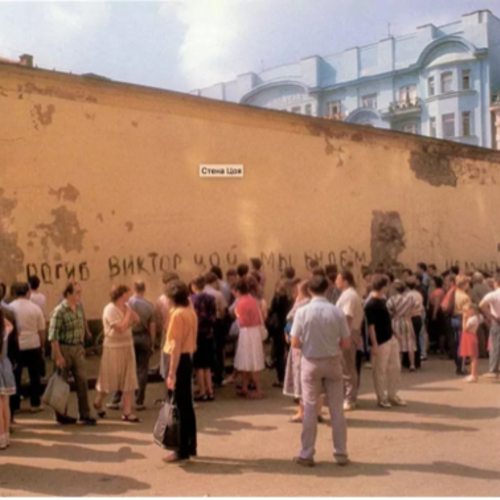
"Tsoi's Wall" on Arbat
A wall of fan graffiti dedocated to the late Soviet rock star Viktor Tsoi on Moscow's famous Arbat Street.
Transilvania is Bothering You (On Radio 101 FM)
The cult radio program Transilvania bespokoit (Transilvania is bothering you) creates an alternative musical canon and produces a new nationalist counterpublic.
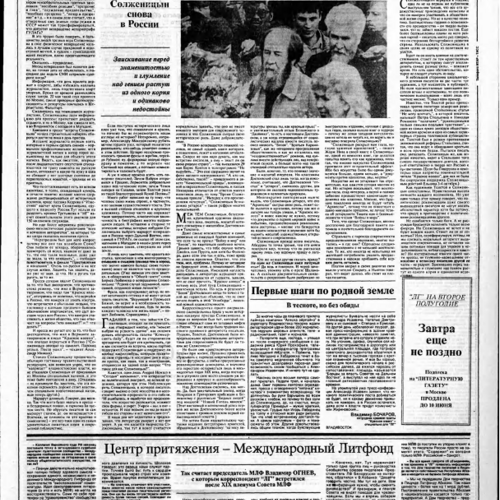
Solzhenitsyn's Return
In 1994, Alexander Solzhenitsyn staged a theatrical return to Russia, flying from America to Magadan, and then returning by train from Vladivostok to Moscow. The journey and the salvific importance Solzhenitsyn attached to it soon became the target of much derision, as well as some praise.