Alla Pugacheva — Post-Soviet Diva

Description
The most famous woman in the Soviet Union transformed into a successful post-Soviet star.
Era
Post-Soviet
Date
1997
Annotation
Among the wisest words attributed to Leonid Brezhnev was this modest self-appraisal: “I will best be remembered as a minor politician in the era of Alla Pugacheva.” He was right to think so. Pugacheva was the greatest pop star of her generation. The soundtrack to the 1977 film The Woman Who Sings (Zhenshchina, kotoraia poet, dir. Aleksandr Orlov), co-written and fully performed by Pugacheva, sold over 50 million copies in the Soviet Union that year. But Brezhnev was wrong about one thing: the era of Pugacheva far outlasted that of Brezhnev. The Soviet Union’s unchallenged queen of pop carried right on through four more General Secretaries, glasnost’, and perestroika. On the eve of the Soviet Union’s fall, she was named the very last People’s Artist of the Soviet Union before the title disappeared forever.
But Pugacheva was just getting started. The post-Soviet 1990s were just as much hers as the previous two decades. Statistically, she was post-Soviet Russia’s most important person. Public opinion polls conducted every year by VTsIOM asked respondents to rank the most important man and woman of each year. One name stands out over the post-Soviet decades: Alla Pugacheva. She monopolizes the number one spot from 1994 to 1997 and does not leave the top three for the whole decade. No one else—man or woman—comes close to this kind of dominance.
1994 was perhaps the height of her fame. Her romance, engagement, and then marriage to the up-and-coming pop star Filipp Kirkorov occupied headlines for the better part of that year. The courtship played out in hit songs (Pugacheva’s “Love that Feels Like a Dream” “Liubov’, pokhozhaia na son,” and Kirkorov’s “My Bunny” “Zaika moia”). The engagement party closed down Tverskaia Street in Moscow and the marriage was registered at the St. Petersburg office of ZAGS, with Mayor Anatolii Sobchak in attendance. But that was not all. Two months later the couple flew to Jerusalem for a traditional Russian Orthodox ceremony. It was Pugacheva’s fourth marriage and this one would last more than a decade. But it was also the moment when Pugacheva made her private life into an ongoing spectacle—with her trademark elan. Pugacheva, who had been savvy enough to maintain her prominence through several Soviet administrations, now proved herself nimble enough not only to survive, but to thrive in the new capitalist attention economy.
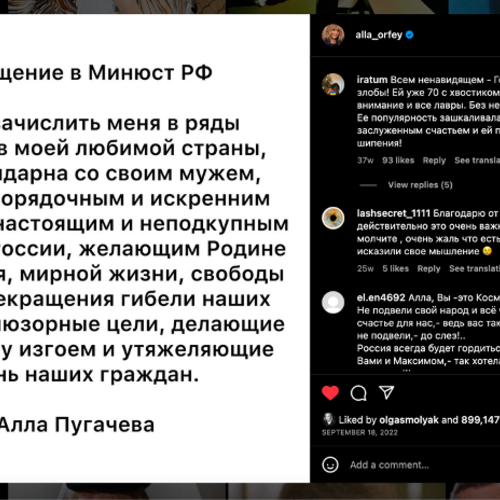
This spread, from the January 1997 issue of Ogonek, details her transformation into a post-Soviet celebrity. That year she went on to represent Russia in the Eurovision song competition in (taking 15th place with “Primadonna”) and later she won several state awards from the new Russian Federation, including the Order “For Merit to the Fatherland” bestowed by Vladimir Putin in 2014. In 2022, her next husband, the satirist Maksim Galkin was labeled a “Foreign agent” for publicly opposing Russia’s invasion of Ukraine. Pugacheva took to social media to request the same for herself.
“To the Ministry of Justice of the Russian Federation:
I ask to be counted among the ranks of foreign agents of my beloved country, for I am in solidarity with my husband, an honest, upright, and sincere person, a true and incorruptible patriot of Russia who wishes his Motherland a flourishing, peaceful existence, freedom of speech, and an end to the killing of our boys for an illusory goal that has made our country a pariah and has made life more difficult for our citizens.
Alla Pugacheva”
Geography: Place Of Origin
Moscow
Associated People
Pugacheva, Alla and Kirkorov, Filipp
Geography: Place Of Focus
St. Petersburg, Moscow , and Jerusalem
Bibliographic Reference
Vitalii Melik-Karamov and Alla Pugacheva, “Alla Pugacheva, Rozhdestvenskaia vstrecha,” Ogonek, No. 1 (4484) January 1997: cover, 12–15.
Explore Related Artifacts