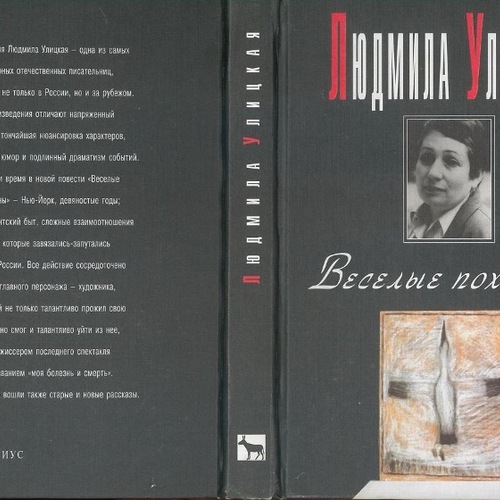
The Black Series from Vagrius
Liudmila Ulitskaia, Veselye pokhorony (Moscow: Vagrius, 1998).

Ludmila Ulitskaya’s novel The Funeral Party (Veselye pokhorony), in the Black Series by Vagrius (1998)
Source
Liudmila Ulitskaia, Veselye pokhorony (Moscow: Vagrius, 1998)
Description
The book series “Contemporary Russian Prose” or the “Black Series,” published by Vagrius, one of post-Soviet Russia’s most successful commercial publishers, made bestsellers out of literary prose.
Era
Post-Soviet
Date
1998
Annotation
Vagrius, among the most successful publishers of the 1990s, was launched in 1992 when three friends with literary backgrounds and capitalist ambitions decided to make their foray into the booming book business. The three founders, Oleg Vasiliev, Vladimir Grigoriev, and Gleb Uspenskii, combined the first syllables of their last names to form the house’s vaguely Latinate and intentionally obscure name. The press’s logo, the donkey, was a winking homage to Christ’s humble entry into Jerusalem transformed into the riches of the Vatican. As Larisa Vasilieva, wife of one of the founders, remembered years later, “I remembered an old Jewish joke: A huge crowd at the Vatican. The pope comes out in a huge luxurious limousine escorted by an entourage of motorcycles. Impressive sight. Two poor Jews are in the crowd. One says to the other, ‘And it all started with a little donkey.’ So I said, ‘Same goes for you. Start with a little donkey.’” Vasilieva’s contribution did not stop there. She was also the author of Vagrius’s first bestseller, Kremlin Wives, which spent several weeks on the Knizhnoe obozrenie bestseller lists in 1993 and 1994. Symptomatically, though, she was never counted among the founders.
In its first years, Vagrius was a respectable, but not necessarily outstanding, member of the new publishing world. But soon it became one of the major players. Its adoption and adaptation of the book series made it stand out in the mid-1990s. The book series had become a major way for publishers to stand out in a crowded marketplace, and series of romance novels, thrillers, detektivy, flooded the marketplace. Vagrius participated in these pulp fiction series with successful entries like “What is Hidden Will be Revealed” (Tainое stanovitsia iavnym) and “Women’s Handwriting” (Zhenskii pocherk). But Vagrius also innovated on the serial format to make real literature look (and sell!) like bestsellers. The series “My 20th Century” (Moi XX vek) collected memoirs by Russian and international literary and artistic figures from Lev Trotskii to Virginia Woolf under a single cover design.
But nothing was as successful in bringing high culture into the market as the series “Contemporary Russian Prose,” known simply as the “Black Series” by its distinctive covers. Beginning in 1996, Vagrius brought out almost fifty volumes of some of the best Russian (and soon international) prose of the time. The list, curated in large part by Elena Shubina, included Vladimir Makanin, Andrei Bitov, Ludmila Ulitskaya (pictured above), Ludmila Petrushevskaya, and many of the best works of Victor Pelevin. “The appearance of this series,” wrote one critic in 2000, “was revolutionary: non-commercial prose not only began to appear in well formatted editions, but also took over the market […]. For a long time, all one saw was the ‘Black Series.’”
Geography: Place Of Origin
Moscow
Associated People
Vasiliev, Oleg, Vasilieva, Larisa, Uspensky, Gleb, Makanin, Vladimir, Bitov, Andrei, Ulitskaya, Lyudmila, Pelevin, Victor, and Petrushevskaya, Lyudmila
Geography: Place Of Focus
Russia
Bibliographic Reference
Cover image from: Liudmila Ulitskaia, Veselye pokhorony (Moscow: Vagrius, 1998).
Explore Related Artifacts