Search
Thematic Tags: Capitalism
25 Results
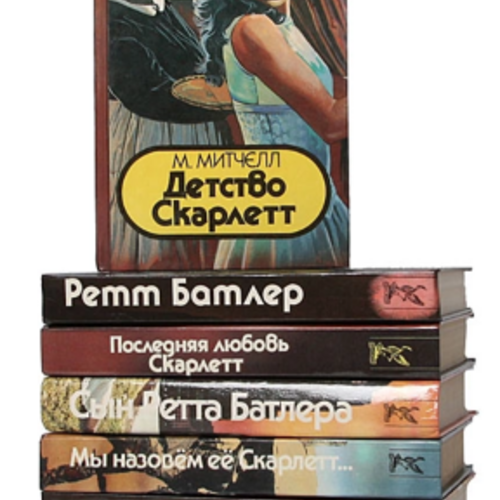
Gone with the Wind - The post-Soviet Sequels
Series of five collectively authored sequels to Margaret Mitchell's bestselling Gone with the Wind. Writing in Minsk, the anonymous authors published under the pseudonym Dzhuliia Khilpatrik and released titles like We'll Call Her Scarlett, Rhett Butler's Son, and Scarlett's Last Love.
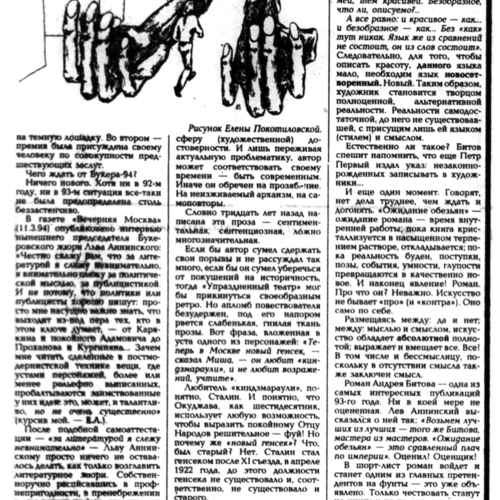
The Russian Booker - Scandals
A series of five articles scandalously decrying the new literary prize, imported from England, the Russian Booker.
"A Way Out of the Dead End"
The open letter that became known as the Letter of the 13, signed by thirteen of post-Soviet Russia’s most powerful businessmen ahead of the 1996 election, was as much as anything a manifesto of the power of capital in post-Soviet politics.
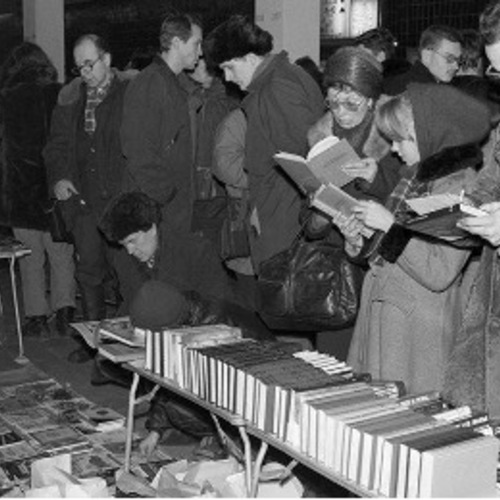
Olympic Stadium Book Market
The center of the post-Soviet book trade made its home in the corridors of the enormous stadium built for the 1980s summer games in Moscow. It was chaotic, even dangerous, and an embarrassment of riches.
Putting the "Spotlight" on an experimental three-hour line for Soviet luxury clothes
Prozhektor Perestroiki [Perestroika's Spotlight], a glasnost-era televised investigative journalism project, investigates a three-hour line for luxury clothes at the recently opened Luxe Fashion Center, where the reporters discover the problem of supply and demand in the USSR.
Soviet technical intelligentsia learns Reaganomics on the Chto? Gde? Kogda? gameshow
Chto? Gde? Kogda? [What? Where? When?], a long-running high-brow quiz show for the late Soviet technical intelligentsia, debates the economic principles of Soviet private enterprise in the heat of Perestroika’s economic reforms in 1988
Petrovich the Soviet everyman survives post-Soviet Russia at Kommersant
A collection of "Petrovich" cartoons at Russia’s ‘first business newspaper,’ Kommersant, drawn by Andrei Bil’zho. They depict a hapless and repulsive comic personage, born and raised in the Soviet era and now trying to get used to the realia of post-Soviet capitalism.
"We Are Building Communism! / We Are Building a New Russia!"
Billboard for Peresvet Trading Firm in Moscow, playing off of an existing Soviet billboard just above it
Parfenov’s Namedni as memory-work in the 1990s
Namedni [Recently], Parfenov's project about recent history, was one of the most successful shows of the 1990s. Eschewing big narrative arcs, the show highlighted the past as a collection of memory sites– in this case, the origin of the New Russian in 1991.
The post-Soviet people’s show, Pole Chudes
A clip from the most-watched entertainment show of the 1990s, "Pole Chudes [Field of Miracles],” which renders the post-Soviet narod of regular folks, engaged in a free-flowing relationship with capitalism and Russia’s central television
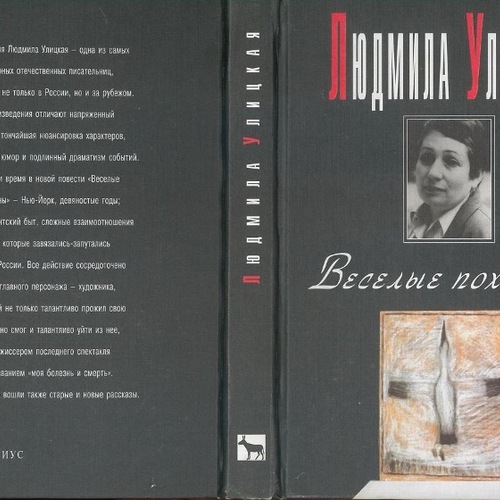
The Black Series from Vagrius
The book series “Contemporary Russian Prose” or the “Black Series,” published by Vagrius, one of post-Soviet Russia’s most successful commercial publishers, made bestsellers out of literary prose.
Interview with Victor Pelevin
After the launch of Victor Pelevin’s hit novel Generation ‘P’, the author set out on a publicity tour in which he behaved poorly, much like his protagonist. And much like his protagonist, he proved that in post-Soviet Russia, bad behavior sells.
The Raspberry blazer as the uniform of the New Russian
The origins and the meaning of the raspberry blazer as the iconic dresscode of New Russians in the early 1990s
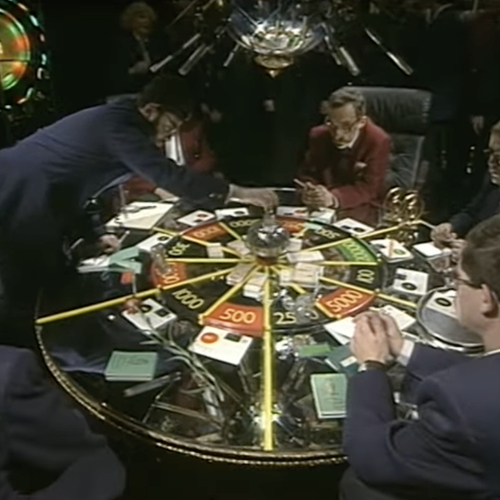
Soviet Engineers become Post-Soviet Aristocrats on TV
Chto? Gde? Kogda? (What? Where? When?) goes through an aristocratic overhaul and becomes an "intellectual casino'
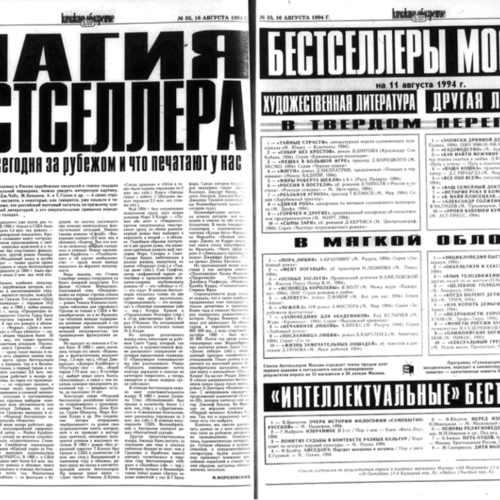
Bestsellers of Moscow
Post-Soviet Russia's first bestseller lists, compiled by the weekly industry newspaper Knizhnoe obozrenie and published from late 1993 through 1998.
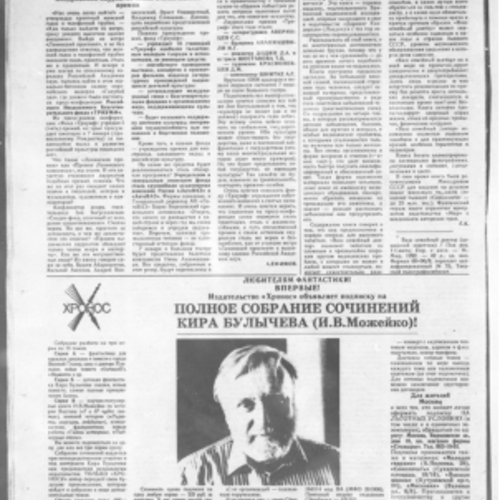
The Triumph Prize
Launched at the same time as the Russian Booker and funded by the newly minted oligarch Boris Berezovsky, the Triumph Prize promised an even broader program of cultural guardianship and philanthropy.
The Making of an Anti-Bourgeois Hero
Excerpt from an early episode (the second) of a new version of the popular talk show Vzgliad, co-hosted by Aleksandr Liubimov and Sergey Bodrov Jr., which aired weekly on the TV channel ORT in 1996-1999.
The World Made of Plastic Has Won
Egor Letov performs his song “Moia oborona” (My defense), during his “concert in the hero city Leningrad,” part of Grazhdanskaia oborona’s 1994 tour Russkii proryv (Russian breakthrough).
Let's Go To War!
The model, writer, singer, and TV personality Natalia Medvedeva (Limonov’s third wife) performs her song “Poedem na voinu!” (Let’s go to war!), a countercultural hymn romanticizing war, violence, and rebellion.
"Stalin, Beria, Gulag!": the Natsboly Go Against Gaidar and Mikhalkov
Two of the early direct actions organized by the young members of the NBP that combined self-martyrdom and totalitarian styob.
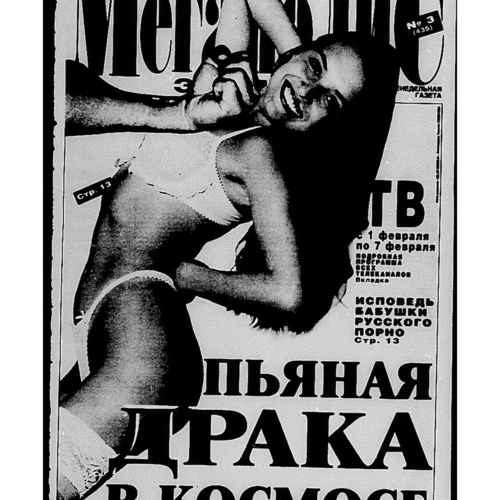
Megapolis-Ekspress: Urban Exoticism and National Pride
Igor Dudinsky takes over the magazine Megapolis-ekspress and turns it into an extreme and surreal parody of the lowest and most excessively sensationalist forms of Western tabloids.
Transilvania is Bothering You (On Radio 101 FM)
The cult radio program Transilvania bespokoit (Transilvania is bothering you) creates an alternative musical canon and produces a new nationalist counterpublic.
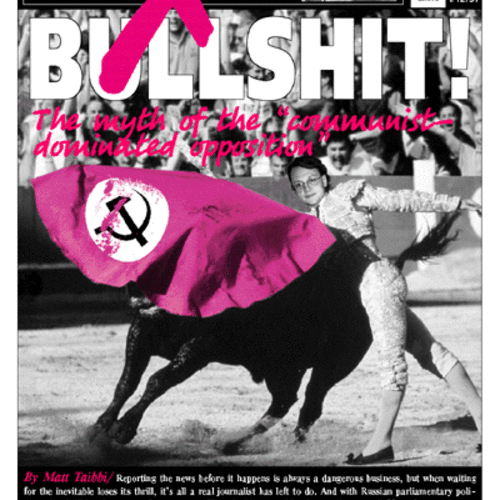
the eXile: Bespredel for Expats
A selection of articles from the English-language magazine the eXile, which combined gonzo journalism and styob and provided unique reporting on post-Soviet Russia, while at the same time fetishizing the 1990s lawlessness or bespredel and the Westerners’ exploitation of Russia (sexual and otherwise) that it itself denounced and condemned.
Stalin, Beria, Gulag: Natsboly against Gaidar and Mikhalkov
Two of the early direct actions organized by the young members of the NBP that combined self-martyrdom and totalitarian styob.
List'ev's Russian Liberals on "Chas Pik"
An excerpt from a compilation of most memorable moments with Vladislav LIst'ev and his Russian liberal guests on "Chas Pik," aired in the week after his murder