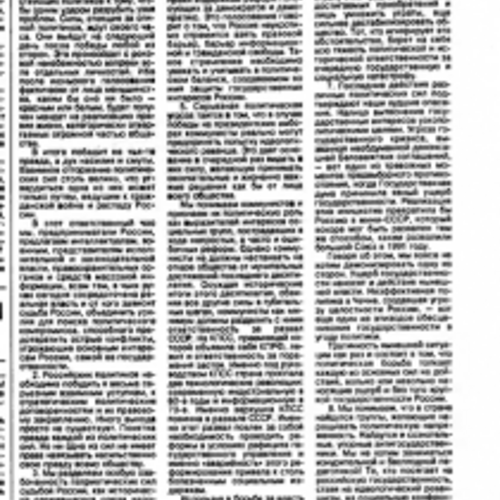
"A Way Out of the Dead End"
“Vyiti iz tupika!” Nezavisimaia gazeta, 27 Apr 1996.

Source
“Vyiti iz tupika!” Nezavisimaia gazeta, 27 Apr 1996.
Description
The open letter that became known as the Letter of the 13, signed by thirteen of post-Soviet Russia’s most powerful businessmen ahead of the 1996 election, was as much as anything a manifesto of the power of capital in post-Soviet politics.
Era
Post-Soviet
Date
1996
Annotation
Ahead of the 1996 presidential election, the very richest of Russia’s rising businessmen—not yet known as oligarchs—got together to assert the power of capital over the political process. In an open letter published in two of the biggest papers, Nezavisimaia gazeta and Argumenty i fakty, thirteen of the most successful “entrepreneurs” suggested that the only way out of the country’s impending political crisis was a compromise with capital. The letter was addressed to both President Yeltsin and his most serious contender, Communist Party leader Gennady Ziuganov, and held out plenty of criticism for both. The Communist Party of the Soviet Union, “of which the Communist Party of the Russian Federation is the successor,” wrote the capitalists, holds all responsibility for the failures of the late-Soviet era and the humiliations of the fall. But the reforms undertaken by Yeltsin’s government were “difficult and often mistaken.”
Though the document that became known as “The Letter of the 13” took no clear side in the presidential election, what it clearly stated was that no Russian leader could possibly rule without the support of big the new tycoons. “Dear Presidents! Without us neither you, Mr. Yeltsin, nor you, Mr. Ziuganov, will have a controlling stake in power. The time has come to decide whether you’ve come to terms with our power.” The term “controlling stake” (kontrol’nyi paket, in the original, meaning 51% of a joint stock company) imported the terminology of capitalism directly into the political sphere. Nevertheless, the letter’s central value was not capitalism, but so called “gosudarstvennost’,” or “statehood.” The entrepreneurs called specifically for a strong state, but one that would be aligned with (if not run by) its business interests. The letter ended on a threat that brought state sovereignty and mobster capitalism into almost prescient alliance:
We understand that in the country there can be found groups that want to cultivate political tensions. There can be found conscientious, stubborn anti-statists. We do not want to undertake exhaustive and fruitless pedagogy! Those who would threaten Russian statehood, insisting on ideological revanchism, on social confrontation, must understand that responsible entrepreneurs have the necessary resources and the will to take action against both unprincipled and uncompromising politicians.
Russia must enter the 21st century as a thriving, great nation. That is our debt to our ancestors and to our descendants.
The document has been seen as the first declaration of the political power of capital, the document that changed businessmen into oligarchs. Indeed, in the months that followed, Yeltsin came to terms with the seven bankers, many of whom signed this letter, and whose power became known as the “semibankirshchina” or the “rule of the seven bankers.”
But it was perhaps after Yeltsin ceded power to his chosen successor that the desires expressed in this letter found their fullest realization. Though several of the signatories found themselves stripped of their holdings, exiled, in prison, or dead, as a direct result of Putin’s rise to power, “The regime of Vladimir Putin,” as Dmitry Butrin put it in Kommersant” Vlast’ ten years later, “is a precise incarnation of the ideological construction that the authors the ‘Letter of the 13’ considered in April, 1996.” What the signatories wanted, “was the recognition of the primacy of state power and statehood in Russia.” Reading the letter in the Putin era, Butrin wrote, one can feel “a clear nostalgia for the near future.”
Associated People
Yeltsin, Boris, Zyuganov, Gennady, Boris Berezovskii, Gusinsky, Vladimir, Potanin, Vladimir, Fridman, Mikhail , and Khodorkovsky, Mikhail
Geography: Place Of Focus
Russia
Bibliographic Reference
“Vyiti iz tupika!” Nezavisimaia gazeta, 27 Apr 1996.
Explore Related Artifacts