Search
Thematic Tags: Nationalism
24 Results
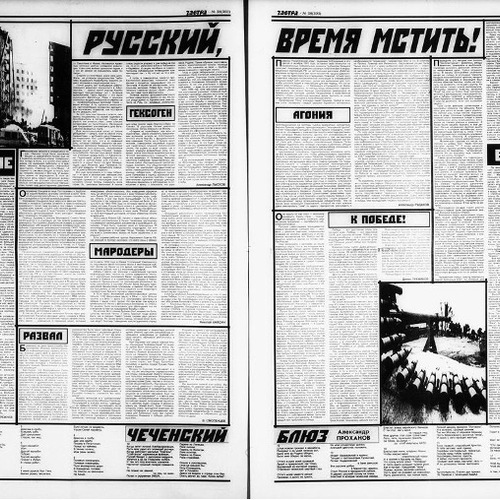
"Russian, It's Time For Revenge!"
In the weeks leading up to the Second Chechen War, Russia’s right wing publications reminded their audiences of the humiliation of the First Chechen War, and called for—nationalist, racist, brutal—revenge.
Shevchuk (DDT) in Chechnya
Excerpt from Vremia DDT, a 2002 documentary centered on DDT, one of Russia’s most famous rock bands throughout the 1990s and later. A montage of amateur film made by the group leader and frontman, Yuri Shevchuk during his visit to Russian frontlines during the First Chechen War in 1995-1996, overlaid by the song, “Patsany [The guys],” inspired by what Shevchuk saw there.
Lyube performing "Atas" during a televised concert on January 1, 1990
The rock band, which Vladimir Putin would later count as among his "favorites," performing on late-Soviet television on the cusp of rock stardom.
Lyube "Stop Fooling Around, America!" (Ne Valiai Duraka, Amerika!) music video
Music video for the fourth track on Lyube’s second studio album Who Said We Lived Poorly? (Kto skazal, chto my plokho zhili?), which was released in 1992. Written from the perspective of the Russo-Soviet “common man,” while using folk vernacular, the song explores questions of Alaska’s historical and territorial integrity – lamenting its sale to the United States and demanding its return while celebrating Russia’s national character.
Lyube "Stop Fooling Around, America!" (Ne Valiai Duraka, Amerika!) music video
Music video for the fourth track on Lyube’s second studio album Who Said We Lived Poorly? (Kto skazal, chto my plokho zhili?), which was released in 1992. Written from the perspective of the Russo-Soviet “common man,” while using folk vernacular, the song explores questions of Alaska’s historical and territorial integrity – lamenting its sale to the United States and demanding its return while celebrating Russia’s national character.
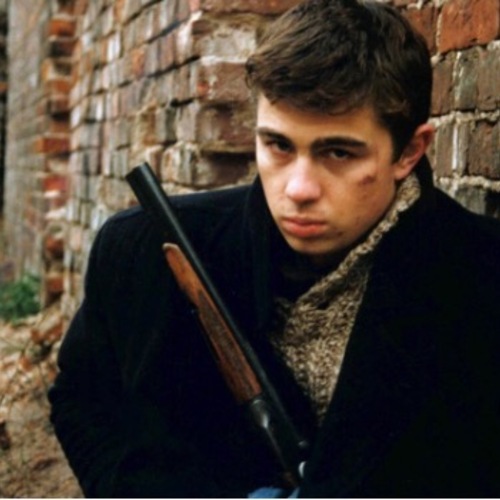
Brother. Motion Picture. Dir. Aleksei Balabanov (Excerpts)
Aleksei Balabanov's cult crime drama, which made its title character, the loveable killer Danila Bagrov into a youth idol and a national emblem of post-Soviet masculinity
Brother 2. Motion Picture. Dir. Aleksei Balabanov (Excerpts)
A sequel of the original Brother, which is partially set in the United States, where national hero Danila Bagrov avenges his friend's death, while reflecting Russo-American cultural differences
Interview with Sergei Bodrov Jr. (1997) (selections)
Interview with actor Sergei Bodrov Jr., who famously played the loveable gangster Danila Bagrov in Aleksei Balabanov’s films Brother and Brother 2, becoming a post-Soviet cultural icon.
A Conservative Revolutionary Avant-Garde
“The New against the Old,” a programmatic article by Aleksandr Dugin from the first issue of Limonka, the official newspaper of Eduard Limonov’s National Bolshevik Party (NBP), radical political organization/countercultural movement.
An Armed Paradise
An article by Aleksey Tsvetkov, anarchist writer and associate director of Limonka who temporarily turned the newspaper to a postmodern art project of sorts.
“Rise, you cursed people!”: The Aesthetics of Limonka
A cover of Limonka from 1997 displaying a collage by Aleksandr Lebedev-Frontov.
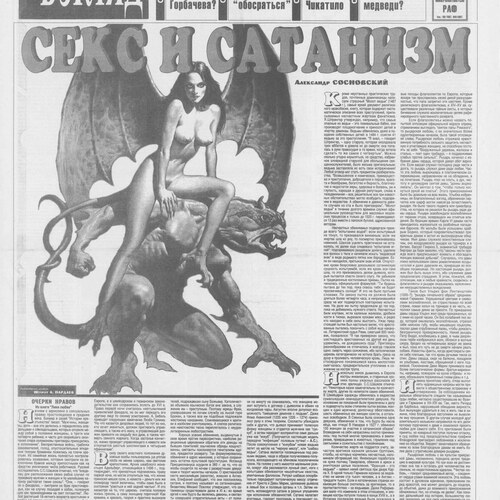
Novyi Vzgliad: Violence, Political Irony, and National Pride
Novyi Vzgliad authors write some of the most scandalous and incendiary political commentaries of the 1990s, producing new forms of political irony. Iaroslav Mogutin and Eduard Limonov turn violence into a paradoxical source of identity. The main artifact here–an article by Mogutin–exemplifies this process.
"What is Concealed Will Be Revealed." Kuryokhin's and Dugin's Post-Ironic Political Campaign in Saint Petersburg
An episode from Dugin's political campaign in Saint Petersburg, in which Sergey Kuryokhin and Aleksandr Dugin make fun of liberal democracy (and Yeltsin’s referendum) on Russian TV.
Limonov Becomes a Post-Soviet Nationalist Rock Star
During an “encounter” with the émigré writer Eduard Limonov broadcasted from the concert hall in the Ostankino TV studios in Moscow (a common genre during perestroika), a young neformal in the audience suggests to create a subculture made up of young “limonovians.”
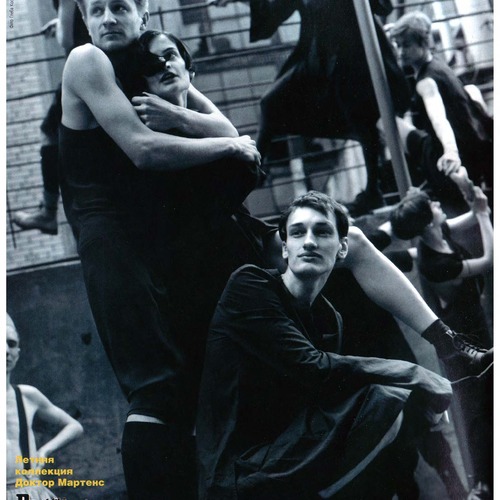
Fascist Fashion Between Counterculture and Mainstream
Images from a photo shoot from the Polushkin Brothers’ collection Fash-Fashion–alluding to both queer and fascist aesthetics–is used as an ad for the popular brand Dr. Martens in the lifestyle magazine Ptiuch and as a model for a nascent National Bolshevik countercultural aesthetics in the pages of the newly founded political newspaper Limonka.
"The Mysteries of the Century": Post-Truth and Mystical Nazism on Russian TV
An episode from the TV program “Tainy veka” (The mysteries of the century), hosted by Iurii Vorobevskii and Aleksandr Dugin. One of the first examples of post-truth on Russian television.
The World Made of Plastic Has Won
Egor Letov performs his song “Moia oborona” (My defense), during his “concert in the hero city Leningrad,” part of Grazhdanskaia oborona’s 1994 tour Russkii proryv (Russian breakthrough).
Let's Go To War!
The model, writer, singer, and TV personality Natalia Medvedeva (Limonov’s third wife) performs her song “Poedem na voinu!” (Let’s go to war!), a countercultural hymn romanticizing war, violence, and rebellion.
"Stalin, Beria, Gulag!": the Natsboly Go Against Gaidar and Mikhalkov
Two of the early direct actions organized by the young members of the NBP that combined self-martyrdom and totalitarian styob.
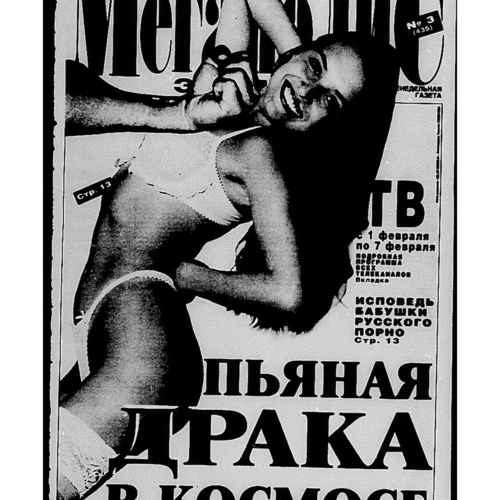
Megapolis-Ekspress: Urban Exoticism and National Pride
Igor Dudinsky takes over the magazine Megapolis-ekspress and turns it into an extreme and surreal parody of the lowest and most excessively sensationalist forms of Western tabloids.
Transilvania is Bothering You (On Radio 101 FM)
The cult radio program Transilvania bespokoit (Transilvania is bothering you) creates an alternative musical canon and produces a new nationalist counterpublic.
Stalin, Beria, Gulag: Natsboly against Gaidar and Mikhalkov
Two of the early direct actions organized by the young members of the NBP that combined self-martyrdom and totalitarian styob.
"Our boys" fight against "fascist" Baltic independence
"Nashi [Our Boys]"- Alexander Nevzorov's propagandistic documentary of the Latvian and Lithuanian Soviet OMON, fighting off the local independence movement in early 1991
Ernst’s “Russian Project” as cultural therapy for the post-Soviet Russian masses
Konstantin Ernst’s series of social advertisements extolling Russia’s shared values and national identity at a time of seeming social crisis in the mid-1990s