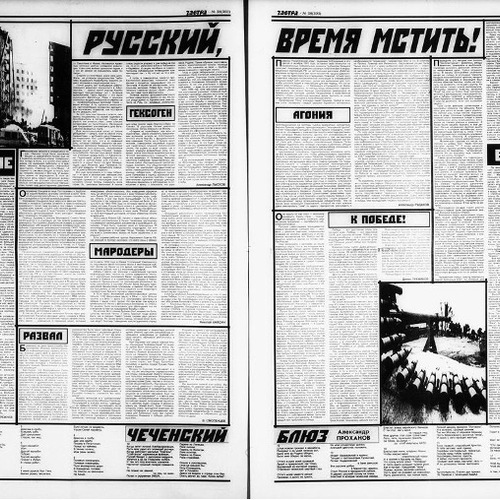
"Russian, It's Time For Revenge!"

“Russian, It’s Time for Revenge!” Zavtra, No. 38 (303), October 1999: 2–3.
Description
In the weeks leading up to the Second Chechen War, Russia’s right wing publications reminded their audiences of the humiliation of the First Chechen War, and called for—nationalist, racist, brutal—revenge.
Era
Post-Soviet
Date
1999
Annotation
The Moscow Peace Treaty signed 12 May 1997 by presidents Boris Yeltsin and Aslan Maskhadov marked the resolution of the First Chechen War. It promised to build bilateral relations “on the generally recognized principles and norms of international law” with the Chechen Republic of Ichkeria. But it left the central issue of Chechen independence unresolved. Though Maskhadov hailed the treaty as an historic victory and Yeltsin sold it at home as the end of a centuries-long conflict, it lasted hardly two years. In August 1999 Chechen forces under Shamil Basayev invaded Dagestan and declared holy war.
The Russian nationalist right all but foamed at the mouth. Many had seen the First Chechen War as a humiliating defeat not only of the once-great Russian Army by a small insurgent force, but also of the (white, Christian) Russian people at the hands of a non-white, Muslim nation. Far-right publications such as Zavtra (Tomorrow) filled their pages with broadsides against the weak Yeltsin administration, racist attacks against the Chechens, and calls for revenge. This spread, titled “Russian, It’s Time For Revenge!” collates many of the paper’s frequent drumbeats into an aesthetically and narratively balanced tableau. Beginning with “Burial” in black on the left, three stories tell of “Hexogen,” “Marauders,” and “Dissolution.” The facing page dips into the depths of despair (“Agony”) before calling the reader “To Victory” and “Vengeance.” The image on the upper left shows one of the recently bombed apartment buildings, attacked with an explosive made from hexogen, while in the bottom right, Russian shells aim at Chechen targets. The entire spread is undergirded by a poem by the extremist, poet, novelist, and editor of Zavtra, Aleksandr Prokhanov entitled “Chechen Blues,” which includes both violent images of brutality against Chechens as well as the following image, which the author does not explicitly connect to the Chechen war:
Играет Березовский в казино,
Танцует с кастаньетами Гусинский,
Потеет Ходарковский
в бане финской,
Все русское добро
в Манхаттен свезено.
Стоит Россия в продранной рубахе,
И держит русский голову на плахе.
Блистает в воздухе чеченская секира,
Блестит алмаз еврейского банкира.
С тех пор, как у меня
на сердце лед,
Мне другом стал один гранатомет.
Лети, лети, печальная граната,
За Терек, за Дунай —
до штаб-квартиры НАТО.
Berezovskii gambles in the casino,
Gusinskii dances with castanets,
Khodarkovskii sweats
in a Finnish sauna,
All that is good in Russia
has been taken to Manhattan.
Russia stands in a ripped shirt,
And the Russian lays his head on the chopping block.
The Chechen battleaxe glistens in the air,
The diamond of a Jewish banker sparkles.
Ever since I’ve had
ice in my heart,
My only friend has been a grenade launcher.
Fly, fly, melancholy grenade,
Over the Terek, beyond the Dunai—
to the headquarters of NATO.
Transcript
Играет Березовский в казино,
Танцует с кастаньетами Гусинский,
Потеет Ходарковский
в бане финской,
Все русское добро
в Манхаттен свезено.
Стоит Россия в продранной рубахе,
И держит русский голову на плахе.
Блистает в воздухе чеченская секира,
Блестит алмаз еврейского банкира.
С тех пор, как у меня
на сердце лед,
Мне другом стал один гранатомет.
Лети, лети, печальная граната,
За Терек, за Дунай —
до штаб-квартиры НАТО.
Translated Transcript
Berezovskii gambles in the casino,
Gusinskii dances with castanets,
Khodarkovskii sweats
in a Finnish sauna,
All that is good in Russia
has been taken to Manhattan.
Russia stands in a ripped shirt,
And the Russian lays his head on the chopping block.
The Chechen battleaxe glistens in the air,
The diamond of a Jewish banker sparkles.
Ever since I’ve had
ice in my heart,
My only friend has been a grenade launcher.
Fly, fly, melancholy grenade,
Over the Terek, beyond the Dunai—
to the headquarters of NATO.
Associated People
Prokhanov, Aleksandr
Geography: Place Of Focus
Chechnya and Russia
Bibliographic Reference
“Russian, It’s Time for Revenge!” Zavtra, No. 38 (303), October 1999: 2–3.
Explore Related Artifacts