Artifacts
1988
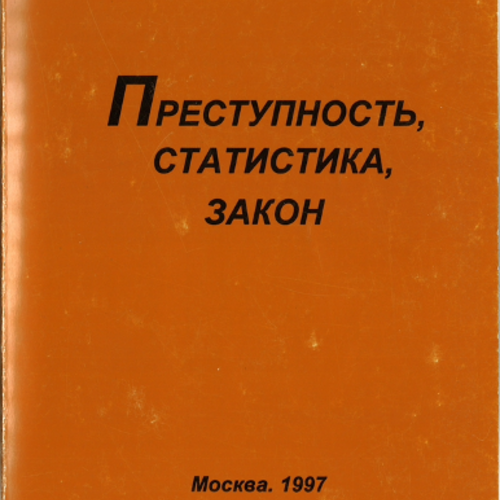
Russian Crime Statistics, 1980–1996
Nothing characterized the everyday experience of the urban Russian 1990s like crime; as shown in this first comprehensive statistical study of the 1990s, crime was just as bad as everyone had known. But the numbers also reveal some unexpected trends.
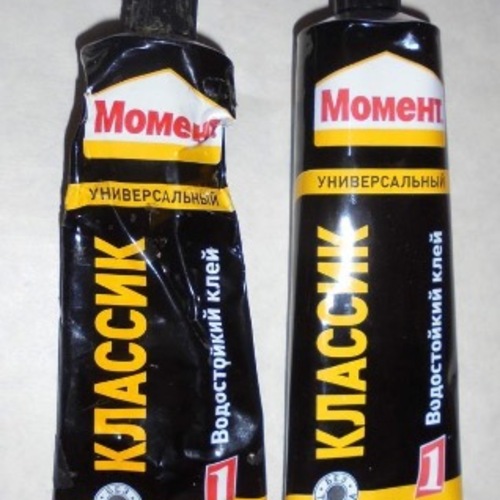
Klei-Moment
Made by the German Henkel company, Moment glue was a staple of post-Soviet hobbyists. It also became one of the prefered drugs among the post-Soviet youth. The brand name became synonymous with huffing itself.
Early Vzgliad parodies itself
A 1988 celebration of a year of Vzgliad, where several sketch comedy artists parody and recapitulate Vzgliad's casual, sincere, freewheeling style of television programming
Putting the "Spotlight" on an experimental three-hour line for Soviet luxury clothes
Prozhektor Perestroiki [Perestroika's Spotlight], a glasnost-era televised investigative journalism project, investigates a three-hour line for luxury clothes at the recently opened Luxe Fashion Center, where the reporters discover the problem of supply and demand in the USSR.
Soviet technical intelligentsia learns Reaganomics on the Chto? Gde? Kogda? gameshow
Chto? Gde? Kogda? [What? Where? When?], a long-running high-brow quiz show for the late Soviet technical intelligentsia, debates the economic principles of Soviet private enterprise in the heat of Perestroika’s economic reforms in 1988
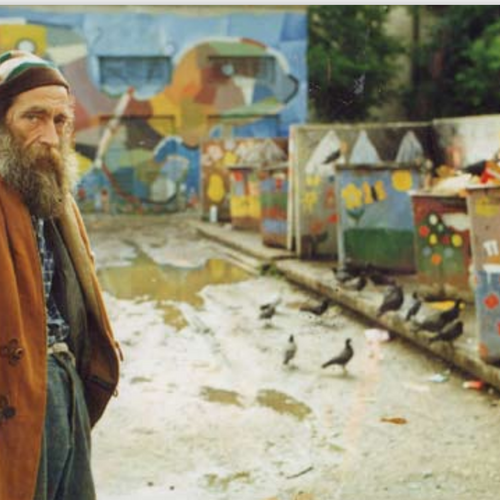
The Collective Society “Kartinnik”[”Picture-man”] with B.U.Kashkin in front of painted Ural Electro-Technical Institute rubbish pins. 1993.
The bearded B.U.Kashkin stands in front of a set of trashbins which have been painted with bright, colorful scenes of trees, butterflies and flowers. Pigeons are digging through the garbage and mud apparent throughout the site.
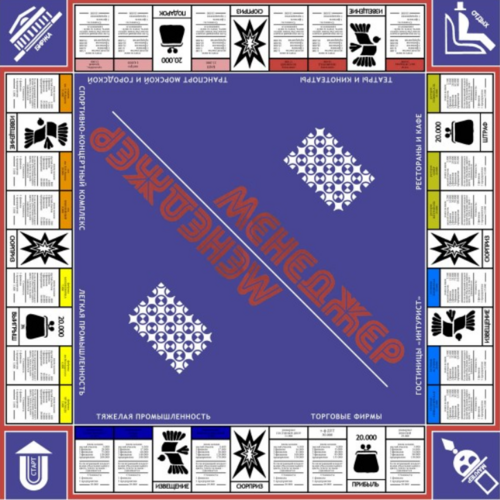
Manager Board Game 1st edition
A square, indigo board game similar to Monopoly, but reading "Manager". Manager, which became the most successful Monopoly-like made in the former Soviet Union, initially presented itself as scientific and rational in its promise of capitalist success.
“Dictatorship of Conscience”
Play by Mikhail Shatrov that opened at the Lenin Komsomol Theather in Moscow, Feb. 1986
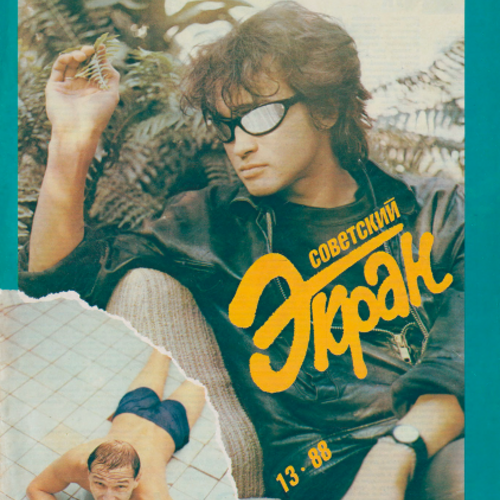
Sovetskii Ekran with Tsoi on cover
The cover image from volume 13 (1988) depicts Viktor Tsoi of Kino and Petr Mamonov of the Moscow-based rockband Zvuki Mu. Both artists appeared in Rashid Nugmanov 1988 film The Needle (Igla, 1988), which cemented Tsoi’s rock stardom and firmly established
Mamonov as a serious actor. He went on to star in Pavel Lungin’s drama Taxi Blues (Taksi Bliuz, 1990), which was released to international acclaim and became one of the classic examples of the perestroika-era chernukha aesthetic.
Perestroika Women Speak to US Women
A clip from one of many Perestroika-era televised conversations between American and Soviet "regular people," in which they find common ground with the help of long-time Soviet propagandist and future star of liberal post-Soviet TV, Vladimir Pozner
Interview with Viktor Tsoi and Natalia Razlogova. Conducted by Sergei Sholokhov at the Golden Duke Film Festival in Odessa, 1988
This eight-minute interview, which took place on a cruise ship chartered for Odessa’s Golden Duke Film Festival in September 1988, depicts rock musician Viktor Tsoi and film critic Natalia Razlogova speaking to a journalist about the insurmountable generational tensions that inhabit the Soviet film industry. Tsoi was attending the festival to promote the film The Needle, where he played the lead role. The interview is significant highlighting the aesthetic and ideological crisis of the Soviet film industry in the last Soviet decade.
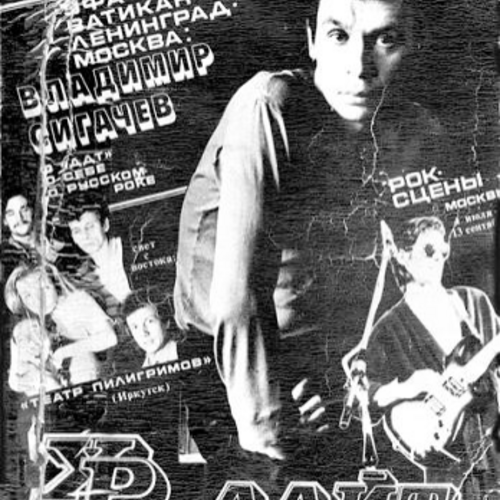
Urlait Music Journal (Samizdat) 1985-1992
Moscow's samizdat music journal, which followed in the footsteps of Lenigrad's Roksi while forging a new journalistic style. The journal positioned itself to in many ways reject the Leningrad scene. Despite Moscow-based bands generally leaning towards a more avant-garde, art-rock aesthetic, Urlait made a point to promote so-called "national rock." According to Urlait's founder I. Smirnov, bands like DDT, DK, and Oblachnyi Krai (Yuri Loza) were said to be "oriented towards national problems, in opposition to estrada and the confluence of Western and domestic cultural traditions."
Tusovka Music Journal (Samizdat)
A central zine of the Siberian underground music community. One of Tusovka's central feats was duping the KGB into allowing the continuation of its publication and dissemination. Before the first issue went to print, the journal's founder Valerii Murzin took the bold step of delivering the pre-print manuscript of the journal to his local KGB office, in this way guaranteeing the publication's survival.
Nautilus Pompilius performing "Last Letter" (Poslednee Pis'mo: Gudbai Amerika)
A televised performance of Nautilus Pomplius's cult song lamenting the frustrated hopes of Perestroika-era Westernization, which was further popularized by its prominent position in Aleksei Balabanov's popular gangster drama Brother 2 (2000), inscribing it into the post-Soviet cultural and cinematic discourse as a sort of antidote to Viktor Tsoi's "Changes!" at the end of S. Solov'ev's ASSA.
Band Survey from the Leningrad Rock Club completed by Sergei Kuryokhin of Pop Mekhanika
An official rock club survey in which Sergei Kuryokhin utlilizes the late-Soviet aesthetic of stiob and performative socialism to underscore the club's dependence on the KGB
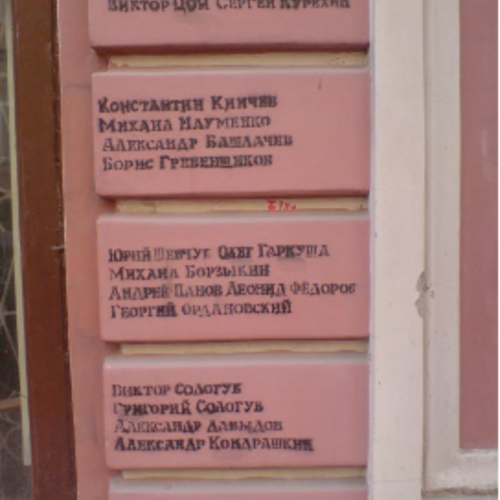
Leningrad Rock Club
A wall of graffiti in the courtyard of the Leningrad Rock Club (1981-1991) on 13 Rubinshteyna Street in Leningrad (St. Petersburg), which featured fan street art dedicated to USSR's most revered rock-music collectives. When the wall was painted over in 2010 by the bulding's new proprietor, this caused a public outcry from both rock fans and the many surviving musicians from that era, who sought to preserve the LRC's legacy and designmate the wall and the building a historical landmark.
The World Made of Plastic Has Won
Egor Letov performs his song “Moia oborona” (My defense), during his “concert in the hero city Leningrad,” part of Grazhdanskaia oborona’s 1994 tour Russkii proryv (Russian breakthrough).
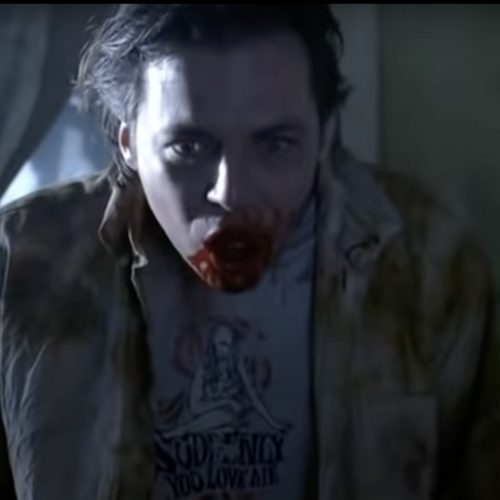
Mumiy Troll's Breakthrough “Utekai” (Take Off) Becomes the Song of the Year 1997
Video and lyrics of Mumiy Troll’s 1997 breakthrough song “Utekai” (Beat it) displaying the combination of surrealism, dark humor, and provincial romanticism that comes to shape the band’s trademark style.