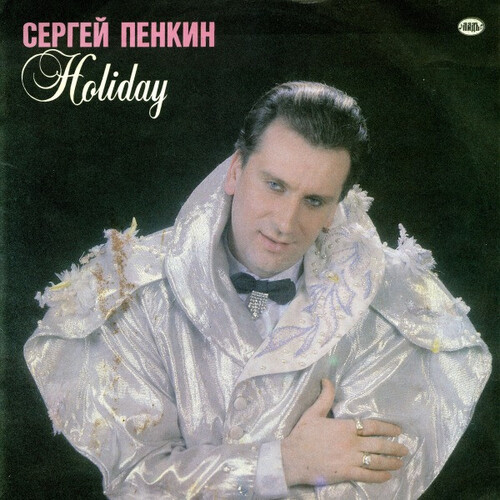
Sergei Penkin: "Holiday" Album Cover

Source
Image downloaded from the internet.
Description
Cover art for an album by pop-music artist Sergei Penkin.
Date
1991
Annotation
The cover image for Sergei Penkin’s 1991 album Holiday features a photograph of the pop-music star draped in an outsize lamé garment adorned with feathers and pearls. At least at that time in Russia such wardrobe signaled a distinctly feminine glamor. Hanging under Penkin’s more conventionally gender-appropriate black bowtie is a sparkling diamond or faux-diamond brooch. In the early 1990s Penkin was a very popular entertainer with a large national audience. He passed off what to many contemporary Russians read as a distinctly gender-transgressive, gay-camp or even almost drag presentation as merely an aspect of a boundary-pushing performative persona that was in no way representative of the personality (or sexuality or gender expression) of that persona’s author (Penkin himself). Penkin suggested that this was an exercise of the transgressive license afforded to performing artists, and while indulging these sensibilities he vigilantly guarded his presumptive heterosexuality (in her book Queer in Russia: A Story of Sex, Self, and the Other the sociologist Laurie Essig reported that Penkin was a fixture at gay nightclubs in Moscow in the 1990s). In the early 1990s Penkin sued some journalists for suggesting he was gay. It is possible that Penkin to some extent looked to Western models such as Liberace, the American pianist-showman famous for his outrageous flamboyance and his extravagant, bejeweled, fur and feather-lined accoutrements, who also insisted on a presumptive heterosexuality and sued journalists who suggested he was gay (it was ultimately revealed that he was in fact gay after his death from AIDS in 1987), and Boy George, the British pop star of the 1980s and 1990s whose on-stage persona was emphatically feminine (by the standards of the time) and who only openly declared his homosexuality in a 1995 autobiography. In terms of the contemporary Russian context, Penkin appears to be engaging in a kind of aestheticized self-presentation or self-fashioning game observed with other figures covered in this sourcebook: Eduard Limonov, Boris Moiseev, and Vladimir Veselkin. All of them fashioned figures or personas that were clearly versions of their creators, versions that included homosexual desire and/or a transgressive gender expression. This appears to have been a strategy that allowed these cultural actors to explore homosexual and/or gender-fluid identities through constructed surrogate figures of their own creation in a way that allowed them to keep the relationship between those surrogates and themselves problematic and indeterminate. In his novel It’s Me, Eddy Eduard Limonov presents a protagonist with whom he shares a first name and a history as a Russian émigré who struggled for psychological and physical survival in 1970s New York. Limonov’s presumable literary alter ego is depicted in the novel having numerous sexual encounters with men. Boris Moiseev was emphatically countercultural in his sexual and gender presentation. Vladimir Veselkin was at times also very demonstratively so. Each in their own ways and at different times will distance themselves from the gay and/or gender-transgressive aspects of their alter egos, casting these aspects as aesthetic devices not to be read literally and/or not attributable to themselves as the creators of these personas. Generally these elements of their personas are relegated to the generalized category of épatage. Upon his return to Russia in the early 1990s, Limonov will deny that the homosexual experiences of his protagonist “Edichka” are in any sense autobiographical. In the 2000s Moiseev will deny having had sexual relations with men and will dismiss his own prior statements to the contrary, along with his gender-transgressive presentation, as performative stunts done exclusively for shock value. In the 2010s Veselkin will claim any homoerotic and/or gender-nonconforming elements of his 1990s public self-presentation were just tropes for freedoms of self-determination and self-expression more generally.
Homosexuality (https://lccn.loc.gov/sh85061780)--Russia (Federation) (https://lccn.loc.gov/n92056007)
Sergey Penkin (https://www.wikidata.org/wiki/Q4348544)
Сергей Михайлович Пенкин российский певец и композитор (http://viaf.org/viaf/2661154260818524480004)
Homosexuality and popular music (https://lccn.loc.gov/sh2005006972)--Russia (Federation) (https://lccn.loc.gov/n92056007)
Associated People
Penkin, Sergei
Geography: Place Of Focus
Russia
Explore Related Artifacts