Search
Thematic Tags: Television
14 Results
Putting the "Spotlight" on an experimental three-hour line for Soviet luxury clothes
Prozhektor Perestroiki [Perestroika's Spotlight], a glasnost-era televised investigative journalism project, investigates a three-hour line for luxury clothes at the recently opened Luxe Fashion Center, where the reporters discover the problem of supply and demand in the USSR.
Soviet technical intelligentsia learns Reaganomics on the Chto? Gde? Kogda? gameshow
Chto? Gde? Kogda? [What? Where? When?], a long-running high-brow quiz show for the late Soviet technical intelligentsia, debates the economic principles of Soviet private enterprise in the heat of Perestroika’s economic reforms in 1988
Soviet Engineers become Post-Soviet Aristocrats on TV
Chto? Gde? Kogda? (What? Where? When?) goes through an aristocratic overhaul and becomes an "intellectual casino'
Nautilus Pompilius performing "Last Letter" (Poslednee Pis'mo: Gudbai Amerika)
A televised performance of Nautilus Pomplius's cult song lamenting the frustrated hopes of Perestroika-era Westernization, which was further popularized by its prominent position in Aleksei Balabanov's popular gangster drama Brother 2 (2000), inscribing it into the post-Soviet cultural and cinematic discourse as a sort of antidote to Viktor Tsoi's "Changes!" at the end of S. Solov'ev's ASSA.
Musical Ring (Музыкальный Ринг). Television program. Musical guest: Sergei Kuryokhin and Pop-Mekhanika. (February 1, 1987.)
Making its debut in 1984, Musical Ring was a Perestroika-era Soviet television program, dedicated to showcasing new musical talent and fostering a live audience Q&A. This 1987 segment features composer and avant-garde jazz pianist Sergei Kuryokhin and his band Pop Mekhanika. Throughout the episode Kuryokhin artfully wields the postmodern rhetorical weapon of styob, imbuing formal musical discourse with farce, an artistic and communicative device that became one a defining mode of expression during perestroika and the early post-Soviet period.
"Politburo" versus the specter of communism, during the 1993 political crisis
A clip from "Politburo," a weekly commentary show from Aleksandr Politkovsky (a Vzgliad alum). This show takes place just prior to May 1, and just after the 1993 Referendum, as well as Rutskoi's first salvo in the "Kompromat Wars," regarding 11 suitcases of materials documenting Yeltsin's corruption. Here, Politkovsky is happy to return the favor to Rutskoy. The show ends with anti-communist chiastushki for Mayday.
Lyube performing "Atas" during a televised concert on January 1, 1990
The rock band, which Vladimir Putin would later count as among his "favorites," performing on late-Soviet television on the cusp of rock stardom.
Pro Eto - The Sexual Lives of the Disabled
Clip from Pro Eto hosted by Elena Khanga that brings together 1990s interest in sex with the increasing visibility of disabilities and the disintegration of state institutions previously entrusted with their care.
Early Vzgliad parodies itself
A 1988 celebration of a year of Vzgliad, where several sketch comedy artists parody and recapitulate Vzgliad's casual, sincere, freewheeling style of television programming
One on One with Vladimir Zhirinovskii and Boris Nemtsov
Aleksandr Liubimov’s talk show One on One staged debates between public figures who disagreed strongly with each other. When nationalist provocateur Vladimir Zhirinovskii and liberal reformer Boris Nemtsov met on air in as the First Chechen War was just beginning, sparks—and piece of the set—flew.
The Making of an Anti-Bourgeois Hero
Excerpt from an early episode (the second) of a new version of the popular talk show Vzgliad, co-hosted by Aleksandr Liubimov and Sergey Bodrov Jr., which aired weekly on the TV channel ORT in 1996-1999.
Lenin Was a Mushroom
An excerpt from the famous episode of the TV show Piatoe koleso in which the experimental musician and performer Sergey Kuryokhin argued and almost convinced Soviet audiences that "Lenin was a mushroom."
The First (Home-Made) Post-Soviet Independent TV
The Saint Petersburg “New Artists” stage a meeting of the committee “anti-state of emergency” on their “Pirate Television,” declaring their support of Yeltsin against the group of communist hardliners who led the coup d’etat against Gorbachev on August 19, 1991.
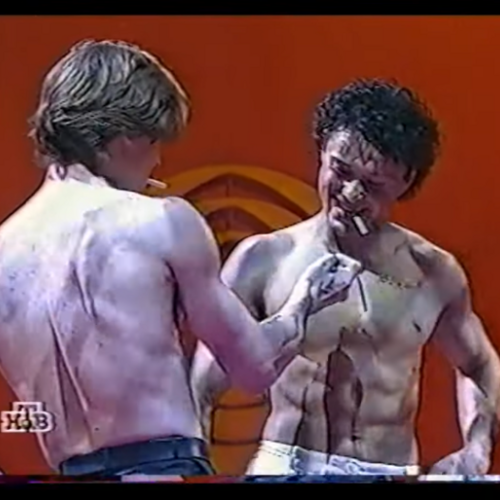
Still from the television show “About It” with host Elena Khanga, Episode “Homosexuality”, 1998
Image of two shirtless men lighting cigarettes in the course of a dance performance illustrating homosexuality