Search
People: Tsoi, Viktor
10 Results
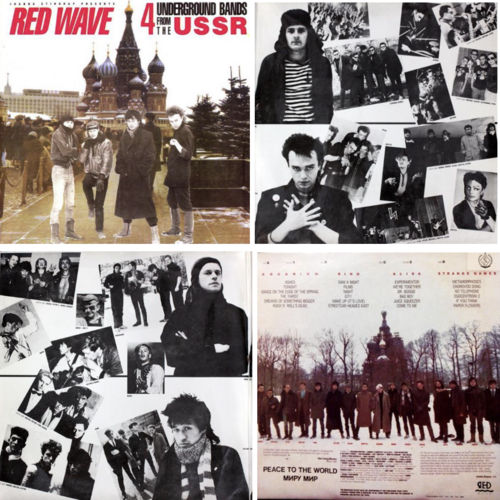
Red Wave: 4 Underground Bands from the USSR
A split double album, recorded and produced by Joanna Stingray, which was the first release of Russian rock music in the west. The album, totaling 15,000 copies, features compositions from four Leningrad-based rock bands: Aquarium, Kino, Alisa, and Strange Games (Strannye Igry). Stingray hoped to popularize Soviet rock music in the West in a direct affront to existing Cold War policies.
Kino’s last concert (Luzhniki Stadium, Moscow)
Footage of a live Kino concert at Moscow's Luzhniki Stadium on June 24, 1990, roughly a month and half prior to frontman Viktor Tsoi's death in a car accident in rural Latvia. The footage shows the band at the very height of its popularity, as well as offering an unencumbered look at a country in transition: a heavy and conspicuous Soviet police detail is assigned to the event, while audience members wave both the Soviet flag and the Russian tricolor banner.
ASSA, motion picture
Scene of Viktor Tsoi performing his rock-anthem "Changes!" (“Peremen!”) during the last seven minutes of Sergei Solov’ev’s 1987 film Assa. Kino's cinematic performance became a defining mass-cultural event that legitimized Soviet rock music as a product of the official mainstream collaborating with the Soviet underground rock movement, crowning Tsoi as USSR's ultimate rock star, and promoting rock music as a legitimate artform for the late-Soviet audience.
Yahha, documentary film
Rashid Nugmanov's course project for Sergei Solov'ev's workshop at VGIK, which included some of the first film footage of the everyday life of the Leningrad rock music scene.
Alexei Uchitel's 1992 documentary film Posldenii Geroi.
Made with the collaboration of Tsoi's widow Marianna Tsoi, the film includes scenes from Viktor Tsoi's funeral and chronicles the mass mourning of the late musician, and the perestroika era by proxy.
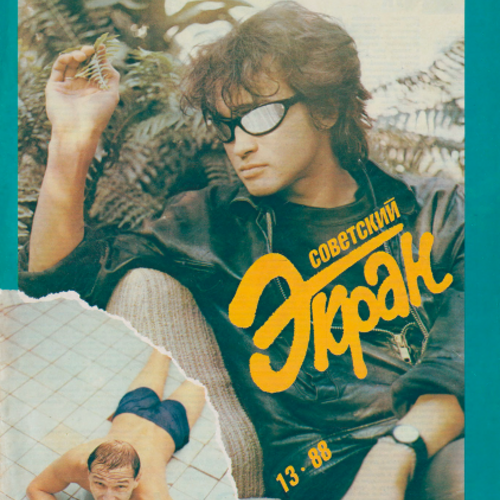
Sovetskii Ekran with Tsoi on cover
The cover image from volume 13 (1988) depicts Viktor Tsoi of Kino and Petr Mamonov of the Moscow-based rockband Zvuki Mu. Both artists appeared in Rashid Nugmanov 1988 film The Needle (Igla, 1988), which cemented Tsoi’s rock stardom and firmly established
Mamonov as a serious actor. He went on to star in Pavel Lungin’s drama Taxi Blues (Taksi Bliuz, 1990), which was released to international acclaim and became one of the classic examples of the perestroika-era chernukha aesthetic.
Interview with Viktor Tsoi and Natalia Razlogova. Conducted by Sergei Sholokhov at the Golden Duke Film Festival in Odessa, 1988
This eight-minute interview, which took place on a cruise ship chartered for Odessa’s Golden Duke Film Festival in September 1988, depicts rock musician Viktor Tsoi and film critic Natalia Razlogova speaking to a journalist about the insurmountable generational tensions that inhabit the Soviet film industry. Tsoi was attending the festival to promote the film The Needle, where he played the lead role. The interview is significant highlighting the aesthetic and ideological crisis of the Soviet film industry in the last Soviet decade.
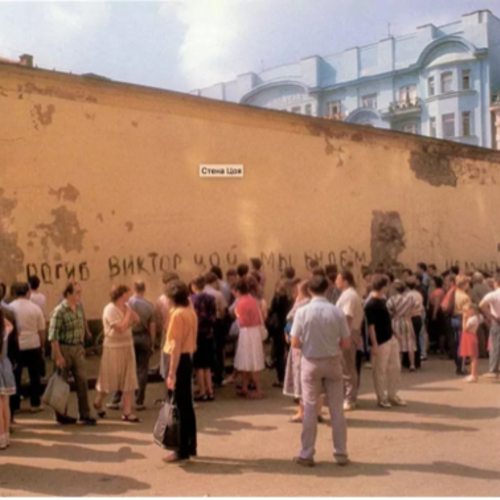
"Tsoi's Wall" on Arbat
A wall of fan graffiti dedocated to the late Soviet rock star Viktor Tsoi on Moscow's famous Arbat Street.
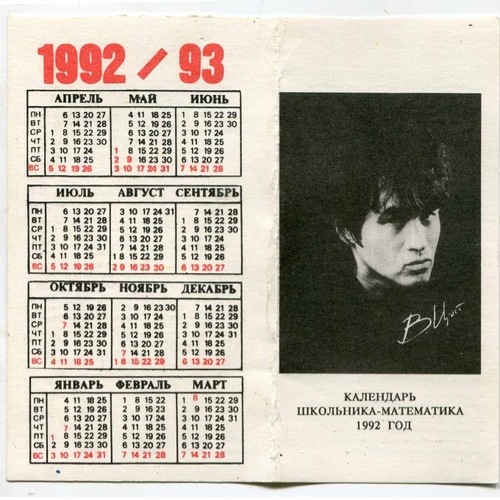
1992-1993 Math calendar intended for a secondary school student with a photograph of Viktor Tsoi, frontman of the rock band Kino on its front cover.
Serving as a testament to the meteoric rise in popularity and the widespread influence of rock music culture on the everyday lives of the newly post-Soviet citizens, this 1992/1993 math calendar, intended for schoolchildren set to master the concepts of algebra and geometry, cements the shift of public opinion about the position and status of rock musicians in Soviet/post-Soviet society from that of ideologically nefarious loafers to newly minted fallen heroes and teenage idols. The recently deceased Tsoi is inscribed in this artifact as an officially sanctioned role model for Russian youth, whose death is emblematic of the fading old regime, and whose music is a fully commercialized consumer product.
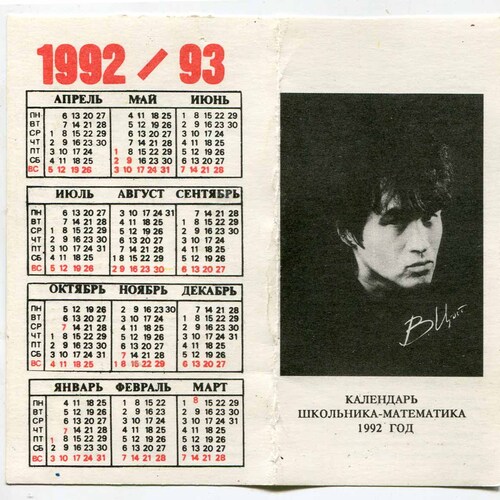
1992-1993 School math calendar
1992-1993 Math calendar intended for a secondary school student with a photograph of Viktor Tsoi, leader of the rock band Kino on its front cover.