Search
Geographic Origins: Ussr
20 Results
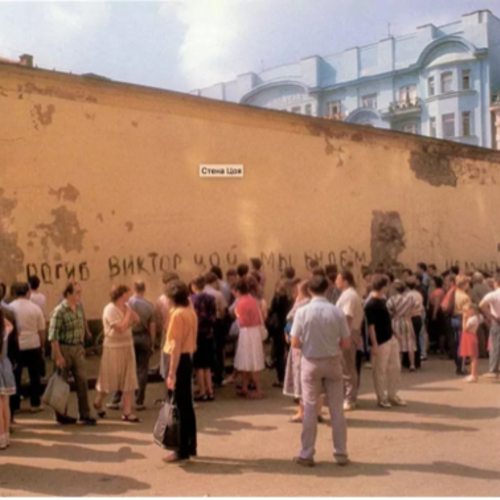
"Tsoi's Wall" on Arbat
A wall of fan graffiti dedocated to the late Soviet rock star Viktor Tsoi on Moscow's famous Arbat Street.
Alexei Uchitel's 1992 documentary film Posldenii Geroi.
Made with the collaboration of Tsoi's widow Marianna Tsoi, the film includes scenes from Viktor Tsoi's funeral and chronicles the mass mourning of the late musician, and the perestroika era by proxy.
Band Survey from the Leningrad Rock Club completed by Sergei Kuryokhin of Pop Mekhanika
An official rock club survey in which Sergei Kuryokhin utlilizes the late-Soviet aesthetic of stiob and performative socialism to underscore the club's dependence on the KGB
"Vse idet po planu." Audio recording. By Grazhdanskaia Oborona
The 16th track on Grazhdanskaia Oborona's 1988 eponymous punk-rock album, whose refrain became a popular catchphrase of the late perestroika and post-Soviet period. The song cemented Egor Letov and his band as a major influence during Perestroika, marking the punk genre's departure from the established norm of largely avoiding politically-charged lyrical content.
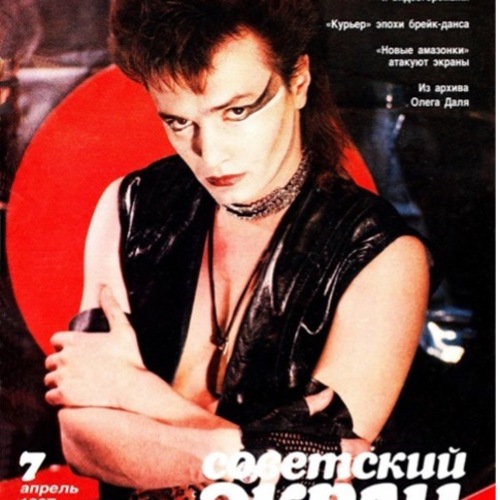
Sovetskii Ekran with K. Kinchev on the cover
Popular film magazines like Soviet Screen (Sovetskii Ekran), were instrumental in establishing rock musicians as cultural icons. Volume 7 (1987) publication places Konstantin Kinchev, frontman of the Leningrad band Alisa, on the cover of its “youth issue” (molodezhnyi vypusk) in an effort to promote the Valerii Ogorodnikov’s film The Burglar (Vzlomshchik, 1987) in which Kinchev plays the lead role.
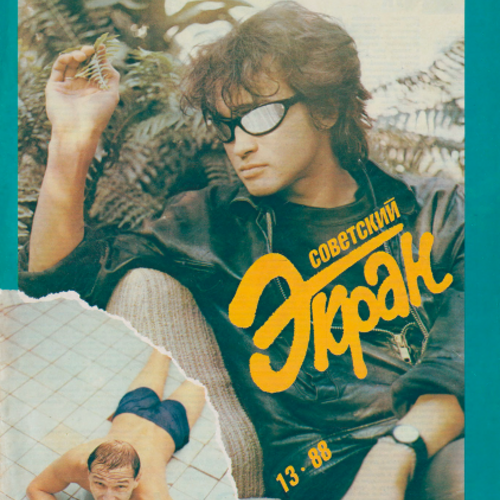
Sovetskii Ekran with Tsoi on cover
The cover image from volume 13 (1988) depicts Viktor Tsoi of Kino and Petr Mamonov of the Moscow-based rockband Zvuki Mu. Both artists appeared in Rashid Nugmanov 1988 film The Needle (Igla, 1988), which cemented Tsoi’s rock stardom and firmly established
Mamonov as a serious actor. He went on to star in Pavel Lungin’s drama Taxi Blues (Taksi Bliuz, 1990), which was released to international acclaim and became one of the classic examples of the perestroika-era chernukha aesthetic.
Musical Ring (Музыкальный Ринг). Television program. Musical guest: Sergei Kuryokhin and Pop-Mekhanika. (February 1, 1987.)
Making its debut in 1984, Musical Ring was a Perestroika-era Soviet television program, dedicated to showcasing new musical talent and fostering a live audience Q&A. This 1987 segment features composer and avant-garde jazz pianist Sergei Kuryokhin and his band Pop Mekhanika. Throughout the episode Kuryokhin artfully wields the postmodern rhetorical weapon of styob, imbuing formal musical discourse with farce, an artistic and communicative device that became one a defining mode of expression during perestroika and the early post-Soviet period.
Interview with Viktor Tsoi and Natalia Razlogova. Conducted by Sergei Sholokhov at the Golden Duke Film Festival in Odessa, 1988
This eight-minute interview, which took place on a cruise ship chartered for Odessa’s Golden Duke Film Festival in September 1988, depicts rock musician Viktor Tsoi and film critic Natalia Razlogova speaking to a journalist about the insurmountable generational tensions that inhabit the Soviet film industry. Tsoi was attending the festival to promote the film The Needle, where he played the lead role. The interview is significant highlighting the aesthetic and ideological crisis of the Soviet film industry in the last Soviet decade.
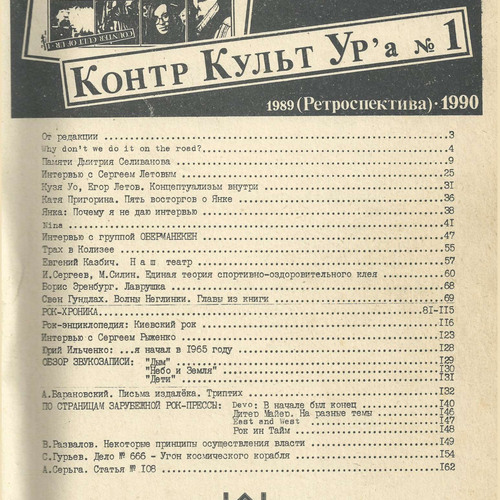
Kontr Kult Ur'a Music Journal (Samizdat) 1989-1991
Kontr Kult Ur'a was envisioned as an ideological reincarnation of Urlait, which was deemed by the new editorial board as "cult-like" and "radically positioned." The journal also was one of the first samizdat rock zines in Moscow and Leningrad to prominently feature and promote Siberian punk rock, including Egor Letov, Civil Defence, and Yanka.
Nautilus Pompilius performing "Last Letter" (Poslednee Pis'mo: Gudbai Amerika)
A televised performance of Nautilus Pomplius's cult song lamenting the frustrated hopes of Perestroika-era Westernization, which was further popularized by its prominent position in Aleksei Balabanov's popular gangster drama Brother 2 (2000), inscribing it into the post-Soviet cultural and cinematic discourse as a sort of antidote to Viktor Tsoi's "Changes!" at the end of S. Solov'ev's ASSA.

Rok Protiv Terrora Music Festival. April 6, 1991, Moscow.
A not-for-profit charitable concert that took place at Moscow's Kryl'ia Sovetov Stadium on April 6, 1991, concieved by the Garik Sukachev, the leader of the rock band Brigada S. Intially the event was meant to be an act of protest against police brutality, but grew to include all forms of state organized terror: political, social, and moral. The festival received organizational support from VID, Komsomolskaya Pravda and the Fili Cultural Center. Fourteen Soviet rock bands took part in the festival.
Lyube performing "Atas" during a televised concert on January 1, 1990
The rock band, which Vladimir Putin would later count as among his "favorites," performing on late-Soviet television on the cusp of rock stardom.
Lyube "Stop Fooling Around, America!" (Ne Valiai Duraka, Amerika!) music video
Music video for the fourth track on Lyube’s second studio album Who Said We Lived Poorly? (Kto skazal, chto my plokho zhili?), which was released in 1992. Written from the perspective of the Russo-Soviet “common man,” while using folk vernacular, the song explores questions of Alaska’s historical and territorial integrity – lamenting its sale to the United States and demanding its return while celebrating Russia’s national character.
You Can't Teach the Lefthanded to Be Righthanded
An article from Argumenty i fakty from 1990 in which w journalists seek comment from Igor Kon on the topic of homosexuality
Primetime hypnotic tele-healing seances with Kashpirovskii
Anatolii Kashpirovskii, the psychic and guru of Perestroika era's "new thinking" uses the power of suggestion to heal the Soviet people from all ailments physical and spiritual
Chumak sends morning healing vibes to Perestroika audiences
A healing seance with TV-psychic Allan Chumak in 1989, during the morning newscast, “120 Minutes.” Works on people, their drinking water and their creams.
Kino’s last concert (Luzhniki Stadium, Moscow)
Footage of a live Kino concert at Moscow's Luzhniki Stadium on June 24, 1990, roughly a month and half prior to frontman Viktor Tsoi's death in a car accident in rural Latvia. The footage shows the band at the very height of its popularity, as well as offering an unencumbered look at a country in transition: a heavy and conspicuous Soviet police detail is assigned to the event, while audience members wave both the Soviet flag and the Russian tricolor banner.
ASSA, motion picture
Scene of Viktor Tsoi performing his rock-anthem "Changes!" (“Peremen!”) during the last seven minutes of Sergei Solov’ev’s 1987 film Assa. Kino's cinematic performance became a defining mass-cultural event that legitimized Soviet rock music as a product of the official mainstream collaborating with the Soviet underground rock movement, crowning Tsoi as USSR's ultimate rock star, and promoting rock music as a legitimate artform for the late-Soviet audience.
Yahha, documentary film
Rashid Nugmanov's course project for Sergei Solov'ev's workshop at VGIK, which included some of the first film footage of the everyday life of the Leningrad rock music scene.
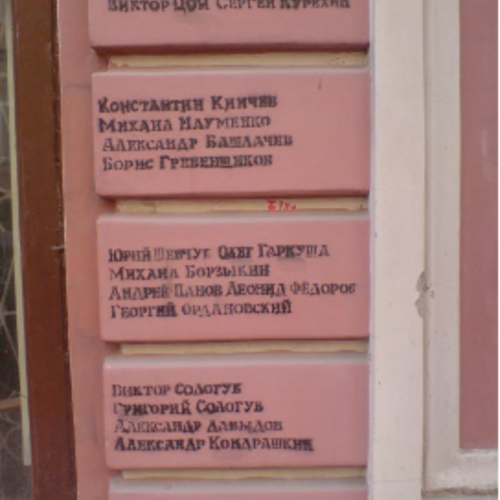
Leningrad Rock Club
A wall of graffiti in the courtyard of the Leningrad Rock Club (1981-1991) on 13 Rubinshteyna Street in Leningrad (St. Petersburg), which featured fan street art dedicated to USSR's most revered rock-music collectives. When the wall was painted over in 2010 by the bulding's new proprietor, this caused a public outcry from both rock fans and the many surviving musicians from that era, who sought to preserve the LRC's legacy and designmate the wall and the building a historical landmark.