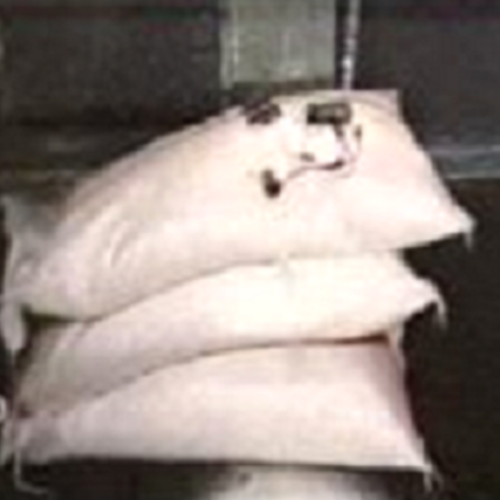
Ryazan Sugar (Hexogen)

Three large sacks wired to a timer set for 5:30 am were found in the bottom of a Ryazan apartment building on 22 September 1999. The sacks were later said to contain sugar as part of a training exercise.
Description
Released at the very end of the Soviet Union, Nol's album, Songs of Unrequited Love for the Motherland, gave the group several hits that carried them into the 1990s. The song Chelovek i koshka in particular became an anthem of drug culture as it spread through Russia in the post-Soviet years.
Era
Post-Soviet
Date
1999
Annotation
In the first days of September, 1999, four explosions spread fear and uncertainty and led to the Second Chechen War. The bombings, which killed more than 300 people in Buynaksk, Moscow, and Volgodonsk, were all executed with explosive devices placed in the bottom of large apartment buildings and set to detonate in the early morning, while residents still slept. Chechen militants were blamed for the bombings but denied responsibility. Nevertheless, the attacks, along with the invasion of Dagestan by the Chechnya-based Islamic International Peacekeeping brigade in August of that year, served as the justification for the renewed assault on Chechnya by federal troops, including the siege of Grozny that started in December 1999. Then-Prime Minister Vladimir Putin won widespread approval for his persecution of the conflict and easily won the presidency in March 2000.
But the series of terrorist attacks have been shrouded in controversy since they began. After the first three attacks, the Speaker of the Duma, Gennadii Seleznyov announced that a fourth bombing had occurred in the relatively small city of Volgodonsk. Though that city indeed became the site of the fourth attack, it didn’t occur until three days after Seleznyov’s announcement. Nevertheless, the authorities, somehow, had been unable to stop it.
A few days later, however, another Russian city, Ryazan, had more luck. A resident called the police after seeing three individuals unloading large sacks into the bottom of an apartment block. When the police arrived, they found three sacks connected to a detonator set for 5:30 am. The apartment building was evacuated and the police initially reported that traces of the explosive hexogen, which had been used in the previous attacks, had been found on the sacks. The day after the evacuation, the perpetrators had not been found, but Vladimir Putin praised the vigilance of Ryazan citizens. The very next day, however, KGB chief Nikolai Petrushev told a TV reporter that the sacks had contained nothing but sugar and the whole thing had been an internal exercise to test public vigilance. The incident coined a new term for explosive substances, “Ryazan sugar” (“riazanskii sakhar”) and suggested the title for Aleksandr Prokhanov’s conspiracy-minded 2002 novel Mr. Hexogen.
Official Russian investigations concluded that the bombings were ordered by Chechen-connected warlords Ibn Al-Khattab and Abu Omar al-Saif (both of Saudi origin) and organized by Achemez Gochiyaev (a Russian citizen).
Geography: Place Of Origin
Ryazan
Geography: Place Of Focus
Ryazan and Russia
Bibliographic Reference
NTV screenshot, 22 Sep 1999.
Explore Related Artifacts