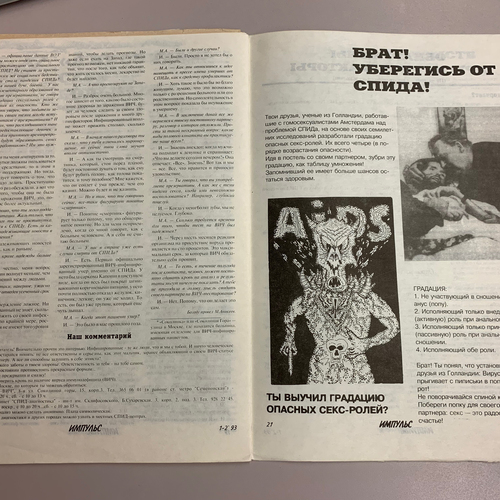
Protect Yourself against AIDS, Brother!

Source
Description
AIDS prevention public service announcement in the gay magazine Импульс
Era
Post-Soviet
Date
1993
Annotation
In addition to the considerable social and legal challenges facing LGBTQ people in Russia in the early post-Soviet period, gay men had to contend with the existential threat of HIV/AIDS — a viral epidemic to which gay men engaged in specific sexual practices were extremely vulnerable. Just as gay men in Russia were beginning to overcome internalized social barriers and tentatively explore their sexual identities and desires, they were confronted with the reality that these experiments had a very real potential to kill them. The anxiety around this lethal threat was compounded by the indignity that AIDS was not treated as a matter of serious concern by the Russian state and broader society, owing to a perception that the people affected (primarily gay men and intravenous drug users) were marginals, at best unimportant, and at worst people Russian society would be better off without.
Article 121 of the Russian Federation Criminal Code — the law criminalizing sexual relations between men — was repealed the same year this issue of Impulse was published, meaning that up to the moment of the issue’s publication, any man who contracted HIV/AIDS through sexual contact with another man was a criminal. In the 1980s high-ranking officials made public statements to the effect that Soviet Society at-large was impervious to the AIDS epidemic thanks to the criminalization of sexual relations between men (see “AIDS: More Questions than Answers”). As also happened in some segments of Western society, in Russia AIDS was often represented as a plague cleansing the population of human dross, a kind of evolutionary agent vindicating the decidedly negative value ascribed to gay men as a human category. In the United States the Clinton administration brought a good deal more attention to, and investment in combatting, the AIDS epidemic, following the Reagan administration’s policy, pursued to appease its conservative religious base, of treating the disease as a minor concern only affecting marginal elements of American society. In Russia this attitude continued into the 1990s. As prospective victims of the disease, gay men in Russia at this time were faced with a situation where the state was not only not willing to devote substantial resources to research and treatment, but was also not willing to invest in far less resource-intensive profilactic measures, including information and education, which is why Impulse readers are encouraged here to rely on their “friends” — Dutch researchers working with the gay population of Amsterdam. Unlike their Dutch counterparts, these readers, if not careful to avoid infection, were faced with the prospect of infection, illness, and painful death from this devastating disease in a country disinterested in their health, wellbeing, even their survival, a country disinclined to invest resources in prevention, research, treatment, or palliative care. The graphic aspects of the page are interesting: a cartoon of the disease imagined as a monster, and a photograph of an emaciated dying AIDS patient being comforted by a loved one. The somewhat jarring juxtaposition of the iconographic, allegorical cartoon image of the disease and the indexicality of the wrenching photograph recording the suffering and demise of a singular, concrete person being destroyed by the disease is echoed in the disjunct between tone and subject matter in the textual component. In an announcement dealing with matters of disease and excruciating death, puerile phrases and formulations are used presumably for jocular effect: “the virus jumps from the pee-pee into the tushy more often than the other way around!”
Homosexuality (https://lccn.loc.gov/sh85061780)--Russia (Federation) (https://lccn.loc.gov/n92056007)--Periodicals (https://lccn.loc.gov/gf2014026139)
Gay men (https://lccn.loc.gov/sh85061798)--Russia (Federation)
AIDS (Disease) (https://lccn.loc.gov/sh85002541)
HIV / AIDS (https://www.wikidata.org/wiki/Q12199)
Geography: Place Of Focus
Russia
Bibliographic Reference
Impul's, No. 1-2, 1993, p. 21
Explore Related Artifacts