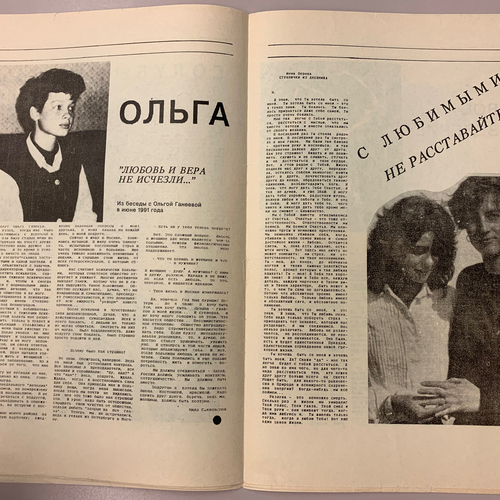
Olga. Love and Faith Are Not Dead

Source
Description
Profile of a post-Soviet lesbian survivor of Soviet-era anti-LGBTQ repressions
Era
Post-Soviet
Date
1991
Annotation
This piece published on the cusp of the Soviet and post-Soviet eras in 1991 documents the ways in which women who pursued sexual relationships with other women were persecuted in the Soviet Union. It is also a document of the gender divide in the Soviet system’s response to homosexuality. Male homosexuality was criminalized and punished via the criminal justice system, though somewhat selectively (see other documents included in this collection: “Homosexuality in Soviet Prisons and Camps,” “Dear Reader”). There was a hierarchical dimension to sexual relations between men, and in certain Soviet contexts, such as in the penal system and the military, homosexual activity was a mechanism via which some men were subjugated by others. Some forms of homosexual behavior (usually “active” as opposed to “passive,” or the giving rather than the receiving end of penetrative sex) did not compromise a person’s masculine identity, or even enhanced their masculine status. Others — usually “passive” behaviors whether voluntary or forced — consigned men to the lowest point of a social hierarchy and to a life of persecution and ostracism (again, more on this in “Homosexuality in Soviet Prisons and Camps”). Lesbianism was not criminalized, but instead pathologized, and in much less differentiated or hierarchical ways. Understanding lesbianism as an illness rather than as a crime or vice, the Soviet system treated sexual relations between women as a single undifferentiated category. There does not seem to be the same preoccupation with distinguishing between masculinizing versus feminizing behaviors, or with viewing specific female homosexual acts as mechanisms of social elevation or humiliation, or with viewing specific sexual behaviors as compromising a woman’s feminine identity. Nonetheless, while their sexual behavior was not criminalized and their social status not necessarily jeopardized, women whose same-sex attraction and relations came to light suffered the traumas associated with forced, often residential “treatments” or “care,” invasive surveillance, and the destruction of crucial relationships. The subject of the piece appears optimistic that an intellectual evolution resulting from a rapprochement of Russia and the West could result in better understanding and treatment of LGBTQ people in Russia.
Homosexuality (https://lccn.loc.gov/sh85061780)--Russia (Federation) (https://lccn.loc.gov/n92056007)--Periodicals (https://lccn.loc.gov/gf2014026139)
Lesbians (https://lccn.loc.gov/sh85076160)--Russia (Federation) (https://lccn.loc.gov/n92056007)
Geography: Place Of Focus
Russia
Bibliographic Reference
Risk, January 1991
Explore Related Artifacts