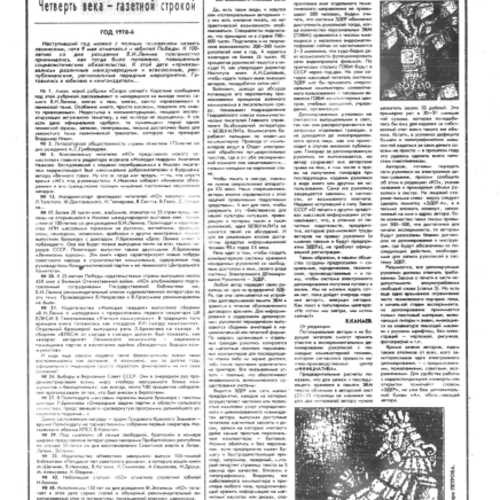
Long Live PaperLessLit

“Da zdravstvyet BezBumLit,” Knizhnoe obozrenie, 14 Dec 1990: 2.
Description
Soviet paper shortages, new computer technologies, and the lifting of censorship come together in an unexpected way in this proposal to preserve manuscripts of unpublished authors for posterity.
Era
Perestroika
Date
1990
Annotation
Vladimir Voinovich’s 1986 satire Moscow 2042 imagined a future Soviet Union in which—among other more atrocious developments—literature had gone paperless. Only the ideologically upright would be published; all other writers were essentially writing for themselves. The same had essentially been the case in the real Soviet Union of Voinovich’s experience, so in his imagined future, the authorities simply made it official. Writers worked long factory hours and saved paper by never publishing anything.
Four years later, the idea of PaperLessLit (BezBumLit) didn’t seem so crazy to Vladimir Kanaev. It even seemed to offer a utopian solution to a serious problem. Most “potential authors,” he wrote, “have the desire to write, but no practical way of publishing their work. Specialists estimate that there are around 700,000–800,000 such people in the country. They’ve estimated their productivity at around 200,000–300,000 manuscripts per year. And only 25,000 books are published a year. 90% of manuscripts are written for no one!” This tragedy of potential literature could be solved using not some future technology, but the computers that were already available. Working with the Innovation Center—a new science and technology cooperative—Kanaev created a computerized method of storing the thousands of manuscripts that would otherwise never see the light of day. Writers were invited to write in to hear about the next steps for transferring their manuscripts to the electronic format EDEM (Electronic DEposit of Manuscipt; or EDER, Elektronnoe DEponirovanie Rukopisei, in the original) where they would be stored for posterity.
Though the initiative never got off the ground, the idea stands at the intersection of several important trends in Soviet, post-Soviet, and even world literature. The Soviet Union’s endemic paper shortages made the idea of PaperLessLiterature thinkable, if not unavoidable. Budding computer technology seemed to promise a solution. And the enormity of what Franco Moretti would soon call “the great unread” was transforming from the ideological problem it had been in the Soviet Union (where the best writing had often been underground or written “for the desk drawer”) to the technological problem it would become for the global trend of “distant reading” and algorithmic philology.
Looking back, it is perhaps not difficult to see why EDEM never attracted the mass of potential authors Kanaev hoped for, but its successors, including stihi.ru, proza.ru, and LiveJournal—which used internet technology, and not just electronic deposit, to connect potential authors to potential readers—completely transformed the literary landscape of post-Soviet Russia. The possibilities of PaperLessLit had to be imagined, and reimagined several times, before they could be realized in practice.
Associated People
Voinovich, Vladimir
Geography: Place Of Focus
Russia
Bibliographic Reference
“Da zdravstvyet BezBumLit,” Knizhnoe obozrenie, 14 Dec 1990: 2.
Explore Related Artifacts