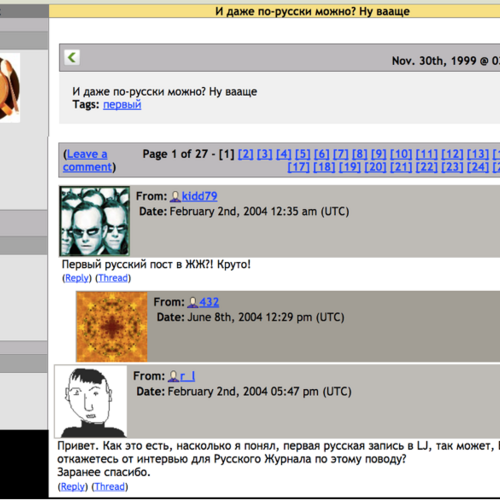
First LiveJournal Post

30 Nov 1999 – user “at”
Source
Description
A post in 1999 demonstrates that LiveJournal processes Cyrillic encoding, leading to the Russian internet's most pervasive and influential early social media site. LiveJournal, soon known simply as ZhZh in Russian, became a platform for poets, writers, political activists, essayists and graphomaniacs. It launched or catalyzed several literary and political careers, and fed the budding market for conspiratorial thinking in late 1990s Russia.
Era
Post-Soviet
Date
1999
Annotation
At 3:27 p.m. on Nov 30, 1999, a user by the name of “at” found that the popular blogging platform and proto-social network LiveJournal supported Cyrillic. The platform’s very first post in Russian, “I dazhe po-russki mozhno? Nu vaashche,” announces the new possibility in language already native to the platform. The misspelling of “voobshche” anticipates the widespread use of non-normative spellings online that would come to be known as Padonskii or Olbanskii (“падонский/олбанский йезыг” or even “йАзЫг пАдОнКаФф”).
LiveJournal, soon known by its Russian acronym ZhZh (for “Zhivoi zhurnal”) soon became the most popular site on the Russian internet. Its format encouraged a long-form confessional style that allowed for intimacy, while its social features encouraged the kind of networking that would be more characteristic of web 2.0. Any user could follow, respond to, and tag other users, providing a pathway for active audience building. The most successful ZhZh users proved adept at balancing the platform’s potential for both intimacy and networking, building themselves into some of Russia’s first internet celebrities, or what Yulia Ildis would call “self-made idols” (“sotvorennye kumiry”). Because ZhZh was a text-heavy platform, this first generation of internet celebrities were less Instagram influencers, and more authors, poets, and public intellectuals. Already popular writers like Boris Akunin and Dmitry Bykov launched popular pages on ZhZh, while several others had not yet made a name for themselves before joining the platform.
Among the first literary sensations to get his start online was Evgeny Grishkovets, who followed up his one-man memoir-show “How I Ate a Dog,” with a series of confessional posts that delved deeper into his past. His extraordinary ZhZh following caught the attention of publishers, and has led to dozens of print publications, including short stories, novels, and at least six volumes of adaptations of his ZhZh posts. Other authors who found prominence through ZhZh include the most popular poet in Russia today (by most measures), Vera Polozkova, and the multimedia artist and writer Linor Goralik. These and many others found not only their voice, but also their audience on ZhZh, changing the way that literature is made, and how it looks and sounds. As they have proven capable of transferring their success and impact beyond their online communities, their examples show how ZhZh has changed Russian literature.
Bibliographic Reference
User "at", "I dazhe po-russki mozhno? Nu vaashche," Live Journal, 30 Nov 1999.
Explore Related Artifacts